Understanding ISI and BIS Certification in India: Why They Matter for Quality and Safety
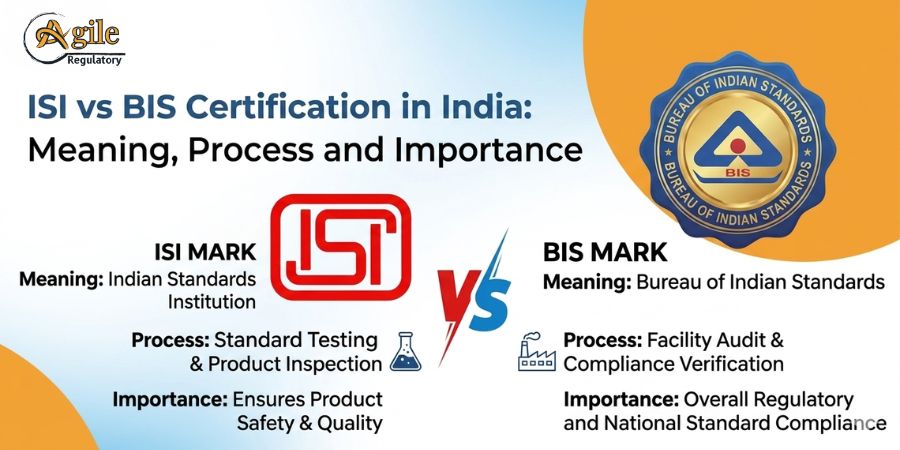
BIS in India governs quality and safety standards for hundreds of product categories: electrical goods, construction materials, food products, electronics, automotive components, and more. If your product falls under a mandatory certification order, you simply cannot manufacture, import, store, or sell it in India without the appropriate license. The ISI mark is the most visible sign of that compliance, and it has been stamped on Indian products since 1955. Yet the number of businesses that approach it reactively after a customs hold or a failed tender is surprisingly high
What ISI and BIS Are and Why People Confuse Them
The short version is that ISI was the old name and BIS is the new one.
The mark stayed the same. The ISI Indian Standards Institution, was founded in 1947 as India's first national standardization body. It made the ISI mark and ran product certification in India for many years. Parliament passed the Bureau of Indian Standards Act in 1986. The Bureau of Indian Standards officially took the place of the ISI in 1987. The new BIS Act was passed in 2016 and went into effect on October 12, 2017. It gave the Bureau more powers such as the ability to require hallmarking and recall products.
The ISI mark itself never went away. Under the current framework, it is formally called the BIS Standard Mark and continues to be issued under Scheme I of BIS's product certification in India system. So if you see an ISI mark on a pressure cooker manufactured last year, that mark was issued by BIS, not by any organization called ISI. The institution closed in 1987. The mark it invented is still running.
The Two Certification Tracks You Need to Know
BIS operates across several certification schemes. For the vast majority of manufacturers and importers, two of them are relevant.
Scheme I: The ISI Mark
Under Scheme I, the original product certification framework, a manufacturer applies for a BIS license in India authorizing use of the ISI Standard Mark on a specific product. BIS reviews the application, conducts a factory audit, has product samples tested at a recognized laboratory, and issues a certification mark license if the product meets the applicable Indian standard.
The ISI mark is mandatory for over 600 product categories today. Electrical switches, wiring cables, electric irons, room heaters, LPG cylinders and valves, Portland cement, automotive tires, pressure cookers, packaged drinking water, and steel products are among the most common. For all of these, a Quality Control Order (QCO) issued by the relevant ministry makes certification non-negotiable. No QCO exemption, no workaround: the product either has a valid BIS license in India or it doesn't clear customs and can't be legally sold.
Outside the mandatory list, ISI certification is also available voluntarily. Plenty of manufacturers pursue it even without legal compulsion because government procurement, large retail chains, and institutional buyers frequently ask for it.
Scheme II: The Compulsory Registration Scheme
CRS was introduced in 2012 and works differently. It covers electronics and IT products: mobile phones, laptops, LED lamps, power banks, set-top boxes, and smart wearables notified by the Ministry of Electronics and Information Technology (MeitY). Under this scheme, BIS registration is granted based on laboratory testing alone. There is no mandatory factory audit, which is a meaningful operational difference from Scheme I.
Products registered under CRS display the BIS Standard Mark with an R-number (format: R-XXXXXXXX), a different identifier from the CM/L number used under Scheme I. The two marks are not interchangeable and confusing them has caused compliance problems for importers who assumed one registration covered both product types
Get Free Consultation!
ISI Mark vs. BIS CRS: A Direct Comparison
|
Parameter |
ISI Mark Scheme I |
BIS CRS Scheme II |
|
Product Categories |
Electrical appliances, cement, steel, LPG, food items, automotive parts |
Electronics, IT goods, LED lighting, mobile phones, laptops |
|
Factory Audit |
Mandatory on-site inspection |
Not required |
|
License Identifier |
CM/L-XXXXXXXX printed below ISI mark |
R-XXXXXXXX printed below BIS mark |
|
Mandatory or Voluntary |
Mandatory for 600+ categories; voluntary for others |
Mandatory for all MeitY-notified products |
|
Foreign Manufacturer Route |
Authorized Indian Representative (AIR) required |
Authorized Indian Representative (AIR) required |
|
Testing |
BIS-recognized lab + factory samples during audit |
BIS-recognized lab only |
|
Issuing Authority |
Bureau of Indian Standards |
Bureau of Indian Standards |
|
License Validity |
One year, renewable |
One year, renewable |
What This Certification Actually Unlocks
A lot of compliance content frames certification as a cost center. That's not the whole picture.
For products covered by mandatory QCOs, the ISI mark is simply the price of entry: no license, no market. But even for products where it's voluntary, the certification does concrete things. Government tenders in India routinely specify BIS-certified products in procurement specifications, which means an uncertified product is ineligible regardless of price or quality. Many large private-sector buyers and e-commerce platforms have added the same requirement to their vendor onboarding process.
Indian standards certification also carries weight beyond India's borders. BIS is a member of both ISO and IEC, and its standards are broadly aligned with international frameworks. In several trade relationships, BIS certification reduces or eliminates the need for separate testing in the destination country, a practical benefit for manufacturers using India as an export base.
Then there's enforcement risk, which is a less obvious but real commercial consideration. BIS runs active market surveillance. Products seized, destroyed, or publicly flagged for non-compliance cause brand and supply chain damage that takes far longer to recover from than the certification process would have taken.
Unlocking the Benefits of BIS Certification for Smart Watches
Documents You'll Need
The documents required for BIS registration and ISI licensing vary by manufacturer type and product category. The standard set includes:
-
Completed application in the prescribed BIS format
-
Business registration certificate and GST certificate
-
Factory layout plan and address proof
-
Process flow chart for the specific product
-
List of manufacturing and testing equipment on-site
-
Preliminary test reports from a BIS-recognized laboratory
-
IEC code (for importers and foreign manufacturers)
-
Authorization letter for the Authorized Indian Representative (mandatory for foreign manufacturers)
-
Performance Bank Guarantee where BIS requires it
-
Proof of application and marking fee payment
Conclusion
Getting ISI certification or BIS registration sorted before your product hits the Indian market is better than dealing with the aftermath of skipped shipments, failed tenders, enforcement action, or the cost of a rushed application under time pressure. The process has real complexity, particularly for foreign manufacturers navigating FMCS or for domestic manufacturers dealing with products that sit at the edge of an IS scope.
Agile Regulatory works with manufacturers and importers on the full range of ISI certification services in India from standard identification and documentation preparation to factory audit readiness and post-license surveillance management. If you need an experienced BIS registration consultant in India for a specific product category, our team handles the process end to end.
FAQs
1. What exactly is the difference between an ISI mark and a BIS certification?
"BIS certification" is the umbrella term for everything the Bureau of Indian Standards issues, including Scheme I licenses, CRS registrations, hallmarks, and more. The ISI mark specifically refers to the standard mark issued under Scheme I to products that have passed factory audits and lab testing against an Indian standard.
2. My product isn't on the mandatory list. Do I still need to register?
Not legally for now. But "for now" is the key qualifier. QCOs are issued periodically, and new product categories get added without much advance notice to industry. Manufacturers who voluntarily obtained ISI certification before their category became mandatory had a significant head start when the QCO came into force.
3. How long does BIS certification realistically take?
For domestic manufacturers with complete documentation and in-house testing capability, three to six months is the typical range under Scheme I. That estimate assumes no major issues at the audit and no test failures requiring retesting. For foreign manufacturers going through FMCS, add time for BIS auditor travel to the overseas facility and the offline submission process; six to nine months is not unusual
4. What is an Authorized Indian Representative, and who qualifies?
The AIR is an Indian resident appointed by a foreign manufacturer to act as their legal contact with BIS for the entire certification and compliance period. The AIR signs the application, submits documents in person, and takes on responsibility for ongoing compliance, including responding to BIS surveillance findings. BIS registration consultants in Indian firms often function as AIRs because they have the institutional familiarity the role requires.
5. Can BIS cancel my license after it's been granted?
Yes, and it does. Under Regulation 11 of the BIS (Conformity Assessment) Regulations 2018, BIS can suspend or cancel a BIS license in India for any material violation, substandard product found during market surveillance, unapproved changes to the manufacturing process, incorrect marking on products or failure to cooperate with a surveillance inspection

About the Author
View ProfileNishi Chawla
Content Writer & Compliance Specialist
Nishi is an expert content writer with expertise in Business Legal Compliances, Certifications, and Registrations — BIS, EPR, Medical Devices, Cosmetics, Drugs, and Import Export. She holds a B.Com from the University of Delhi and has been writing industry content since 2019.