


Get Instant Solution By an Expert Advisor
(4.8)
CDSCO Medical Device Registration has been required for Manufacturers, importers, wholesalers, and distributors of Medical Devices and diagnostics. Obtain CDSCO Medical Devcie (MD) Online Registration with the support of Agile Regulatory a team of experienced Medical Devcie Professionals.




Get personalized guidance in minutes - no waiting, no bots.


10000 +
Projects Completed for Our Respected Clients.

15 +
Years Experienced Advisors in Indian Compliance.

98.9%
Project Delivery Ratio for Our Valuable Clients.

99.9%
Satisfied Customers All Over India.
Medical Devices Registration in India is a mandatory regulatory process for manufacturers and importers who intend to market medical devices in the country. The process is governed by the Medical Devices Rules, 2017 and regulated by the Central Drugs Standard Control Organization (CDSCO) under the Ministry of Health and Family Welfare. Depending on the device's risk classification (Class A, B, C, or D), applicants must obtain the appropriate license or registration before manufacturing, importing, selling, or distributing the product in India.
For imported devices, foreign manufacturers must appoint an Authorized Indian Agent to submit applications through the CDSCO SUGAM portal. The registration process involves device classification, preparation of technical documents, quality management certificates, product testing (where applicable), and regulatory review by CDSCO. Once approved, the relevant license is issued, allowing the device to be legally marketed in India. Timely registration ensures regulatory compliance, product safety, and smooth access to the Indian healthcare market while avoiding legal or commercial disruptions.
CDSCO Medical Devices include any instrument/apparatus/appliance/ implant/material or another article, either used solely or in combination including any software or accessory designed by the manufacturer to be employed particularly for human beings or animals that don't attain the key proposed action in or on human body or animals through any pharmacologic/ immunological/metabolic means, but assists in its envisioned function:
Some of the CDSCO medical devices that need registration in India include spinal needles, cochlear implants, annuloplasty rings, tracheostomy tubes, dental implants, surgical sealants, heart valves, cardiac stents, orthopaedic implants, endotracheal tubes, etc.
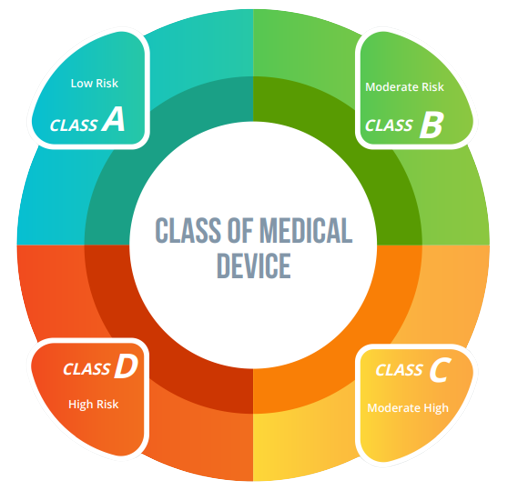
CDSCO classifies devices using a risk-based system aligned with Global Harmonization Task Force principles, sorting products into four classes by how invasive they are and how much systemic risk they carry:
|
Class |
Risk Level |
Examples |
Licensing Authority |
|
Class A |
Low risk |
Thermometers, bandages, examination gloves, tongue depressors |
State Licensing Authority |
|
Class B |
Low-moderate risk |
Hypodermic needles, suction equipment, nebulizers |
State Licensing Authority |
|
Class C |
Moderate-high risk |
Bone fixation implants, heart valves, intraocular lenses, ventilators |
Central Licensing Authority |
|
Class D |
High risk |
Pacemakers, defibrillators, implantable stents |
Central Licensing Authority |
This is the process you need to follow while registration:
Before anything else map the device against Schedule I of the Medical Device Rules 2017 to confirm which class it belongs to. This single decision determines the form used, the authority the application goes to and how much technical data CDSCO will expect.
Every application manufacturing, import or registration now runs through CDSCO's Medical Device Sugam Portal (sugam.cdsco.gov.in). Create an account with a verified email and mobile number. This becomes the account used to track the filing end to end.
The dossier typically includes:
Device Master File (design, materials, manufacturing process, testing data)
Plant Master File
ISO 13485 certificate for the manufacturing site
Free Sale Certificate, for imported devices
Clinical evaluation data or a Clinical Evaluation Report, mandatory for Class C and D
Labelling and Instructions for Use, formatted for the Indian market
Class A/B manufacturing: Form MD-3, reviewed by the State Licensing Authority
Class C/D manufacturing: Form MD-7, reviewed by the Central Licensing Authority
Import (any class): Form MD-14, filed by an Authorised Indian Agent through SUGAM
Deficiency letters are standard not some kind of warning that is uncommon for an application to receive. What keeps the process going is a complete response otherwise there will be another deficiency letter.
Class C and D manufacturing applications typically require a facility audit before approval. Import applications are generally assessed on documentation and existing regulatory approvals rather than a physical Indian-side inspection.
Once CDSCO is satisfied, it issues the relevant approval MD-5 for Class A/B manufacturing, MD-9 for Class C/D manufacturing, or MD-15 for import.
Currently, there are two different categories of medical devices for Medical Devices Registration through the SUGAM portal which have been explained below:
Notified Medical Devices: As of now, the CDSCO authorities have notified a list of 30+ categories of medical devices that mandatorily require registration and even require prior approval from CDSCO to market such marketing devices in India. For such devices, there are separate forms for application and different documents required to be submitted to the approving authority.
Non-Notified Devices: Further, other non-notified devices have not yet been notified and regulated. Thus, the registration of such devices has been made voluntary under the CDSCO SUGAM portal.
Class of Medical Device:
The list of individuals who can submit applications for CDSCO Medical Device Registration in India is as follows
Meets Significant Requirements of the Indian Market: In order to address the substantial need for accessible healthcare in India, the Indian authorities are progressively depending on international manufacturers to fulfil the considerable requirement. As a result, the implementation of the medical device registration scheme becomes valuable for ensuring control and uniformity in the quality of these products.
Registration Monitoring and Oversight: Following registration, the Drugs and Cosmetics Act mandates manufacturers and distributors to give precedence to adhering to the provisions of the Act. This involves conducting on-site evaluations of medical devices. Manufacturers have the opportunity to aid the audit team in identifying possible concerns, thereby averting penalties for violations through product registration. This process guarantees adherence to regulations and the safety of patients.
Legal Protection through Compliance: Relentless pressure to maintain medical device compliance has made manufacturers worry about preparing and distributing products according to prescribed guidelines, but with medical device registration, it becomes easier.
Opportunities for Higher Growth & Sales: The Indian government addresses escalating demand for medical devices by allowing overseas manufacturers to enter the Indian market, ensuring compliance with CDSCO guidelines, and maintaining a high-profit margin.
Improve Brand Identity: The Indian market has seen a shift in manufacturers' obligations to register their products, allowing them to explore the market dynamically. However, the steep penalties make it sense not to infringe on guidelines for profit.
|
Applicant Type
|
Device Class
|
Application Form
|
Form of License
|
|---|---|---|---|
|
Importer
|
A, B, C, D
|
MD-14
|
MD-15
|
|
Manufacturer
|
A, B
|
MD-3
|
MD-5
|
|
Manufacturer
|
C, D
|
MD-7
|
MD-9
|
|
Loan Licence
|
A, B
|
MD-4
|
MD-6
|
|
Loan Licence
|
C, D
|
MD-8
|
MD-10
|
Packaging description comprising pack sizes.
Copy of the Site Master File & Plant Master File.
Labelling details conforming to Drugs & Cosmetics Rules, 1945.
Recommended storage conditions, Brief description of the device.
Testing facilities are available in the manufacturing units for testing.
Details of the Product such as Brand or Proprietary name, Device category.
A detailed explanation of the manufacturing process of the devices to be manufactured.
List of accessories & other devices or equipment to be used in combination with the device.
Copies of ISO or any other certifications, if required, obtained by the firm for its manufacturing premises.
Details of the standards followed by the company for product examination & Good Manufacturing Practices.
Summary of the company's plan, a device to be manufactured, their viability & other important profiles.
Qualification, experience & name of technical staff under whose supervision the devices will be manufactured.
Method of use and intended use, Specification of the materials used, Variations in style, size, or shape of the device, if applicable.
Details of the applicant entity like names, addresses of the company's directors and addresses of the manufacturing units and registered offices of the Manufacturer.
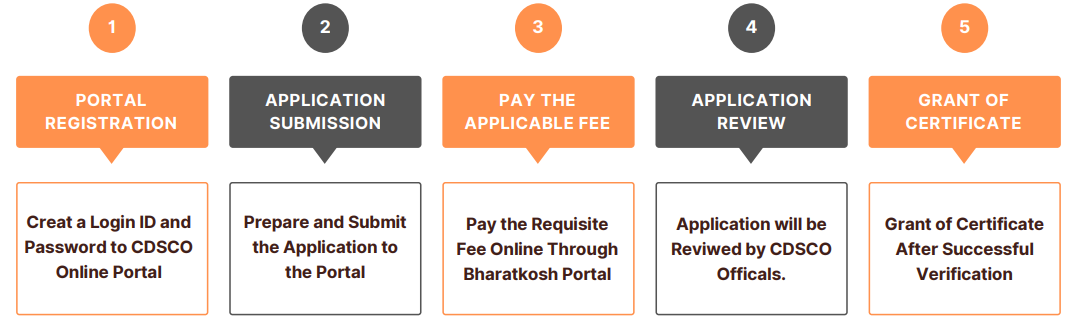
Step 1: Product Verification: The initial stage in the process of importing a medical device involves verifying whether it necessitates registration under the Medical Device Rules of 2017 and determining its classification as either a regulated or unregulated product.
Step 2: Portal Registration: After this, navigate to the online CDSCO SUGAM platform and initiate the signup procedure to acquire login credentials for website access.
Step 3: Application Submission: Submission of an application for a manufacturing license for these specified devices to the SLA using Form 27, and for the CLA through Form MD-3 or MD-7, alongside the necessary fee on the online portal.
Step 4: Scrutiny of the Application: On receipt of the application, the approving body will scrutinize the application, conduct an inspection of the manufacturing premises, and perform tests on the medical devices.
Step 5: Grant of Certificate: After which, if the approving authority is of the view that the applicant's medical device in question is genuine and manufactured in line with the pre-specified guidelines, then it may grant the registration, followed by a notification to the applicant.
Depending on the device class and the applicant's role, the approval that comes out the other end differs:
|
Application Route |
Approval Granted |
|
Class A/B manufacturing (MD-3) |
MD-5 Manufacturing License |
|
Class C/D manufacturing (MD-7) |
MD-9 Manufacturing License |
|
Import, all classes (MD-14) |
MD-15 Import License |
|
New Device with no Indian predicate (MD-26) |
MD-27 Permission |
|
Class A Non-Sterile, Non-Measuring |
Self-declared registration on SUGAM |
A useful distinction here: MD-27 isn't a routine import approval like MD-15. It's reserved for genuinely new devices ones without a comparable product already registered in India and it typically involves a Subject Expert Committee review before CDSCO signs off.
The timeline for medical device license registration in India varies depending on the application type, device classification, and document completeness. Standard registrations are generally processed faster, while applications requiring detailed technical evaluation may take longer. Submitting accurate documentation and responding promptly to CDSCO queries can help expedite the approval process.
|
Device Category |
Typical Approval Time |
|
Class A (manufacturing/registration) |
1–3 months |
|
Class B (manufacturing) |
2–4 months |
|
Class C (manufacturing or import) |
3–6 months |
|
Class D (manufacturing or import) |
6–9 months |
|
New Device (MD-26/MD-27 route) |
9 months or longer |
Timelines assume a complete, query-free filing. In practice, incomplete Device Master Files and classification disputes are what stretch these numbers well past the estimate a tight first submission tends to matter more than almost anything else in the process.
The cost of obtaining a medical device license in India depends on factors such as the type of license, device classification, number of products, manufacturing sites, and applicable government fees. Additional expenses may include testing, documentation, regulatory compliance, and consultancy services. The overall cost varies based on the complexity of the application and the regulatory pathway.
|
License Type |
Government Fee |
|
MD-5 (Class A/B manufacturing) |
₹5,000 per site + ₹500 per product |
|
MD-9 (Class C/D manufacturing) |
₹50,000 per site + ₹1,000 per product |
|
MD-15 (Class A import) |
$1,000 per site + $50 per device |
|
MD-15 (Class B import) |
$2,000 per site + $1,000 per device |
|
MD-15 (Class C/D import) |
$3,000 per site + $1,500 per device |
|
Class A NSNM registration |
No government fee |
Import fees are set in USD under the Second Schedule of the Medical Device Rules and paid in INR through the Bharatkosh gateway at the prevailing exchange rate. CDSCO registration fees don't stop at the government slab either lab testing, documentation support, and Authorised Agent charges for foreign manufacturers sit outside this table and need separate budgeting.
Obtaining the Medical Devices registration could be a bit challenging due to the complex process of the documents required and the processes involved. However, with the right amount of guidance and consultation, you could easily acquire Medical Device registration within the prescribed time. At Agile Regulatory we are committed to helping budding entrepreneurs by enabling them to acquire business licenses smoothly and carry on their business.
Get Instant Solution By an Expert Advisor
(4.8)
A nominated representative is qualified to apply for acquiring the Import License for Medical Devices in India. The representative should possess a valid license for manufacturing (intended for selling or distributing) or maintain a wholesale license in accordance with the directives outlined by CDSCO, as stated in Form 20B and Form 21B. This authorized representative has the potential to be either an individual or a business entity.
The Central Drugs Standard Control Organisation (CDSCO) under the Government of India, operates as the National Regulatory Authority which also acts as the Central authority responsible for granting and monitoring the medical devices manufactured or imported in India.
The certificate remains effective for 5 years starting from the registration date unless it is suspended or revoked by the DGCI authority for valid reasons.
Medical devices are divided into four distinct categories denoted as A, B, C, and D, while devices categorized as A & B could be understood as the ones with moderate risk whereas C and D encompass devices with elevated and extremely high levels of risk. Manufacturers producing A and B categories of goods shall be registered with the SLA whereas the C& D category of medical devices must be registered under the CLA.
The timeline for medical registration devices registration may take around 6-9 months to complete and accurate documentation and fees to obtain a registration certificate. Once obtained, the registration shall be valid for a period of 5 years and a renewal application needs to be filed needs to be submitted 6 months in advance of expiry.
In order to register medical devices in India, you first need to classify the device (Class A, B, C, or D), subsequently appoint an Indian Authorized Agent (in the case of foreign manufacturers/importers), make a complete technical dossier containing Device Master File (DMF), Plant Master File (PMF), and ISO 13485 certification, and lastly, file the application through the CDSCO Sugam online portal along with the fees as stipulated, which will be scrutinized by the State Licensing Authority (in the case of Class A/B) or Central Licensing Authority (in the case of Class C/D), involving possibly inspections, resulting in an import (MD-15) or manufacturing (MD-5/MD-9) license.
In India, medical devices are mainly approved by the Central Drugs Standard Control Organization (CDSCO), which is the national regulatory agency. The Central Licensing Authority (CLA) of CDSCO deals with the approval of imported medical devices (through MD-15 license) and manufacturing of Class C and D medical devices. The State Licensing Authority (SLA) approves the manufacturing of Class A and B medical devices and licenses for sale, stock, exhibition, or distribution (MD-42).
Any institution or individual interested in selling, stocking, displaying, or distributing medical devices (including in-vitro diagnostic medical devices) on a wholesale scale in India qualifies for an MD-42 license, provided they have conditions like suitable premises, well-trained technical personnel (who may be a graduate of a recognized university, a registered pharmacist, or an intermediate with experience in selling medical devices for one year) and adherence to Good Distribution Practices (GDP).
It's the mandatory approval process through which CDSCO verifies a device's safety and performance before it can be manufactured, imported, or sold in India, under the Medical Device Rules, 2017.
Registered applicants can track application and approval status directly through the SUGAM portal dashboard using their login credentials.
CDSCO maintains records of notified devices and approvals through the SUGAM system, though a fully public, searchable India medical device registration database for all approved products is still limited compared to databases like the US FDA's.
Most Class A devices go through the State Licensing Authority via Form MD-3. Class A Non-Sterile, Non-Measuring devices qualify for a simpler self-declared registration on SUGAM instead of a full license.
Registration generally refers to the overall approval process for a device; an import license (MD-15) is specifically the permission granted to bring an already-registered device into India for sale.
Class A will take between 1 to 3 months, Class B between 2 to 4 months, Class C between 3 to 6 months and Class D 6 to 9 months.
Not legally, but the classification step and Device Master File preparation are where most delays originate experienced support can meaningfully cut down back-and-forth with CDSCO.
Proven 4-step Process: Consultation, Documentation, Submission, and Certification.


Startups to large enterprises, we deliver end-to-end solutions business compliance needs.
 One-Stop Compliance Solution:
From BIS, CDSCO, Drug License, EPR, BEE, WPC, LMPC, PSARA, Startup Compliance, Pollution Certificates, Factory License, Fire NOC, Export Licenses and more.
End-to-End Support:
we manage the complete process which includes a proper Consultation & Requirement Analysis, Complete Documentation & Application Filing, Face to Face Coordination with Department Authorities, Certification, Renewal & Post-approval Support.
Clear and set prices:
There are no extra fees or last-minute surprises, because our prices are straightforward, competitive, and set in stone.
Focus on the client:
Each client has a dedicated project manager who keeps them up to date and makes sure communication goes smoothly.
Support for Indian and Foreign Companies:
We offer customized compliance plans and authorized representative services to both Indian businesses that are growing in India and foreign manufacturers that want to enter the Indian market.
One-Stop Compliance Solution:
From BIS, CDSCO, Drug License, EPR, BEE, WPC, LMPC, PSARA, Startup Compliance, Pollution Certificates, Factory License, Fire NOC, Export Licenses and more.
End-to-End Support:
we manage the complete process which includes a proper Consultation & Requirement Analysis, Complete Documentation & Application Filing, Face to Face Coordination with Department Authorities, Certification, Renewal & Post-approval Support.
Clear and set prices:
There are no extra fees or last-minute surprises, because our prices are straightforward, competitive, and set in stone.
Focus on the client:
Each client has a dedicated project manager who keeps them up to date and makes sure communication goes smoothly.
Support for Indian and Foreign Companies:
We offer customized compliance plans and authorized representative services to both Indian businesses that are growing in India and foreign manufacturers that want to enter the Indian market.


What our customer says about us

Lavkush Sharma
KTPL Instruments
Agile Regulatory handled my BIS Certification registration smoothly. Their expert team ensured quick approvals, transparent pricing, and a completely stress-free compliance experience.

Nitin Mukesh
Justrack IOT
We are grateful to Agile Regulatory for their excellent support. Their team showed patience, expertise, and professionalism throughout, providing clear guidance and making the entire process smooth and hassle-free.
Pradeep Varma
Coaire Compressor
Being an excellent BIS Certification Consultant provider, they help customers with all requirements such as BIS Certification, CDSCO services, Agile Regulatory support, legal issues, and lab testing with quick results.
Bharat Bachwani
Easy Polymer
With the help of Agile Regulatory, we have made significant progress in our business. Their service is fast, genuine, and reliable. We look forward to continued success together in the future.
Atul Jain
Tarus International
Many thanks to Agile Regulatory for all the support, guidance, and expert advice. Their professional approach and consistent assistance have made a significant difference.

Paramjeet Singh
Anchor Weighing
Top-tier consulting! offered strategic solutions that revolutionized our approach. Their deep expertise and personalized guidance made a significant impact on our success. Highly recommend their services.
Anshul Rathi
AM Capacitor
Agile Regulatory exceeded expectations! Their tailored solutions, expertise, and proactive approach led to remarkable results. Highly recommend for businesses seeking impactful and strategic guidance.
Shekhar Maurya
Imaxx Pro Aquistic
Outstanding service! delivered targeted solutions with professionalism and expertise. Their insights elevated our business strategies, resulting in noticeable growth. Highly recommended for exceptional consultation.

