


Get Instant Solution By an Expert Advisor
(4.8)
If you are planning to import cosmetic products into India, it is mandatory to obtain Cosmetics Import Registration. Agile Regulatory provides complete support to obtain CDSCO Cosmetics Import Registration as per Drugs and Cosmetics Act, 1940 and Cosmetics Rules, 2020. This registration confirms that the imported cosmetic products comply with the required safety, quality and labelling standards of India before they are imported, distributed or sold in the market.





Get personalized guidance in minutes - no waiting, no bots.


10000 +
Projects Completed for Our Respected Clients.

15 +
Years Experienced Advisors in Indian Compliance.

98.9%
Project Delivery Ratio for Our Valuable Clients.

99.9%
Satisfied Customers All Over India.
Under Section 3(aaa) of the Drugs and Cosmetics Act, 1940, cosmetic means any article intended for use as a rub, pour, spray, sprinkle, introduce into or apply in any other manner to the human body or any part thereof for the purpose of cleansing, beautifying, promoting attractiveness or altering its appearance. It shall also include any substance intended to be used as a component of a cosmetic product;
All the cosmetic products including its pack sizes, variants and manufacturing site need to be registered with CDSCO prior to import into India. Registration ensures that the products comply with the approved ingredient standards, quality specifications and labelling regulations of the Indian authorities. Cosmetic products cannot be imported legally unless it is registered by the Central Licensing Authority or an authorised official empowered under the Cosmetics Rules, 2020.
No cosmetic product crosses into India for sale without clearing CDSCO first. The Cosmetics Rules, 2020 states that nothing gets imported unless it's registered with the Central Licensing Authority. A cosmetics import license in India is the proper registration and it runs through two forms that work in sequence rather than as alternatives; COS-1 to apply, COS-2 to receive. The Drugs Controller General (India) is the head of this process and the whole process is done through the SUGAM portal now.
If you skip this step customs can hold a shipment at port indefinitely and stock already in the country can be pulled from shelves. Getting the registration right before the first container ships is the best way to avoid issues later.
Not everyone gets to file a COS-1. CDSCO restricts this to parties with a real legal stake in the Indian market:
An Indian importer already holding a valid import license or company registration for bringing goods into India
An Authorised Indian Agent appointed directly by the foreign manufacturer to handle the registration
The foreign manufacturer's Indian subsidiary, where one exists and is authorised to file on the parent company's behalf
A foreign brand with no Indian entity or appointed agent simply can't apply there's no route around this. Whichever party files, the same name carries full legal responsibility for everything on the form.
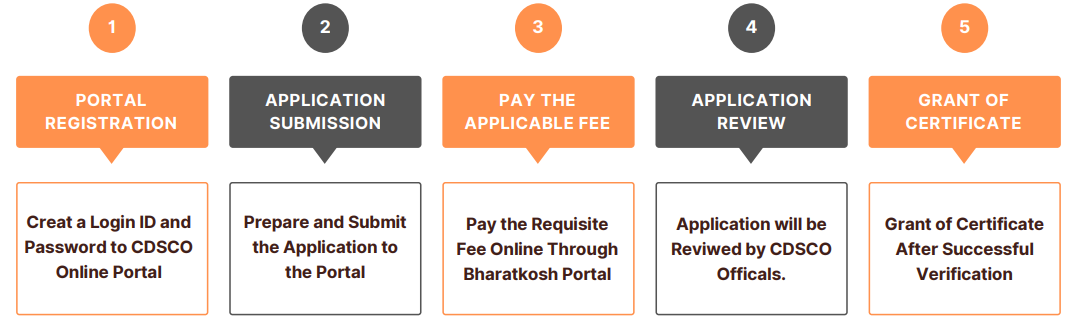
Step 1: Categorization of the Cosmetics: The initial phase of importing cosmetics involves determining whether it necessitates registration according to the Drugs & Cosmetics Act 1940, and amended rules, 2020.
Step 2: Online Portal Registration: An applicant who wants to import cosmetics in India needs to create a login ID and password through the CDSCO sugam online portal https://cdscoonline.gov.in/.
Step 3: Nomination of an Authorized Representative: When seeking a cosmetics import license, foreign manufacturers are not allowed to apply directly. Regulations dictate that the manufacturer cannot approach CDSCO themselves. Instead, they must engage an authorized licensing agent, which could be an individual or entity. The manufacturer must grant power of attorney to this agent, enabling them to apply on their behalf, communicate with the licensing authority, and submit the required information and documents.
Step 4: Fill out the form and submit: Complete Form COS-1 and provide all the necessary documents and specified fees through the CDSCO SUGAM portal by accessing the CDSCO website online and logging in to the portal.
Step 5: Grant of Cosmetics Import Registration Certificate: On receipt of the application, the Central Licensing Authority shall proceed with the assessment of the application. Upon reviewing the application, the authority may seek additional information or issue a Cosmetic Import License in the form of Form COS-2.
|
Step |
What Happens |
|
Register on SUGAM |
Create login credentials using a valid email and mobile number |
|
Categorise the product |
Map each item to its correct group under the Fourth Schedule (roughly 80 categories exist) |
|
Compile the dossier |
Free Sale Certificate, GMP/ISO 22716 certificate, ingredient list, label artwork, Power of Attorney |
|
File Form COS-1 |
Submit online with all supporting documents attached |
|
Pay the fee |
Routed through the Bharatkosh gateway, in INR at the prevailing rate |
|
Respond to queries |
CDSCO often comes back with clarification requests answer these fully, not partially |
|
Receive Form COS-2 |
The Registration Certificate is issued once CDSCO is satisfied |
Each COS-1 filing can cover up to 50 products across multiple variants and manufacturing sites, provided the fees for each are paid correctly. Bundling products into one filing where possible saves both time and repeat paperwork.
Assuming the application is comprehensive and no additional information is needed, the processing time from the application submission date could range from approximately 90 to 180 days. Upon approval, the import registration certificate will possess legal validity lasting for three years from the date of registration approval.
SUGAM is CDSCO's online filing system. Every cosmetic registration, medical device application, and drug-related filing with CDSCO now happens through this one platform.
Practically, it means applicants track their submission status, respond to CDSCO's queries, and receive the final certificate all from a single dashboard, rather than shuffling paper between offices.
It also means the account created at signup becomes the single point of contact for that registration going forward worth keeping accurate and monitored, since deadlines for query responses are tracked from the portal, not from email reminders.
The Fourth Schedule of the Cosmetics Rules, 2020 sorts cosmetics into roughly 80 categories. Here's where most imported products land:
|
Category |
Examples |
|
Skincare |
Creams, lotions, serums, sunscreens |
|
Haircare |
Shampoos, conditioners, hair oils, hair colourants |
|
Colour cosmetics |
Lipsticks, foundations, eyeliners, nail polish |
|
Oral care |
Toothpaste, mouthwash |
|
Fragrances |
Perfumes, deodorants, body mists |
|
Bath and body |
Soaps, body wash, talcum powder |
|
Baby care |
Baby lotions, baby oils, baby powders |
These two forms confuse almost every first-time applicant mostly because people assume they're two separate licenses rather than two stages of one:
COS-1 is the application. It's what gets filed on SUGAM, and it carries every detail about the importer, the manufacturer, the product, and the manufacturing site.
COS-2 is the Registration Certificate. CDSCO issues it only after reviewing and approving what was submitted in COS-1.
A COS-2 certificate doesn't quietly lapse it needs to be renewed proactively, and CDSCO doesn't offer a retrospective revival for one that's expired.
Start the renewal filing at least three to six months before expiry.
Renewal is filed the same way as a fresh application, through SUGAM, with the applicable retention fee.
If the retention fee isn't paid on time, a late fee applies calculated at 2% of the fee for every month or part of a month the payment is delayed, capped at 180 days.
Miss that 180-day window entirely, and the registration is treated as cancelled outright at which point it's a fresh COS-1 filing, not a renewal.
|
Item |
Detail |
|
COS-2 validity |
5 years from date of issue (renewable indefinitely with retention fee) |
|
Processing timeline |
Up to 180 working days from a complete filing, per Rule 13(5) |
|
Government fee |
$1,000 per product category |
|
Additional variant fee |
$50 per variant |
|
Additional manufacturing site fee |
$500 per site |
|
Late renewal fee |
2% of retention fee per month of delay, within a 180-day window |
Filing under the wrong product category this alone accounts for a large share of CDSCO's query letters and rejected applications.
Inconsistent details across documents a manufacturer's address that doesn't match exactly between the Free Sale Certificate, the authorisation letter and the COS-1 form triggers a query almost automatically.
Submitting documents not in English, or without proper notarisation/apostille where required.
Missing the renewal window and assuming a grace period exists beyond 180 days it doesn't.
Treating a reformulated or resized product as covered under an existing COS-2 material changes to formulation, packaging, or claims generally need a fresh filing or amendment.
Underestimating the review timeline and shipping stock before COS-2 is actually in hand.
The right form depends on where the product is actually made and what stage of the supply chain the applicant sits at:
COS-1 / COS-2: Import registration for cosmetics manufactured abroad and brought into India for sale.
COS-4 / COS-4A: For importing a cosmetic that's already registered under an existing COS-2 a separate importer bringing in an already-approved product.
COS-5 / COS-8: For cosmetics manufactured domestically within India, filed with the State Licensing Authority rather than CDSCO centrally.
COS-6 / COS-9: The loan license route for domestic manufacturing, used when production happens at another party's licensed facility.
CDSCO registration covers whether a cosmetic is allowed into India at all. The Legal Metrology (Packaged Commodities) Rules, 2011 govern something separate: what has to appear on the label once it's here.
Every pre-packaged cosmetic sold in India needs, at minimum:
Name and address of the manufacturer, packer, or importer
Country of origin (for imported products specifically)
Generic or common name of the product
Net quantity, declared in standard units
Month and year of manufacture, packing, or import
Maximum Retail Price, inclusive of all taxes
A contact point name, address, phone, and email for consumer complaints
Obtaining the Cosmetics import registration could be a bit challenging due to the complex process of the documents required and the processes involved. However, with the right amount of guidance and consultation, you could easily acquire cosmetics import registration within the prescribed time. At Agile Regulatory we are committed to helping budding entrepreneurs by enabling them to acquire business licenses smoothly and carry on their business.
Get Instant Solution By an Expert Advisor
(4.8)
All cosmetics brought into India must undergo registration with the Central Licensing Authority. This involves submitting an application via Form 42 through the SUGAM portal, and subsequently, a license in Form -43 will be granted.
Indeed, if the manufacturer remains the same entity, they can submit a singular application using Form 42 for multiple brands that are manufactured at one or multiple sites by the same manufacturer.
If the importer wishes to include more products to an already approved Registration Certificate, they need to apply for an endorsement. This application should include the necessary documents, excluding fees if the category is already registered, and as long as the extra product(s) are manufactured at the same site as before. If a new category is to be added, a fee of 250 USD per category must be paid. The validity of the endorsement granted for these supplementary products will match that of the main Registration Certificate
Any changes concerning the manufacturer (legal/actual), such as changes in constitution, name, address, etc., or any changes involving the importer or Indian Agent, like changes in constitution or name, etc require fresh registration
Changes in product composition, alterations in testing methods, minor adjustments in the manufacturing process that do not impact the final product specifications, and updates in labels and packaging with appropriate justification
A cosmetic import license (properly known in India as an Import Registration Certificate) is a compulsory permit granted by the Central Drugs Standard Control Organisation (CDSCO) that enables individuals or entities to legally import cosmetics into India for distribution and sale, subject to compliance with safety and quality standards according to the Cosmetics Rules 2020.
To obtain a cosmetics license in India, you typically must apply for a manufacturing license (Form COS-8) through the State Licensing Authority (State Drug Controller), which includes submitting Form COS-5, furnishing detailed documentation regarding your facility, products, and qualified personnel, and being subjected to a site inspection.
Yes, in India, you essentially have to have a manufacturing license (Form COS-8) from the State Licensing Authority to market cosmetics, even homemade ones, and an import license (Form COS-2) if they are being imported.
In CDSCO (Central Drugs Standard Control Organization), a cosmetic is referred as "any article intended to be rubbed, poured, sprinkled or sprayed on, or introduced into, or otherwise applied to, the human body or any part thereof for cleansing, beautifying, promoting attractiveness, or altering the appearance, and includes any article intended for use as a component of cosmetic."
The present government charge for a cosmetic import permit in India is around INR 83,000 (equivalent to $1000 USD) per category of cosmetic, INR 41,500 (equivalent to $500 USD) per production facility, and INR 4,150 (equivalent to $50 USD) per variant of product.
Proven 4-step Process: Consultation, Documentation, Submission, and Certification.


Startups to large enterprises, we deliver end-to-end solutions business compliance needs.
 One-Stop Compliance Solution:
From BIS, CDSCO, Drug License, EPR, BEE, WPC, LMPC, PSARA, Startup Compliance, Pollution Certificates, Factory License, Fire NOC, Export Licenses and more.
End-to-End Support:
we manage the complete process which includes a proper Consultation & Requirement Analysis, Complete Documentation & Application Filing, Face to Face Coordination with Department Authorities, Certification, Renewal & Post-approval Support.
Clear and set prices:
There are no extra fees or last-minute surprises, because our prices are straightforward, competitive, and set in stone.
Focus on the client:
Each client has a dedicated project manager who keeps them up to date and makes sure communication goes smoothly.
Support for Indian and Foreign Companies:
We offer customized compliance plans and authorized representative services to both Indian businesses that are growing in India and foreign manufacturers that want to enter the Indian market.
One-Stop Compliance Solution:
From BIS, CDSCO, Drug License, EPR, BEE, WPC, LMPC, PSARA, Startup Compliance, Pollution Certificates, Factory License, Fire NOC, Export Licenses and more.
End-to-End Support:
we manage the complete process which includes a proper Consultation & Requirement Analysis, Complete Documentation & Application Filing, Face to Face Coordination with Department Authorities, Certification, Renewal & Post-approval Support.
Clear and set prices:
There are no extra fees or last-minute surprises, because our prices are straightforward, competitive, and set in stone.
Focus on the client:
Each client has a dedicated project manager who keeps them up to date and makes sure communication goes smoothly.
Support for Indian and Foreign Companies:
We offer customized compliance plans and authorized representative services to both Indian businesses that are growing in India and foreign manufacturers that want to enter the Indian market.


What our customer says about us

Lavkush Sharma
KTPL Instruments
Agile Regulatory handled my BIS Certification registration smoothly. Their expert team ensured quick approvals, transparent pricing, and a completely stress-free compliance experience.

Nitin Mukesh
Justrack IOT
We are grateful to Agile Regulatory for their excellent support. Their team showed patience, expertise, and professionalism throughout, providing clear guidance and making the entire process smooth and hassle-free.
Pradeep Varma
Coaire Compressor
Being an excellent BIS Certification Consultant provider, they help customers with all requirements such as BIS Certification, CDSCO services, Agile Regulatory support, legal issues, and lab testing with quick results.
Bharat Bachwani
Easy Polymer
With the help of Agile Regulatory, we have made significant progress in our business. Their service is fast, genuine, and reliable. We look forward to continued success together in the future.

Atul Jain
Tarus International
Many thanks to Agile Regulatory for all the support, guidance, and expert advice. Their professional approach and consistent assistance have made a significant difference.

Paramjeet Singh
Anchor Weighing
Top-tier consulting! offered strategic solutions that revolutionized our approach. Their deep expertise and personalized guidance made a significant impact on our success. Highly recommend their services.

Anshul Rathi
AM Capacitor
Agile Regulatory exceeded expectations! Their tailored solutions, expertise, and proactive approach led to remarkable results. Highly recommend for businesses seeking impactful and strategic guidance.

Shekhar Maurya
Imaxx Pro Aquistic
Outstanding service! delivered targeted solutions with professionalism and expertise. Their insights elevated our business strategies, resulting in noticeable growth. Highly recommended for exceptional consultation.

