

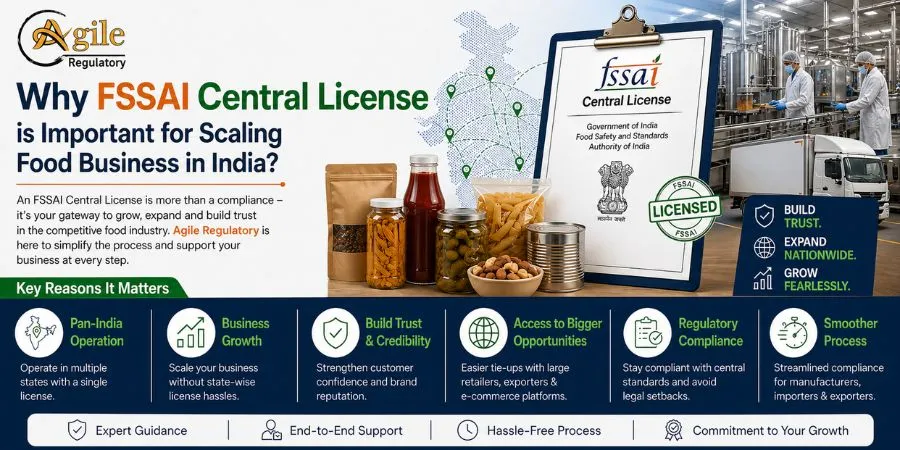
Most food entrepreneurs in India come to understand FSSAI licensing the hard way when months of effort and real money are already on the table. The FSSAI central license is not a bureaucratic inconvenience. It is what separates a food business that can grow from one that keeps hitting walls. If your ambitions go beyond your city or your home state, if you want shelf space across India, government contracts, or a foothold in international markets, there is no workaround for this.
This article discusses why the central food license is a growth instrument, not just a legal requirement, and what the actual process of getting one looks like.
FSSAI divides food business operators into three categories based on scale: basic registration, state license, and central license. The central FSSAI license sits at the top of that hierarchy and its scope reflects that.
You need a central license FSSAI if any of the following apply to your business:
Your annual turnover is above ₹20 crore
You run operations across more than one state
You import or export food products
You supply to Indian Railways, defense canteens, or central government bodies
You are operating as an FSSAI central license for merchant exporter
You manage a central warehouse or cold storage facility serving multiple states
A state license is geographically bound. The moment your distribution, manufacturing, or sourcing crosses a state border even partially, you are legally operating outside what a state license covers.
Ugly & Hilarious Realities of Building a Food Business in India Grow a food business and the game is not just about boosting sales — it’s about building a strong, compliant and scalable structure. This is why the FSSAI Central License becomes mandatory. Companies that want to scale up big cannot just be content with basic registration or state-level licenses.
Large retail chains and e-commerce platforms don't take onboarding decisions casually. Their compliance departments vet every vendor, and a state license will not clear that bar if you're supplying pan-India. Platforms like BigBasket, Blinkit, or institutional procurement portals look for the central FSSAI license specifically.
India's food and agriculture export sector crossed $50 billion in 2023–24. If you want any part of that, the regulatory path runs squarely through the FSSAI central license for merchant exporter or manufacturer category. Your export certificates, NOCs from APEDA, and eligibility under EIC inspections are all linked to your central license standing. No central license means no legal export, full stop.
When investors evaluate a food startup, one of the first things their legal teams check is compliance status. A valid FSSAI central license registration doesn't just show you're following the law; it signals that your operations are built with some seriousness. A state license on a company that claims multi-state ambitions is a contradiction that raises questions you don't want raised in a funding conversation.
Railways catering, defense canteen supply, mid-day meal schemes, and government hospital food contracts these are sizeable, recurring revenue opportunities. Every single one of them requires a central food license. State-licensed businesses are not eligible, regardless of their product quality or operational capability.
What Documents are Required for FSSAI License Renewal?
Before jumping into the application process, it helps to see exactly where the central license fits relative to the other tiers
|
Parameter |
Basic Registration |
State License |
Central License |
|
Applicable Turnover |
Up to ₹12 lakh/year |
₹12 lakh – ₹20 crore |
Above ₹20 crore or multi-state ops |
|
Operational Scope |
Single petty unit |
Within one state |
Pan-India + Import/Export |
|
FSSAI License Cost |
₹100/year |
₹2,000 – ₹5,000/year |
₹7,500/year |
|
FSSAI Central License Fee for 5 years |
Not applicable |
Varies by category |
₹37,500 |
|
Export Permitted |
No |
No |
Yes |
|
Multi-state Distribution |
No |
No |
Yes |
|
Government Supply Eligibility |
No |
No |
Yes |
|
Validity Options |
1 to 5 years |
1 to 5 years |
1 to 5 years |
These food license fees are based on FSSAI's published schedule. Confirm current FSSAI Central License cost figures directly on the FOSCOS portal before filing, as sector-specific rates can differ.
It is much easier and far less confusing to know the procedure How the system works and apply for the FSSAI Central License. While this may all be seem a little technical at the outset, there is a solid process if it is properly followed.
Everything goes through FOSCOS, the Food Safety Compliance System, accessible at foscos.fssai.gov.in. This is FSSAI's centralized digital platform and the only valid channel for FSSAI central license apply online submissions. Physical applications are not accepted for central licensing anymore.
Create your account, select the appropriate business category, and initiate the Form B application.
Getting your FSSAI central license documents together before you start the online process saves significant time. A missing or mismatched document is the most common reason applications get stuck.
Here's what the standard checklist looks like:
Completed Form B
Business constitution proof MOA for a company, partnership deed, or proprietorship declaration
Identity and address proof for directors or proprietors
Food Safety Management System (FSMS) plan
NOC from the local authority or municipal body
Water testing report from an NABL-accredited or government laboratory
Import Export Code (IEC) mandatory if you're applying as an exporter
Machinery list with installed capacity (for manufacturers)
These food license documents need to be current and clearly legible. Scanned copies with poor resolution or expired certificates will stall your application
The register your business cost is ₹7,500 per year, paid through the FOSCOS portal at the time of application. If you choose a 5-year validity upfront, the FSSAI Central License Fee for 5 years comes to ₹37,500 paid in one transaction. There are no hidden charges beyond this; the food license fees are transparent and fixed by FSSAI's official schedule
A designated officer is assigned to inspect your premises within 30 days of a complete application. If everything checks out, the license is issued digitally and uploaded to your FOSCOS account. The FSSAI central license download option becomes available once the status updates to "Approved." No physical copy is dispatched; the digital version is the official document.
FSSAI central license renewal has to be filed at least 30 days before your license expiry date and again, it runs through FOSCOS. The FSSAI license cost for renewal is the same annual rate ₹7,500 and the process mirrors the initial application in structure, though documentation requirements may be lighter if nothing about your operations has changed
How to Apply for FSSAI License for your Restaurant and Food Business in 2026?
There's a reason established food companies don't treat their central FSSAI license as just another compliance item. It is what makes serious distribution, export contracts, and institutional sales legally accessible. For a food business with real growth ambitions, it's infrastructure, the same way GST registration or a company incorporation is infrastructure.
If you need help with your FSSAI central license registration, gathering the right food license documents, navigating FOSCOS, or staying ahead of FSSAI central license renewal deadlines, Agile Regulatory handles the entire process for food businesses across India. Our team works with manufacturers, exporters, and startups to get applications filed right the first time without the back-and-forth that comes from incomplete submissions. Get in touch with us today.
A state license limits you to operations within one state and applies to businesses with turnover between ₹12 lakh and ₹20 crore. The central FSSAI license covers everything above that threshold, all multi-state operations, and all import/export activity. If your growth plan involves either, the state license simply won't hold up.
Log into FOSCOS at foscos.fssai.gov.in, register your business, and select Form B for central licensing. Upload your FSSAI central license documents, pay the applicable fee, and submit. You'll receive an application reference number and can track inspection scheduling through the same portal.
At ₹7,500 per year, the FSSAI Central License Fee for 5 years totals ₹37,500. That's the standard FSSAI license cost for most categories, though you should verify current food license fees on FOSCOS since sector-specific variations exist.
Yes. The FSSAI central license for merchant exporters is its own category under the central licensing framework. Merchant exporters, meaning businesses that buy food products and export them without manufacturing, are required to hold this. Your IEC is a mandatory document in this application.
Once approved, the FSSAI central license download is available directly from your FOSCOS account. Navigate to your application, check the status, and download the PDF. That digital copy is your official license; there's no physical document.


You might also be interested in these articles.
Preeti gupta
15 Oct 2026
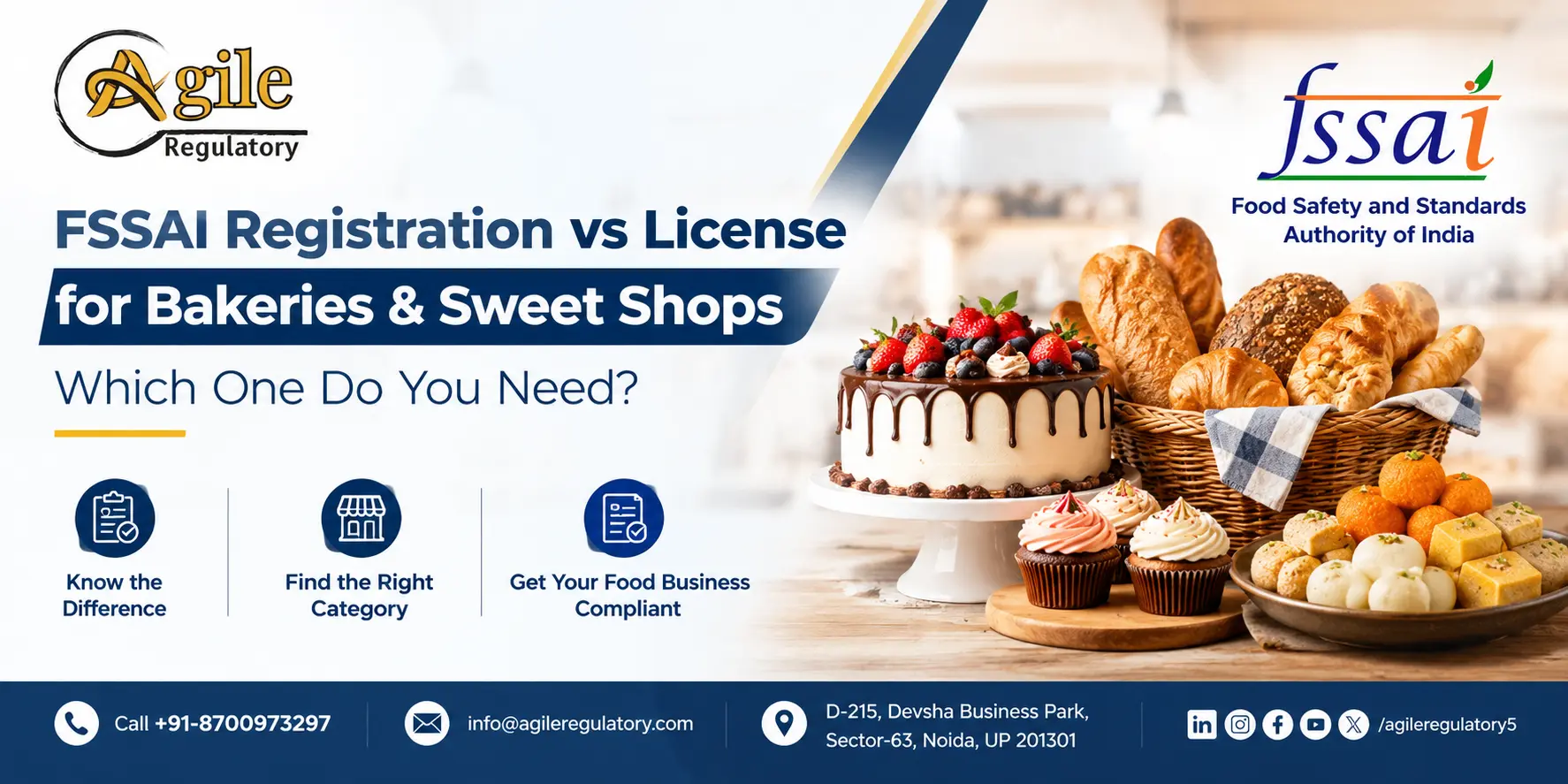
Planning to start a bakery, home baking business, cake shop, or sweet shop in India? Before selling cakes, bread, biscuits, or traditional sweets, you need to understand which FSSAI approval applies to your business. Choosing between FSSAI Registration, a
Sanskriti
25 Aug 2026
Running a manufacturing business in India involves more than setting up a factory and starting production. Businesses must comply with several legal, labour, environmental, product-specific, packaging, taxation, and operational requirements. A well-planne
Preeti Gupta
13 Aug 2026
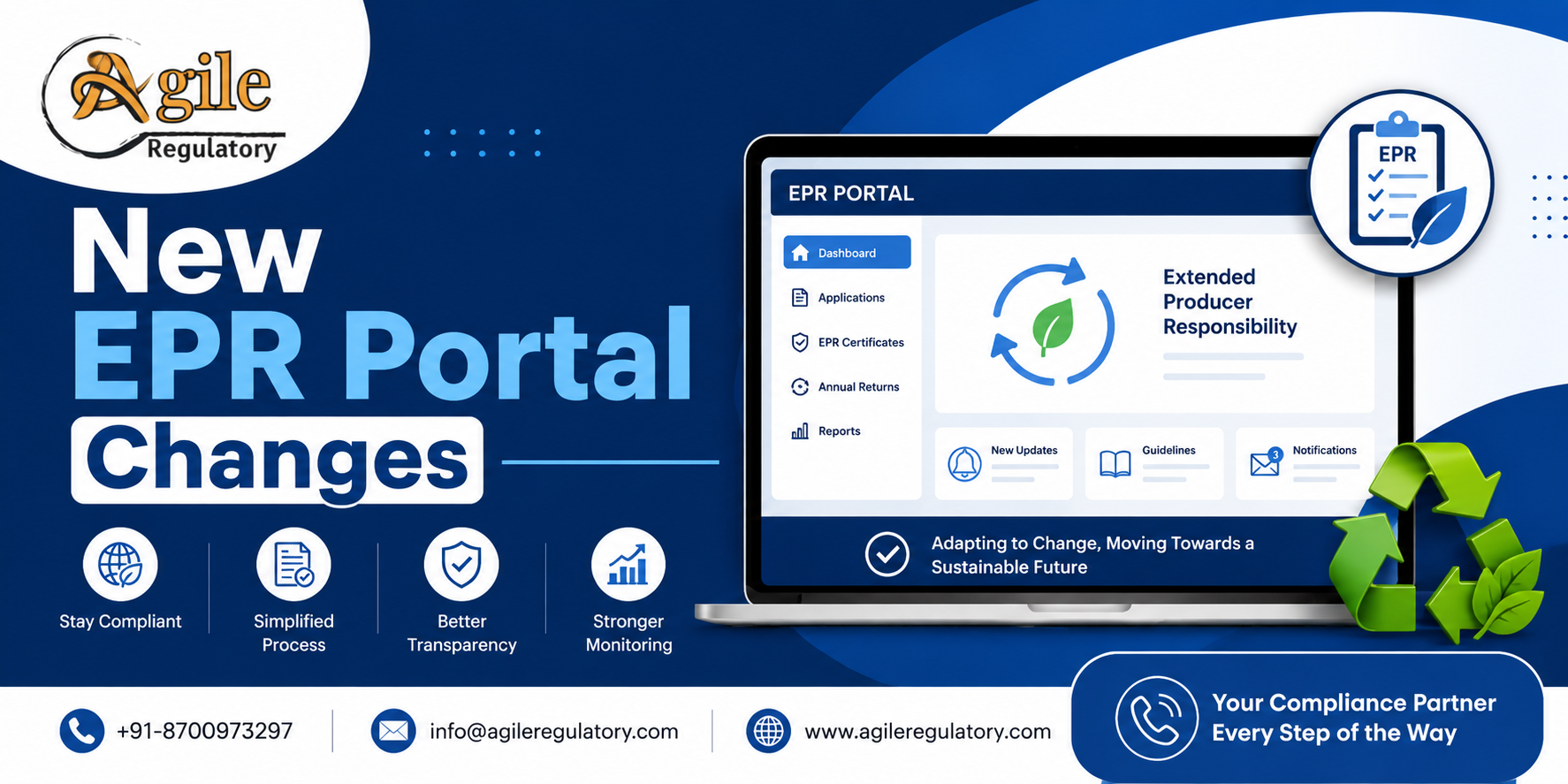
The EPR system in India is becoming more digital and compliance-focused, making it important for Producers, Importers and Brand Owners (PIBOs) to maintain accurate registration details, waste-processing records and annual returns. Understanding the latest
Divya Saxena
11 Aug 2026
FSSAI License Registration is essential for food businesses operating in India. This guide explains the types of FSSAI approvals, eligibility, documents required, online registration process, Uttar Pradesh requirements, and the latest 2026 regulatory upda
Nishi Chawla
22 Jun 2026
Discover how Tea Board Registration in Delhi helps tea exporters access global markets, enhance credibility, and streamline export compliance for business growth.
Nishi Chawla
06 Jun 2026
MD 42 License in Noida is essential for medical device manufacturers and importers to ensure legal compliance, build market credibility, avoid penalties, and expand business opportunities.
Nishi Chawla
19 May 2026
ICEGATE registration is an essential process for import-export businesses in India. It allows importers, exporters, customs brokers, and logistics companies to access online customs services through the Indian Customs Electronic Gateway (ICEGATE). With re
Nishi Chawla
09 May 2026
APEDA Registration is essential for businesses involved in the export of agricultural and processed food products from India. This complete guide for 2026 explains the APEDA registration process, required documents, eligibility, benefits, and compliance r
Nishi Chawla
20 Apr 2026
The GeM (Government e-Marketplace) Portal Registration is a simple online process that allows sellers, service providers, and organizations to register and sell goods or services directly to government departments in India.
Nishi Chawla
20 Apr 2026
Rubber Board Registration helps rubber businesses gain official recognition, access government benefits, improve market credibility, and expand trade opportunities. It ensures compliance with industry regulations and supports better pricing, exports, and
Nishi Chawla
08 Apr 2026
Create an account, complete the Startup India registration form, upload required documents, self-certify eligibility, and track application status until the certificate is issued.
Nishi Chawla
23 Mar 2026
FSSAI State Food License in Telangana and Hyderabad is mandatory for food businesses with turnover between ₹12 lakh and ₹20 crore. It ensures compliance with food safety, hygiene, and quality standards under the Food Safety Act. The process includes onlin
Nishi Chawla
09 Mar 2026
This 2026 update explains how businesses can apply for FSSAI trade license registration in India, required documents, eligibility, and benefits.
Divya Saxena
06 Mar 2026
Getting an FSSAI Food License in Maharashtra and Mumbai is mandatory for anyone running a food-related business such as restaurants, food manufacturing, packaging, or distribution
We simplify compliance through a proven 4-step process: Consultation, Documentation, Submission, and certification. From understanding requirements to getting final approvals, we deliver a smooth, timely, and fully compliant journey for your business.


What our customer says about us

Lavkush Sharma
KTPL Instruments
Agile Regulatory handled my BIS Certification registration smoothly. Their expert team ensured quick approvals, transparent pricing, and a completely stress-free compliance experience.

Nitin Mukesh
Justrack IOT
We are grateful to Agile Regulatory for their excellent support. Their team showed patience, expertise, and professionalism throughout, providing clear guidance and making the entire process smooth and hassle-free.

Pradeep Varma
Coaire Compressor
Being an excellent BIS Certification Consultant provider, they help customers with all requirements such as BIS Certification, CDSCO services, Agile Regulatory support, legal issues, and lab testing with quick results.

Bharat Bachwani
Easy Polymer
With the help of Agile Regulatory, we have made significant progress in our business. Their service is fast, genuine, and reliable. We look forward to continued success together in the future.

Atul Jain
Tarus International
Many thanks to Agile Regulatory for all the support, guidance, and expert advice. Their professional approach and consistent assistance have made a significant difference.

Paramjeet Singh
Anchor Weighing
Top-tier consulting! offered strategic solutions that revolutionized our approach. Their deep expertise and personalized guidance made a significant impact on our success. Highly recommend their services.
Anshul Rathi
AM Capacitor
Agile Regulatory exceeded expectations! Their tailored solutions, expertise, and proactive approach led to remarkable results. Highly recommend for businesses seeking impactful and strategic guidance.

Shekhar Maurya
Imaxx Pro Aquistic
Outstanding service! delivered targeted solutions with professionalism and expertise. Their insights elevated our business strategies, resulting in noticeable growth. Highly recommended for exceptional consultation.
Trusted by over 1,00,000 + Global Brands in the past 15+ years




.webp)
.webp)
(1).webp)


Leave a Reply
Your email address will not be published. Required fields are marked *