

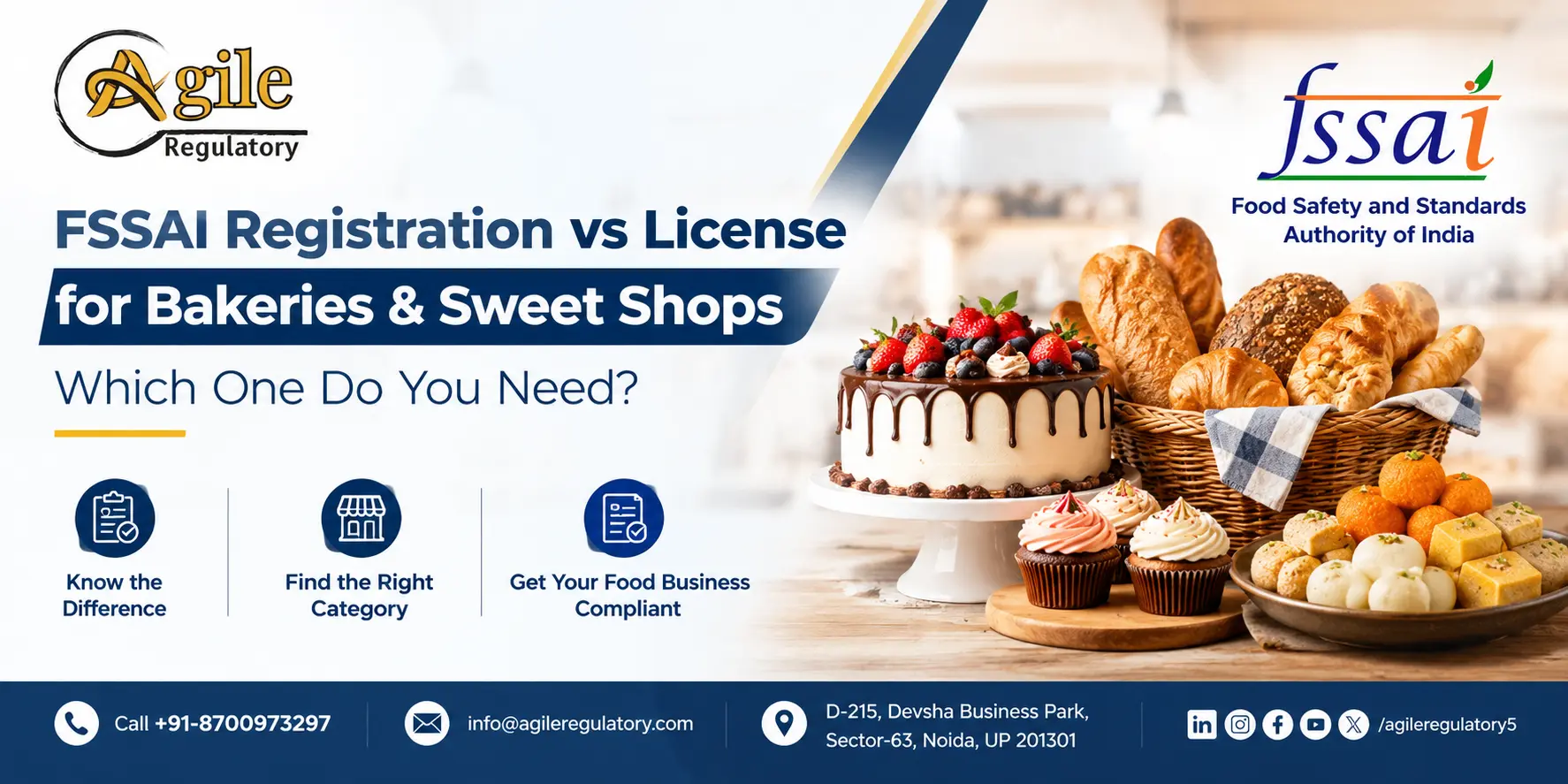
There’s one important step to take before selling food of any kind in India (sweets or beverages). It's called getting approval from the legal authority called the Food Safety and Standards Authority of India (FSSAI). The one question that everyone asks is whether they should apply for an FSSAI Registration or FSSAI License for their business.
Both may sound similar but are not the same. In this guide, we will explain the main difference between FSSAI registration and license, which one to apply for, and how to do it if you run a bakery or a sweet shop.
|
Feature |
FSSAI Registration |
State License |
Central License |
|
Annual turnover |
Up to ₹1.5 crore |
Above ₹1.5 crore to ₹50 crore |
Above ₹50 crore |
|
Best suited for |
Home bakers, small bakeries, local halwai shops |
Popular cake shops, sweet shop chains, mid-sized bakeries |
Big bakery brands, large mithai manufacturers, multi-state businesses |
|
Issued by |
Local registering authority |
State Food Safety Authority |
Central FSSAI |
|
Government fee |
₹100 per year |
₹2,000 to ₹5,000 per year (₹5,000 for most manufacturers) |
₹7,500 per year |
|
Documents needed |
Basic: ID proof, photo, address proof |
More detailed: kitchen layout, machinery list, water test report, food safety plan |
Most detailed, similar to State plus extra compliance |
Quick tip: Turnover isn’t the only factor. A bakery or sweet shop producing large quantities every day may need a higher category even if its turnover is low, so always check both before applying.
How to Get FSSAI Food License in India?
Initially, the threshold limit to apply for an FSSAI license or registration was ₹12 lakh. But 2026 came with a major change for them by moving the limits to ₹1.5 crore and above. FSSAI notified new amendment regulations on 10 March 2026, and then a separate order was released on 13 March 2026 for revised turnover limits. These limits came into effect from 1 April 2026
Here are the latest limits and the rest that changed:
|
Type |
Annual Turnover |
|
FSSAI Registration |
Up to ₹1.5 crore |
|
State License |
Above ₹1.5 crore to ₹50 crore |
|
Central License |
Above ₹50 crore |
Suppose you bake cupcakes, cookies, or birthday cakes from your home kitchen and sell them to limited clients via social media platforms like Instagram, Facebook, or even WhatsApp to your neighbours or close acquaintances; you would still need to get FSSAI approval. So, yes, many believe home businesses are exempt from FSSAI’s scrutiny, but that’s not true at all.
However, the FSSAI registration process for home bakers is much quicker and easier to handle, as most such businesses earn below ₹1.5 crore; getting basic FSSAI registration is enough. Plus, its much much cheaper, with this registration type charging only ₹100 by FSSAI. The documents needed for FSSAI registration for home bakers include ID proof, a photo, and basic details about their home kitchen, including the methods and equipment used to prepare delicacies and food items.
Having the FSSAI Registration number printed on your packaging also helps boost trust and credibility among customers.
For a local bakery in the market that sells bread, puffs, pastries, and other similar items like cakes, the yearly turnover often crosses over ₹1.5 crore. This leads them to the second limit set by FSSAI, known as the State FSSAI License for bakeries. State Food Safety Authority issues this license, and one needs to pay around ₹2,000 to ₹5,000 per year (₹5,000 for most manufacturers) to apply for it.
One thing to keep in mind for an FSSAI License for bakeries is that for those crossing ₹1.5 crore, FSSAI doesn’t only check the turnover amount; it also looks at the production capacity. The rules for production capacity remain the same, so some bakeries might even need to apply for a Central license even if their turnover limit doesn’t cross the ₹50 crore mark.
So if your bakery has big ovens running all day and supplies bread to many shops, check both your turnover and your production capacity before applying
FSSAI License for Restaurant & Food Business 2026.
Sweet shops get more scrutiny compared to bakeries as they use a large amount of khoya, milk, and ghee to produce, which spoils easily. A small halwai shop with turnover under ₹1.5 crore can usually manage with basic registration, and those crossing it get a state license. This applies to well-known mithai brands that have multiple branches, sell gift boxes during festivals, or supply sweets to weddings and events.
The only catch for these shops is that you may need to apply with additional documents like a layout plan of your kitchen, a list of machines, a water testing report, and a food safety management plan.
Cake shops that grow into popular brands often cross the limit and need to apply for a Central FSSAI license, especially if they have multiple outlets and are delivering through apps like Zomato and Swiggy.
Get answers to these questions to make the right choice:
What is your annual turnover, and is it below or above 15 crore?
How much food do you produce daily?
Do you sell in only one state or more?
These answers will point you towards the right choice of FSSAI license.
FSSAI Cloud Kitchen Registration
Yes. Every food business, including those run from home, needs FSSAI approval. Most home bakers only need basic registration.
No, it no longer expires. However, you must pay the annual fee on time.
You could face heavy fines and even have your business shut down.


You might also be interested in these articles.
Divya Saxena
11 Aug 2026
FSSAI License Registration is essential for food businesses operating in India. This guide explains the types of FSSAI approvals, eligibility, documents required, online registration process, Uttar Pradesh requirements, and the latest 2026 regulatory upda
Nishi Chawla
25 Apr 2026
An FSSAI central license is essential for food businesses aiming to scale across India. It ensures legal compliance, builds consumer trust, and allows operations in multiple states and large-scale production.
Nishi Chawla
23 Mar 2026
FSSAI State Food License in Telangana and Hyderabad is mandatory for food businesses with turnover between ₹12 lakh and ₹20 crore. It ensures compliance with food safety, hygiene, and quality standards under the Food Safety Act. The process includes onlin
Nishi Chawla
09 Mar 2026
This 2026 update explains how businesses can apply for FSSAI trade license registration in India, required documents, eligibility, and benefits.
Divya Saxena
06 Mar 2026
Getting an FSSAI Food License in Maharashtra and Mumbai is mandatory for anyone running a food-related business such as restaurants, food manufacturing, packaging, or distribution
We simplify compliance through a proven 4-step process: Consultation, Documentation, Submission, and certification. From understanding requirements to getting final approvals, we deliver a smooth, timely, and fully compliant journey for your business.


What our customer says about us

Lavkush Sharma
KTPL Instruments
Agile Regulatory handled my BIS Certification registration smoothly. Their expert team ensured quick approvals, transparent pricing, and a completely stress-free compliance experience.

Nitin Mukesh
Justrack IOT
We are grateful to Agile Regulatory for their excellent support. Their team showed patience, expertise, and professionalism throughout, providing clear guidance and making the entire process smooth and hassle-free.

Pradeep Varma
Coaire Compressor
Being an excellent BIS Certification Consultant provider, they help customers with all requirements such as BIS Certification, CDSCO services, Agile Regulatory support, legal issues, and lab testing with quick results.

Bharat Bachwani
Easy Polymer
With the help of Agile Regulatory, we have made significant progress in our business. Their service is fast, genuine, and reliable. We look forward to continued success together in the future.

Atul Jain
Tarus International
Many thanks to Agile Regulatory for all the support, guidance, and expert advice. Their professional approach and consistent assistance have made a significant difference.

Paramjeet Singh
Anchor Weighing
Top-tier consulting! offered strategic solutions that revolutionized our approach. Their deep expertise and personalized guidance made a significant impact on our success. Highly recommend their services.
Anshul Rathi
AM Capacitor
Agile Regulatory exceeded expectations! Their tailored solutions, expertise, and proactive approach led to remarkable results. Highly recommend for businesses seeking impactful and strategic guidance.

Shekhar Maurya
Imaxx Pro Aquistic
Outstanding service! delivered targeted solutions with professionalism and expertise. Their insights elevated our business strategies, resulting in noticeable growth. Highly recommended for exceptional consultation.
Trusted by over 1,00,000 + Global Brands in the past 15+ years






Leave a Reply
Your email address will not be published. Required fields are marked *