


Get Instant Solution By an Expert Advisor
(4.8)
Consent to Establish (CTE) is an important environmental clearance to be obtained in India before the commencement of any industrial construction or expansion. It is basically a No Objection Certificate (NOC) from the State Pollution Control Board which checks the planned activities for compliance with the environmental standards right from the beginning.
“This approval is the go-ahead to begin laying the foundation. You need a CTE before any physical installation of buildings or machinery. Once your facility is operational and there are pollution controls, you’ll then need a Consent to Operate (CTO) before you can start production. It’s a two-step process that would protect the environment while allowing industry to grow.





Get personalized guidance in minutes - no waiting, no bots.


10000 +
Projects Completed for Our Respected Clients.

15 +
Years Experienced Advisors in Indian Compliance.

98.9%
Project Delivery Ratio for Our Valuable Clients.

99.9%
Satisfied Customers All Over India.
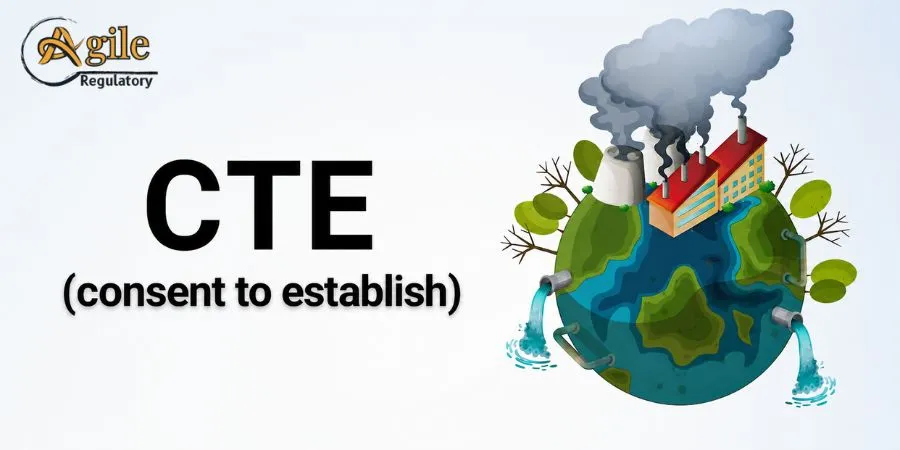
CTE full form is Consent to Establish. It is a pre-construction approval issued by your State Pollution Control Board (SPCB) before you set up any industrial plant, manufacturing unit or process that generates pollution.
The CTE meaning in the pollution control board framework is: you are asking the board to review your proposed project its location, its production process, its waste generation and your plan to control that waste and confirm that you can legally proceed with construction.
Two central laws make this mandatory:
Water (Prevention and Control of Pollution) Act, 1974 Under Section 25 of this Act no industry can establish any plant or begin construction of any outlet or system that will discharge trade effluent into a water body, stream, sewer or land without first obtaining consent from the State Board.
Air (Prevention and Control of Pollution) Act, 1981 Section 21 of this Act covers air pollution control areas which in practice means most industrial zones across India. Any person who intends to establish or operate an industrial plant in such an area must obtain prior consent from the State Board. The Act does not wait for emissions to begin the establishment of the plant itself requires approval.
Any industry, plant or operation that will generate air emissions, liquid effluents or hazardous waste during construction or once operational needs a Consent to Establish from the pollution control board before construction begins.
That definition is wider than most people expect. It covers:
All manufacturing factories and processing units
Pharmaceutical, chemical and dye intermediate plants
Textile mills and dyeing units
Hotels and resorts above a certain scale (because of sewage treatment requirements)
Hospitals that generate biomedical waste and pharmaceutical effluents
Power plants, captive power units and diesel generator sets above specified capacity
Mining and quarrying operations
Cold storage and food processing units that use ammonia-based refrigerants
Residential townships and commercial complexes that need sewage treatment plants
The category of your industry Red, Orange or Green determines how rigorous the scrutiny will be. But across all three categories you need the consent before you start.
The Central Pollution Control Board classifies industries into three categories based on pollution potential.
|
Category |
Pollution Potential |
Examples |
Approving Authority |
|
Red |
Highly polluting |
Cement, fertilisers, pharmaceuticals, petrochemicals, tanneries, distilleries, pulp and paper, iron and steel, thermal power, sugar. |
SPCB senior-level scrutiny; EC from MoEFCC often required first |
|
Orange |
Moderately polluting |
Food processing, rubber processing, auto service stations, glass and ceramics, synthetic detergents |
SPCB Regional Officer level |
|
Green |
Low polluting |
Atta chakki, small bakeries, incense sticks, garments without surface treatment |
SPCB District-level in many states |
Red category industries carry the heaviest compliance load. Before you can apply for a State Pollution Control Board CTE you must secure an EC order from the central ministry
These two approvals are issued at different stages of your project and they are not interchangeable.
|
Parameter |
Consent to Establish (CTE) |
Consent to Operate (CTO) |
|
When you apply |
Before construction begins |
After construction is complete, before production starts |
|
What the board reviews |
Your design, location, ETP/STP plans, emission control proposals |
Actual installed systems post-construction inspection |
|
Legal basis |
Water Act 1974, Sec. 25 + Air Act 1981, Sec. 21 |
Same Acts but at the operational stage |
|
Validity |
Typically 5 years |
1–5 years depending on state and category |
|
What it allows you to do |
Begin construction |
Begin production |
|
What happens if it expires |
You cannot convert to CTO; must renew first |
Production becomes illegal; renewal required immediately |
The sequence is fixed: CTE first, construction then CTO application then operation. Skipping or reversing any step creates legal exposure that cannot be papered over later.
Certain industries and activities are exempt from requiring a CTE. These are generally listed in schedules notified by SPCBs or covered under CPCB guidelines on exempt categories.
Common exemptions include:
Cottage and micro-enterprises with negligible pollution potential as specified in state notifications
Purely agricultural activities
Solar and wind energy projects in most states
Software companies, offices, and retail establishments that generate no industrial effluents or air emissions
Small construction activities not involving industrial processes
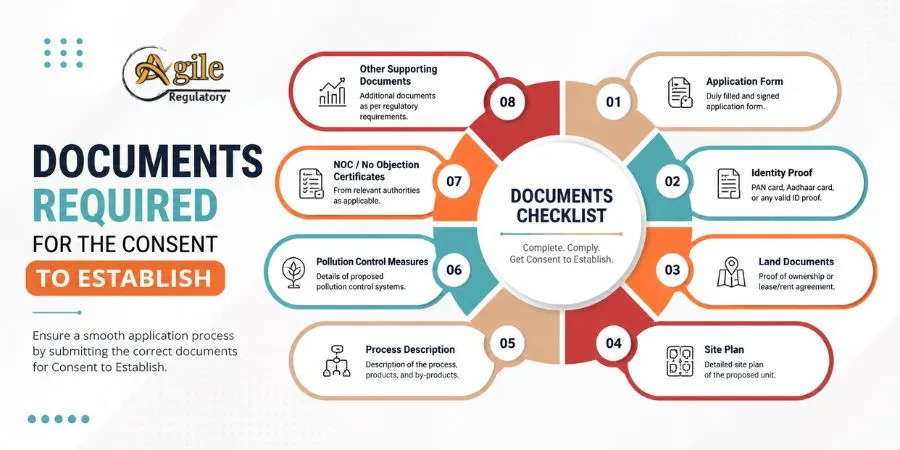
Below is the standard document set required across most SPCBs. Individual boards may ask for additional documents depending on the industry type and project scale.
Completed CTE application form
Site location plan with survey number and coordinates
Land ownership documents or registered lease deed
Detailed Project Report (DPR)
Process flow chart with mass balance
Factory layout plan showing ETP, STP, chimney, and equipment
ETP or STP design with capacity calculations
Air pollution control equipment details type, efficiency, stack height
Consent fee payment receipt
NOC from local authority (Gram Panchayat or Municipality)
Environmental Clearance order (Red category projects)
Affidavit of compliance by the applicant
The Consent to Establish process in India follows a defined sequence. Timelines vary by state and category but the steps below represent the standard CTE approval process step by step.
Determine your industry category (Red/Orange/Green) and check if EC is required
Prepare DPR, ETP/STP design, process flowchart, and layout plan
Register on SPCB online portal or Parivesh portal (for EC + CTE integration)
Fill the CTE application form online and upload all documents
Pay prescribed consent fee through the portal
SPCB scrutiny checklist review, deficiency notice issued if documents are incomplete
Respond to deficiency notice with additional or corrected documents
Site inspection by SPCB officers (mandatory for Red; discretionary for Orange and Green)
Technical appraisal and internal approval by competent SPCB authority
CTE issued with consent conditions
Consent fees are set by each state independently. They are typically calculated on the basis of capital investment in the project or the pollution load it will generate.
|
Industry Category |
Fee Basis |
Approximate Range |
|
Red |
Capital investment or pollution index |
Rs. 30,000 to Rs. 5,00,000+ for large projects |
|
Orange |
Capital investment |
Rs. 10,000 to Rs. 1,00,000 |
|
Green |
Capital investment |
Rs. 2,000 to Rs. 25,000 |
|
Micro and Small enterprises |
MSME classification |
Concessional rates in most states |
The figures below are indicative check your specific SPCB's current fee schedule before applying.
Most rejections are preventable. They fall into a small number of recurring patterns
|
Reason |
How to Avoid It |
|
Missing or illegible documents |
Prepare a pre-submission checklist; verify every upload |
|
ETP or STP design inadequate for the pollution load |
Get your treatment system designed by a certified environmental engineer not a general civil contractor |
|
Site in a prohibited zone flood plain, eco-sensitive area, or CRZ |
Verify land use with local planning authority and SPCB norms before finalising the site |
|
Land not zoned for industrial use in the master plan |
Get land use certificate from the local authority before approaching SPCB |
|
Incorrect fee category claimed |
Calculate fee on actual project cost; under-declaring to pay a lower fee invites scrutiny |
|
Red category project submitted without Environmental Clearance |
Secure EC from MoEFCC first |
|
No local body NOC attached |
Obtain Gram Panchayat or municipal NOC before the SPCB application |
|
Air pollution control plan does not meet stack height or emission norms |
Specify equipment type, efficiency percentage and stack height as per CPCB norms for your industry |
|
Contradictions between DPR and application form |
One person should cross-check both documents before submission |
Your Consent to Establish certificate covers the project as you described it at the time of application. If anything changes you cannot quietly proceed under the original consent.
If you modify your production process, add a product line, change raw materials, expand your installed capacity or revise your ETP design after CTE is issued you must apply for a consent amendment before implementing those changes.
When ownership of the unit changes through sale, partnership reconstitution, merger or inheritance the CTE does not transfer automatically. The new owner must apply for consent transfer, submit proof of ownership change and give a fresh undertaking to comply with all existing conditions. Operating under a previous owner's consent name after ownership transfer is a violation.
CTE validity is generally five years. If your construction is still ongoing as expiry approaches, apply for renewal at least 90 days before the expiry date many SPCBs require even earlier submission.
A Consent to Establish (CTE) form, also known as Consent for Establishment (CFE), has many benefits for businesses and the environment. It helps to meet environmental regulations, avoid legal penalties, improve reputation, and obtain funding.
A valid CTE means your project has been formally reviewed and cleared. If a local body complaint or NGT petition challenges your project you have documented regulatory approval.
Most project finance lenders and term loan banks now ask for environmental clearances as part of due diligence. A Consent to Establish from the pollution control board on file answers their question before it becomes a loan condition.
The CTE process requires you to design your ETP, STP and air pollution control systems before construction, not after. Under the Air (Prevention and Control of Pollution) Act, 1981 and the Water (Prevention and Control of Pollution) Act, 1974, compliance is not just about having equipment it is about meeting prescribed standards. The CTE process by forcing that planning early, gives you a better chance of meeting those standards when production starts.
SPCB enforcement wings and state pollution control inspectors do conduct surprise site visits at industrial construction sites. A unit under construction without a valid SPCB Consent to Establish can be issued a stoppage order. The cost of even a two-week stoppage during peak construction typically exceeds what the consent would have cost.
Get Instant Solution By an Expert Advisor
(4.8)
CTE in pollution control stands for Consent to Establish. It is issued by the State Pollution Control Board.
Yes without exception for industries under Red, Orange, or Green categories. Construction of any plant, any industrial operation that will generate pollution cannot legally begin without a valid CTE.
Yes. CTE registration is now available online for state SPCBs. The application is processed through the Parivesh portal (parivesh.nic.in).
There is no legal difference. "Pollution NOC for industry" is informal language used by contractors, local bodies and banks to refer to the Consent to Establish certificate.
In most states no. The SPCB issues a single Consent to Establish that covers both air and water compliance in one order.
Proven 4-step Process: Consultation, Documentation, Submission, and Certification.


Startups to large enterprises, we deliver end-to-end solutions business compliance needs.
 One-Stop Compliance Solution:
From BIS, CDSCO, Drug License, EPR, BEE, WPC, LMPC, PSARA, Startup Compliance, Pollution Certificates, Factory License, Fire NOC, Export Licenses and more.
End-to-End Support:
we manage the complete process which includes a proper Consultation & Requirement Analysis, Complete Documentation & Application Filing, Face to Face Coordination with Department Authorities, Certification, Renewal & Post-approval Support.
Clear and set prices:
There are no extra fees or last-minute surprises, because our prices are straightforward, competitive, and set in stone.
Focus on the client:
Each client has a dedicated project manager who keeps them up to date and makes sure communication goes smoothly.
Support for Indian and Foreign Companies:
We offer customized compliance plans and authorized representative services to both Indian businesses that are growing in India and foreign manufacturers that want to enter the Indian market.
One-Stop Compliance Solution:
From BIS, CDSCO, Drug License, EPR, BEE, WPC, LMPC, PSARA, Startup Compliance, Pollution Certificates, Factory License, Fire NOC, Export Licenses and more.
End-to-End Support:
we manage the complete process which includes a proper Consultation & Requirement Analysis, Complete Documentation & Application Filing, Face to Face Coordination with Department Authorities, Certification, Renewal & Post-approval Support.
Clear and set prices:
There are no extra fees or last-minute surprises, because our prices are straightforward, competitive, and set in stone.
Focus on the client:
Each client has a dedicated project manager who keeps them up to date and makes sure communication goes smoothly.
Support for Indian and Foreign Companies:
We offer customized compliance plans and authorized representative services to both Indian businesses that are growing in India and foreign manufacturers that want to enter the Indian market.


What our customer says about us

Lavkush Sharma
KTPL Instruments
Agile Regulatory handled my BIS Certification registration smoothly. Their expert team ensured quick approvals, transparent pricing, and a completely stress-free compliance experience.

Nitin Mukesh
Justrack IOT
We are grateful to Agile Regulatory for their excellent support. Their team showed patience, expertise, and professionalism throughout, providing clear guidance and making the entire process smooth and hassle-free.
Pradeep Varma
Coaire Compressor
Being an excellent BIS Certification Consultant provider, they help customers with all requirements such as BIS Certification, CDSCO services, Agile Regulatory support, legal issues, and lab testing with quick results.

Bharat Bachwani
Easy Polymer
With the help of Agile Regulatory, we have made significant progress in our business. Their service is fast, genuine, and reliable. We look forward to continued success together in the future.

Atul Jain
Tarus International
Many thanks to Agile Regulatory for all the support, guidance, and expert advice. Their professional approach and consistent assistance have made a significant difference.

Paramjeet Singh
Anchor Weighing
Top-tier consulting! offered strategic solutions that revolutionized our approach. Their deep expertise and personalized guidance made a significant impact on our success. Highly recommend their services.

Anshul Rathi
AM Capacitor
Agile Regulatory exceeded expectations! Their tailored solutions, expertise, and proactive approach led to remarkable results. Highly recommend for businesses seeking impactful and strategic guidance.

Shekhar Maurya
Imaxx Pro Aquistic
Outstanding service! delivered targeted solutions with professionalism and expertise. Their insights elevated our business strategies, resulting in noticeable growth. Highly recommended for exceptional consultation.

