


Get Instant Solution By an Expert Advisor
(4.8)
Fast replies · No spam · Real experts
Without it your shipment will not clear Chinese customs. It will either be returned or destroyed at the port
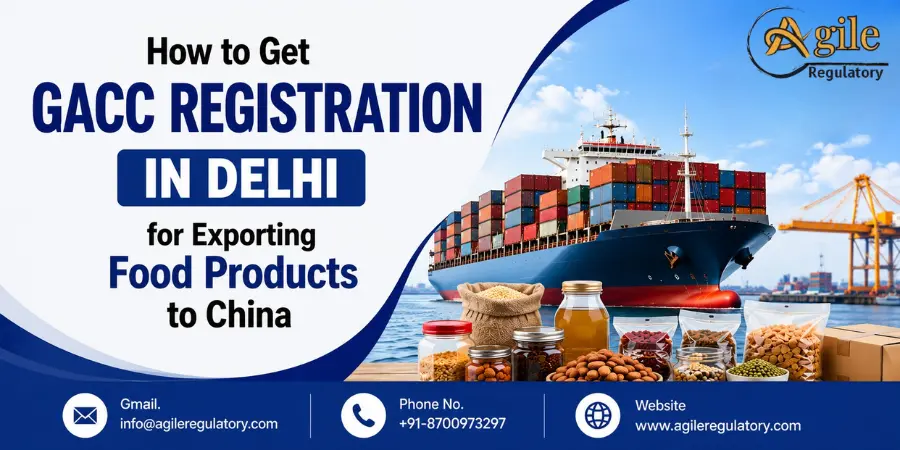
This guide breaks down the GACC registration process for food exporters in Delhi what it is, who needs it, what documents are required and how to complete it
GACC stands for the General Administration of Customs of China. Under GACC Decree 248 every overseas food manufacturing or processing facility that exports to China must register on a dedicated platform and receive a unique registration code. This code your GACC certificate must be printed on the inner and outer packaging of every product before it leaves India.
The registration is facility-specific, not company-specific. If your business has two production units and both export to China, both units must register separately.
GACC Approval Process in Rajasthan India 2026
|
Business Type |
Registration Needed? |
|
Food manufacturers exporting to China |
Yes mandatory under Decree 248 |
|
Food processors and packers |
Yes |
|
Cold storage facilities handling export goods |
Yes |
|
Traders who source from third-party factories |
The manufacturing facility must register, not just the trader |
|
Exporters of low-risk categories (tea, chocolates, packaged snacks) |
Yes but eligible for self-registration on CIFER |
This is where Indian exporters often get confused. There are two routes to a GACC China registration, and the one you take depends entirely on your product category.
If your product falls under one of the 18 high-risk food categories including dairy, meat, seafood, aquatic products, casings, bee products, eggs, and edible oils you cannot apply directly to GACC. Your facility must be recommended by India's competent authority. For most food exporters in Delhi, this means APEDA or FSSAI, depending on the product. You submit your application to the relevant Indian authority first. They verify your documents and facility then forward your case to GACC. GACC reviews it and issues the GACC certificate if everything is in order
For products outside the high-risk list spices, grains, tea, packaged snacks, processed foods, confectionery you can apply directly through the CIFER portal at cifer.singlewindow.cn. No government intermediary is required. This route is faster and works well for most Delhi-based food exporters in the processed foods segment.
Business registration certificate
IEC (Import Export Code)
FSSAI licence
GST certificate
Factory layout and floor plan
HACCP or ISO 22000 certificate
Product list with HS codes
Production flow chart
Hygiene SOPs
Lab test reports
Product labels and packaging samples
Chinese importer details
Signed commitment letter
Confirm your product category and which pathway applies
Ensure your facility holds valid FSSAI, IEC, HACCP/ISO 22000 certifications
For high-risk categories, submit your application to APEDA or FSSAI for recommendation to GACC
For low-risk categories, create a facility account on cifer.singlewindow.cn
Complete the online application form with all facility, product, and management system details
Upload all required documents in the formats specified by the portal
GACC reviews the application and may request additional information
On approval, your unique GACC registration code is issued
Print the registration code on all product packaging before exporting
Confirm your registration details annually on the CIFER portal to keep it active
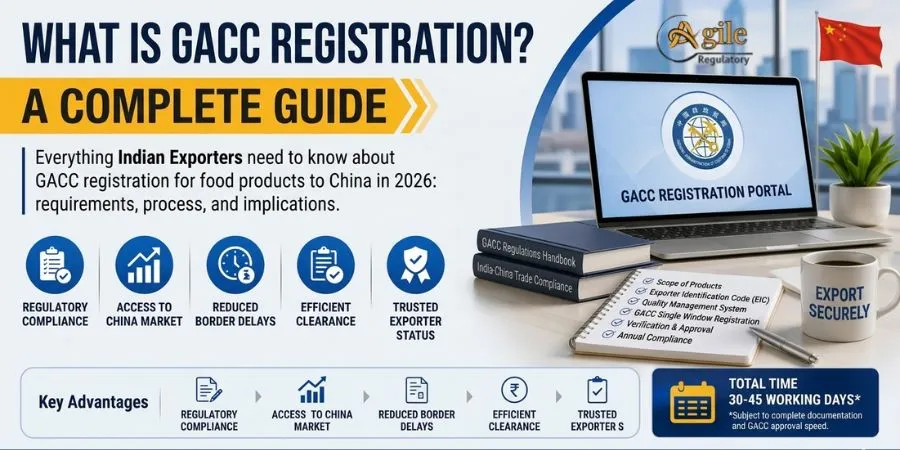
GACC registration fees from the Chinese government side are zero registration on the CIFER portal carries no official government charge. Costs you will actually pay are for compliance preparation, document translation into Chinese, HACCP or ISO 22000 certification (if not already held), and professional assistance if you use a consultant.
The GACC certificate is valid for five years. Annual confirmation of details on CIFER is mandatory missing this can result in cancellation. Renewal should be initiated three to six months before expiry.
|
Category |
Registration Pathway |
|
Dairy products |
Government recommendation (APEDA/FSSAI) |
|
Meat and poultry |
Government recommendation |
|
Seafood and aquatic products |
Government recommendation |
|
Edible oils and fats |
Government recommendation |
|
Spices and condiments |
Self-registration on CIFER |
|
Tea and coffee |
Self-registration on CIFER |
|
Processed and packaged foods |
Self-registration on CIFER |
|
Grains and cereals |
Self-registration on CIFER |
|
Confectionery and chocolates |
Self-registration on CIFER |
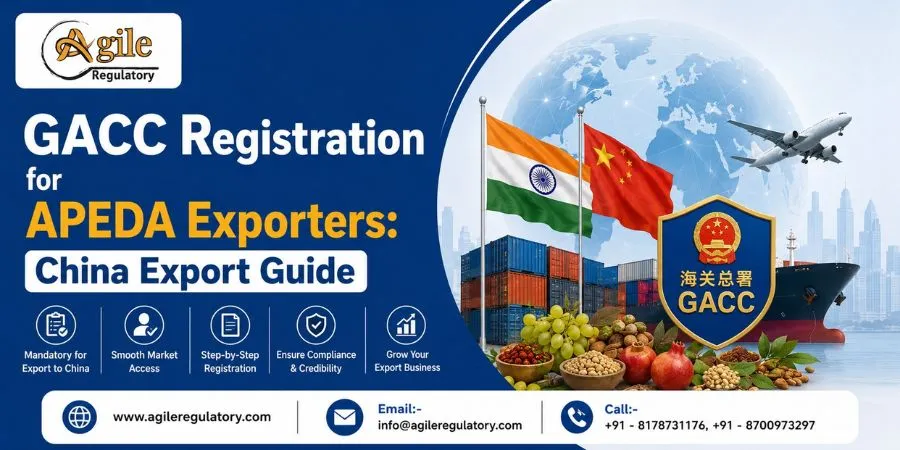
GACC registration in China is not optional. Every Indian food exporter shipping to China needs it the only variable is which pathway applies to your product. Getting your documents in order early, choosing the right registration route, and maintaining annual compliance on CIFER are what keep your exports running without interruption.
For Delhi-based food businesses that want the GACC registration process handled correctly from the start should contact experts. Agile Regulatory manages the full process from eligibility check to CIFER filing and follow-up with APEDA or FSSAI where required
GACC Registration Guide for Indian Exporters 2026
No. The GACC certificate under Decree 248 is a facility registration code for food manufacturers. A GACC certificate of origin is a separate trade document issued for certain product categories to certify where goods were produced. Both are different requirements.
The GACC food registration applies to the production facility, not the trading company. If you are a trader, your supplier's manufacturing unit must hold the registration. Products from unregistered facilities will not clear Chinese customs.
For self-registration on CIFER (low-risk categories) approval typically takes 20 to 45 working days after a complete application is submitted. Government-recommended applications for high-risk categories may take longer depending on APEDA or FSSAI review timelines


You might also be interested in these articles.
Divya Saxena
19 Aug 2026
A practical guide to GACC Registration for APEDA exporters, covering the registration process, required documents, applicable fees, and approval requirements for exporting food and agricultural products to China.
Nishi Chawla
15 Jun 2026
Get complete guidance on GACC Certification and Registration in Ghaziabad for 2026. Learn the registration process, eligibility, documents, and compliance requirements for exporting food products to China.
Nishi Chawla
11 Jun 2026
GACC Certification for Exporters in Noida is mandatory for food exporters to China. It ensures compliance with Chinese customs regulations, product safety, and smooth export approvals, helping businesses expand internationally in 2026 market growth sector
Nishi Chawla
25 Apr 2026
GACC Registration is a mandatory requirement for Indian exporters dealing with food products and certain related categories when exporting to China. Governed by the General Administration of Customs of China (GACC), this registration ensures that foreign
Nishi Chawla
08 Apr 2026
Agile Regulatory provides complete support for GACC registration in Gujarat. We assist with documentation, compliance, and smooth application filing. Get quick approval and expand your export business to China with ease.
Nishi Chawla
02 Apr 2026
GACC stands for the General Administration of Customs of the People's Republic of China. This is the authority that controls everything entering China from inspection to clearance.
We simplify compliance through a proven 4-step process: Consultation, Documentation, Submission, and certification. From understanding requirements to getting final approvals, we deliver a smooth, timely, and fully compliant journey for your business.


What our customer says about us

Lavkush Sharma
KTPL Instruments
Agile Regulatory handled my BIS Certification registration smoothly. Their expert team ensured quick approvals, transparent pricing, and a completely stress-free compliance experience.

Nitin Mukesh
Justrack IOT
We are grateful to Agile Regulatory for their excellent support. Their team showed patience, expertise, and professionalism throughout, providing clear guidance and making the entire process smooth and hassle-free.
Pradeep Varma
Coaire Compressor
Being an excellent BIS Certification Consultant provider, they help customers with all requirements such as BIS Certification, CDSCO services, Agile Regulatory support, legal issues, and lab testing with quick results.

Bharat Bachwani
Easy Polymer
With the help of Agile Regulatory, we have made significant progress in our business. Their service is fast, genuine, and reliable. We look forward to continued success together in the future.

Atul Jain
Tarus International
Many thanks to Agile Regulatory for all the support, guidance, and expert advice. Their professional approach and consistent assistance have made a significant difference.

Paramjeet Singh
Anchor Weighing
Top-tier consulting! offered strategic solutions that revolutionized our approach. Their deep expertise and personalized guidance made a significant impact on our success. Highly recommend their services.

Anshul Rathi
AM Capacitor
Agile Regulatory exceeded expectations! Their tailored solutions, expertise, and proactive approach led to remarkable results. Highly recommend for businesses seeking impactful and strategic guidance.

Shekhar Maurya
Imaxx Pro Aquistic
Outstanding service! delivered targeted solutions with professionalism and expertise. Their insights elevated our business strategies, resulting in noticeable growth. Highly recommended for exceptional consultation.
Trusted by over 1,00,000 + Global Brands in the past 15+ years


 China is one of the world's largest food import markets. Indian food businesses from spice manufacturers in Delhi to grain processors across NCR have real opportunities to supply Chinese buyers. But since January 2022 a GACC registration applies to every overseas food facility that wants to export to China
.webp)
(1).webp)


Leave a Reply
Your email address will not be published. Required fields are marked *