


Get Instant Solution By an Expert Advisor
(4.8)
Fast replies · No spam · Real experts
.webp)
Running a tea business in India whether you grow, process, or export comes with a long list of regulatory requirements. Among all of the, Tea Board registration tends to be the one that catches newcomers off guard. Some assume it is optional. Others file it at the last minute right before their first shipment. Both approaches create problems that are entirely avoidable
This article covers everything you need to know: what the registration actually is, who genuinely needs it, what it costs, how long it takes and more
The Tea Act of 1953 is still in charge of making, selling, and exporting tea all over the country. The board is in charge of regulating and promoting India's tea industry. It works under the Ministry of Commerce and Industry
The official way for growers, manufacturers, exporters, dealers and brokers to get recognized as legitimate players in India's tea market is to register with the Tea Board. This could be called a tea exporter license, a manufacturer registration or a dealer permit depending on what you do.
Get Your Tea Board License in India: Expert Registration Guide
Under the Tea Act 1953 exporting tea without a valid Tea Board license in India is a legal violation. The Tea (Marketing) Control Order 2003 makes it explicitly clear no entity can export tea unless it holds a current valid registration with the Tea Board
Tea export compliance in India is actively enforced. Shipments from unregistered exporters get flagged at customs, consignments can be held or confiscated and the financial consequences can be significant.
This is where most articles go vague. Let us be specific.
|
Benefit |
What It Means in Practice |
|
Legal export authorisation |
Without this, your tea does not leave India legally |
|
Access to government subsidy schemes |
Market Access Initiative (MAI), Transport and Marketing Assistance (TMA) |
|
Auction house access |
Participation in Kolkata, Guwahati, Coonoor, Siliguri, Coimbatore auctions |
|
Certificate of Origin |
Required by many importing countries; affects import duty rates under FTAs |
|
Brand and market credibility |
Registered exporters are trusted by international buyers |
|
Quality certification alignment |
Easier path to FSSAI, EIC, and organic certifications |
|
Trade data and intelligence |
Tea Board shares export trend reports with registered entities |
|
Grievance access |
Tea Board provides dispute resolution support for registered members |
Tea exporter license in India is required for anyone shipping tea abroad regardless of volume. Tea manufacturer registration in India applies to processing units manufacturing tea from green leaf above the threshold prescribed under the Act. Dealers buying and selling tea across state lines, brokers operating at auction centres and warehouse operators storing tea commercially also need to register.
Small tea growers defined under Tea Board rules as those with landholdings under 10.12 hectares have a dedicated registration track. Their requirements are simpler, but registration is still necessary for accessing formal market channels and government welfare programmes
Beyond the legal baseline, Tea Board registration helps your export business in ways that compound over time.
For starters, registration is the only route to obtaining a Certificate of Origin for tea a document that importing countries frequently require and that can determine your duty liability under bilateral or multilateral trade agreements.
Registered exporters also get access to Tea Board-organised buyer-seller meets and participation in international trade fairs under the Board's promotion programmes. These are not small perks.
Finally, how Tea Board registration helps in tea export business is perhaps most visible in financing. Banks and trade finance institutions typically ask for Tea Board registration as part of export credit documentation.
The document checklist varies slightly by category.
The standard requirements are:
PAN card of the business entity and authorised signatory
GST registration certificate
IEC (Import Export Code) from DGFT mandatory for exporters
Proof of business constitution (incorporation certificate, partnership deed, etc.)
Address proof for the registered office
Bank account details with a cancelled cheque
Photographs of the authorised signatory
Board resolution or authorisation letter for companies
Factory licence and state pollution clearance (for manufacturers)
Land records (for small tea grower applicants)
With a complete application, processing typically takes between 15 and 30 working days. Where field verification is required which is more common for manufacturer and grower registrations the timeline can stretch to 45 days
Realistically if there is back-and-forth over documents or information discrepancies, the timeline extends further. Filing with accurate complete documentation from day one is the fastest path to approval
The cost and benefits of Tea Board registration in India depend on your registration category.
Exporters: Government fees generally range from INR 1,000 to INR 5,000.
Manufacturers: Annual licence fees linked to installed production capacity
Dealers and brokers: Typically below INR 2,500 per annum.
Small tea growers: Minimal or waived under welfare scheme provisions
Yes and they should. Tea Board registration benefits for small tea growers are substantial. Beyond the legal recognition it provides, registered STGs can access the Tea Board's Replanting and Rejuvenation subsidy, quality improvement training and integration with formal supply chains.
Without registration small growers are often at the mercy of unorganised middlemen and have no recourse when prices or quality disputes arise. Tea Board registration changes that equation. It connects small growers to the formal tea economy and to the government support infrastructure that was designed in large part for exactly this group
The consequences are serious and immediate. Under the Tea Act, 1953, exporting tea without a valid Tea Board registration can result in.
Seizure of the shipment at the port of export
Financial penalties as prescribed under the Act
Prosecution of the responsible persons
Potential blacklisting from future Tea Board licensing
For very small-scale domestic traders operating within a single state, the requirement may not always apply. However anyone buying and selling tea across state lines, participating in auction centres, or operating as a broker in the formal trade channels needs to be registered under Tea Board
Manufacturers supplying to domestic bulk buyers are also typically required to hold a current registration. Many domestic players choose to register voluntarily primarily because Tea Board registration opens up the auction centre route and auction-sourced tea often comes at better prices and with documented provenance that retail and food service buyers increasingly demand
How to get Tea Board registration in India step by step, through the official portal.
Go to www.teaboard.gov.in and locate the registration section
Select the appropriate category exporter, manufacturer, dealer, grower
Create an account using your business PAN or official email
Fill in the application form completely and accurately
Upload all required documents in the prescribed format and size
Pay the applicable fee through the online payment gateway
Note your acknowledgement number for tracking
Respond to any queries from the Tea Board office within the stipulated time
Download your registration certificate once approved
The Tea Board is in charge of most of the rules about tea trade in India. The Board sets the quality standards for export shipments, works with the Export Inspection Council (EIC) and FSSAI to make sure that food is safe, and gives exporters Certificates of Origin that they need to get through customs at their destination ports.
Yes. A manufacturer registration and an exporter license are two separate, legally distinct registrations. Holding one does not automatically grant the other. Manufacturers who wish to export their produce directly must obtain a tea exporter license in India as a separate application.
Both applications can be filed simultaneously which is advisable for any manufacturer planning to export. Starting the export process without both registrations in place creates gaps in documentation that customs and trade finance institutions will catch
Tea Board registration is issued for a set amount of time, usually one to three years depending on the type. Before the expiration date, renewal must begin. If your registration has expired it is considered invalid. If you export or trade during that time you could face the same penalties as if you had never registered
Tea Board registration is what makes your tea business official in one of the world's most competitive commodity markets. Whether you are just entering the trade or looking to regularise an existing operation, the registration process is structured and manageable when approached correctly.
For businesses that want to move quickly and avoid documentation pitfalls, Agile Regulatory provides complete support for Tea Board registration in India from document preparation to application filing and follow-up. Reach out to their team to get started.
Tea Board Kolkata Registration Process, Documents, and Fees
No. These are entirely separate. Tea Board registration covers trade and export authorisation. FSSAI covers food safety compliance. Many businesses need both
Yes. Filing both simultaneously saves time and ensures no gap between production and export authorisation
Yes. A valid GSTIN is required across most Tea Board registration categories
Registered STGs can directly apply for Tea Board's replanting and quality improvement schemes which are open only to formally registered growers
Typically one to three years. The exact period depends on the category. Renewal should be filed at least 30 days before expiry.


You might also be interested in these articles.
Nishi Chawla
22 Jun 2026
Discover how Tea Board Registration in Delhi helps tea exporters access global markets, enhance credibility, and streamline export compliance for business growth.
Nishi Chawla
22 Jun 2026
Tea Board Registration in Noida helps tea businesses gain legal recognition, access export opportunities, build buyer trust, and expand into domestic and international markets with ease.
Nishi Chawla
18 Jun 2026
APEDA Registration in Noida plays a crucial role in helping exporters establish a credible and recognized presence in international markets.
Nishi Chawla
11 Jun 2026
GACC Certification for Exporters in Noida is mandatory for food exporters to China. It ensures compliance with Chinese customs regulations, product safety, and smooth export approvals, helping businesses expand internationally in 2026 market growth sector
Nishi Chawla
03 Jun 2026
GJEPC Certificate Registration in Noida helps jewellery exporters obtain RCMC certification, ensuring export compliance, industry recognition, government benefits, and seamless access to global jewellery markets.
Nishi Chawla
02 Jun 2026
An RCMC (Registration-Cum-Membership Certificate) is a crucial document for exporters in Delhi looking to expand their business in international markets. Issued by Export Promotion Councils or Commodity Boards, the certificate helps exporters access gover
Nishi Chawla
30 May 2026
RCMC Registration is an important requirement for exporters in Ghaziabad who want to access export benefits and government schemes. This guide explains the complete application process, eligibility criteria, required documents, and registration procedure
Nishi Chawla
26 May 2026
GACC Registration in Delhi is essential for businesses exporting food products to China. The registration helps food manufacturers and exporters comply with Chinese import regulations and ensures smooth international trade operations.
Nishi Chawla
19 May 2026
ICEGATE registration is an essential process for import-export businesses in India. It allows importers, exporters, customs brokers, and logistics companies to access online customs services through the Indian Customs Electronic Gateway (ICEGATE). With re
Nishi Chawla
19 May 2026
Discover the key benefits of GJEPC Membership for jewellery exporters, including export promotion support, international market access, trade fair participation, policy updates, and business growth opportunities.
Nishi Chawla
09 May 2026
APEDA Registration is essential for businesses involved in the export of agricultural and processed food products from India. This complete guide for 2026 explains the APEDA registration process, required documents, eligibility, benefits, and compliance r
Nishi Chawla
27 Apr 2026
Coffee Board registration provides coffee growers and exporters with legal recognition, quality certification, and access to government support. It enables businesses to participate in international trade, ensures compliance with export regulations, and e
Nishi Chawla
25 Apr 2026
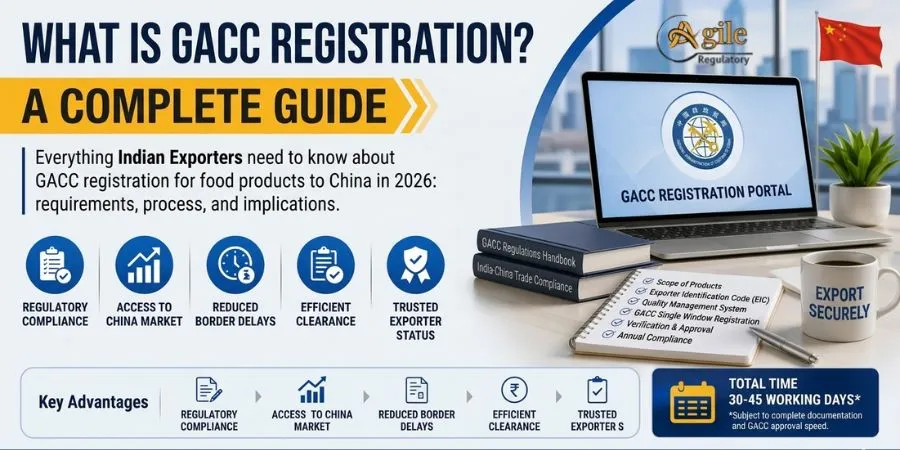
GACC Registration is a mandatory requirement for Indian exporters dealing with food products and certain related categories when exporting to China. Governed by the General Administration of Customs of China (GACC), this registration ensures that foreign
Nishi Chawla
25 Apr 2026
Spices Board India Registration is essential for exporters involved in spice exports from India. It ensures legal compliance, improves export credibility, and helps businesses access global trade opportunities smoothly.
Nishi Chawla
23 Apr 2026
CAPEXIL certification is an important requirement for Indian exporters dealing in chemical and allied products. It is issued by the CAPEXIL to promote exports and ensure compliance with trade regulations. This complete guide explains its benefits, eligibi
Nishi Chawla
23 Apr 2026
CHEMEXCIL Registration is essential for exporters dealing in chemicals, pharmaceuticals, cosmetics, and related products in India. Issued by the Basic Chemicals, Cosmetics & Dyes Export Promotion Council (CHEMEXCIL), this registration helps businesses
Nishi Chawla
07 Apr 2026
Agile Regulatory stands as a trusted export consultancy in Himachal Pradesh, delivering efficient solutions for documentation, approvals, and global trade success.
Nishi Chawla
13 Mar 2026
Import and export consultants help businesses manage international trade compliance smoothly. From IEC registration to DGFT documentation, expert guidance ensures hassle-free global trading. Discover reliable import and export consulting services in Del
Nishi Chawla
13 Mar 2026
Noida and Uttar Pradesh import-export consultants provide compliance support, market insights, customs clearance, and strategies for efficient international trade.
We simplify compliance through a proven 4-step process: Consultation, Documentation, Submission, and certification. From understanding requirements to getting final approvals, we deliver a smooth, timely, and fully compliant journey for your business.


What our customer says about us

Lavkush Sharma
KTPL Instruments
Agile Regulatory handled my BIS Certification registration smoothly. Their expert team ensured quick approvals, transparent pricing, and a completely stress-free compliance experience.

Nitin Mukesh
Justrack IOT
We are grateful to Agile Regulatory for their excellent support. Their team showed patience, expertise, and professionalism throughout, providing clear guidance and making the entire process smooth and hassle-free.
Pradeep Varma
Coaire Compressor
Being an excellent BIS Certification Consultant provider, they help customers with all requirements such as BIS Certification, CDSCO services, Agile Regulatory support, legal issues, and lab testing with quick results.

Bharat Bachwani
Easy Polymer
With the help of Agile Regulatory, we have made significant progress in our business. Their service is fast, genuine, and reliable. We look forward to continued success together in the future.

Atul Jain
Tarus International
Many thanks to Agile Regulatory for all the support, guidance, and expert advice. Their professional approach and consistent assistance have made a significant difference.

Paramjeet Singh
Anchor Weighing
Top-tier consulting! offered strategic solutions that revolutionized our approach. Their deep expertise and personalized guidance made a significant impact on our success. Highly recommend their services.

Anshul Rathi
AM Capacitor
Agile Regulatory exceeded expectations! Their tailored solutions, expertise, and proactive approach led to remarkable results. Highly recommend for businesses seeking impactful and strategic guidance.

Shekhar Maurya
Imaxx Pro Aquistic
Outstanding service! delivered targeted solutions with professionalism and expertise. Their insights elevated our business strategies, resulting in noticeable growth. Highly recommended for exceptional consultation.
Trusted by over 1,00,000 + Global Brands in the past 15+ years


.webp)

.webp)
.webp)
(1).webp)
.webp)
.png)

.webp)
.webp)


Leave a Reply
Your email address will not be published. Required fields are marked *