


Get Instant Solution By an Expert Advisor
(4.8)
Fast replies · No spam · Real experts
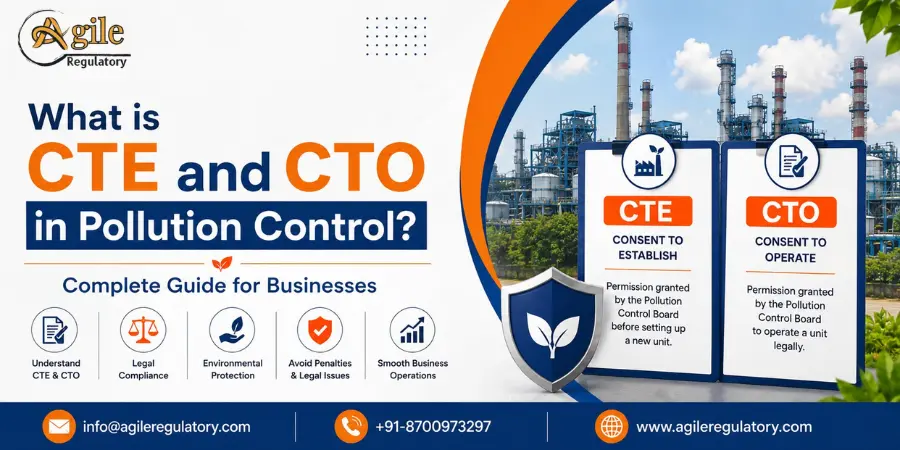
Before a single brick is laid at an industrial facility, Indian environmental law requires the business to obtain permission from its State Pollution Control Board. Before that facility starts production, it requires a second permit. These two approvals Consent to Establish and Consent to Operate, are what businesses across India collectively call CTE and CTO.
The confusion about CTE and CTO usually starts with the acronyms. Both get used casually. CTO and CTE full form questions are among the most searched compliance queries in the manufacturing sector, and the terms get conflated. They're not the same approval, they don't apply at the same stage, and the consequences of mixing them up can mean shutting down a facility that just completed construction.
The CTE full form in the Pollution Control Board is Consent to Establish. The permission granted by an SPCB before a business establishes its unit.
The full form of CTO in the environment is Consent to Operate. This is the permission that follows, granted after construction is complete and before commercial production starts. It verifies that what was actually built matches what was approved and that pollution control systems are operational
These are issued by State Pollution Control Boards (SPCBs), not by the Central Pollution Control Board (CPCB)
What is CTE and its importance for your business in 2026
The statutory requirement comes from two central laws. Section 25 of the Water (Prevention and Control of Pollution) Act prohibits any person from establishing any industry likely to discharge sewage or trade effluent without prior consent from the SPCB. Section 21 of the Air (Prevention and Control of Pollution) Act, 1981, makes a parallel requirement for industries that will emit air pollutants
The CTE/CTO Pollution Control Board framework is how these two statutory requirements are implemented at the state level. Every SPCB administers an Online Consent Management and Monitoring System (OCMMS) through which applications are submitted, tracked and decided
Before applying for either consent a business must identify which CPCB pollution category it falls under
Red category: High pollution potential cement plants, chemicals, large-scale manufacturing, and tanneries. Highest fees, mandatory site inspection, annual CTO renewal
Orange category: Moderate pollution, dairy processing, pharmaceuticals, paints manufacturing, and automobile workshops. Biennial CTO renewal
Green category: Low pollution potential small food processing, apparel, wooden furniture, paper products
White category: No significant pollution IT offices, small printing presses, handloom weaving, and solar power. Exempt from CTE and CTO, only an online intimation to the SPCB is required
Blue category (introduced by CPCB in 2025): Covers industries that are generally low polluting but require monitoring certain packaging units, cold storage, agro-processing
|
Parameter |
CTE Consent to Establish |
CTO Consent to Operate |
|
Full Form |
Consent to Establish |
Consent to Operate |
|
Stage of Application |
Before construction or installation begins |
After construction, before operations start |
|
What the Board Evaluates |
Proposed site, activity type, planned pollution control systems |
Installed systems, actual facility, operational readiness |
|
Inspection Required? |
Generally not required for new units; required for expansions |
Mandatory before CTO is granted |
|
Validity |
5 years (1 year free); 15 years for micro/small Green units |
Red: 1 year; Orange: 2 years; Green: 3 years |
|
Governing Statutes |
Water Act 1974 (S.25); Air Act 1981 (S.21) |
Water Act 1974 (S.26); Air Act 1981 (S.21) |
|
Who Issues It |
State Pollution Control Board (SPCB) |
State Pollution Control Board (SPCB) |
|
Can You Operate Without It? |
No construction without CTE violates the Water and Air Acts |
No production without CTO is a punishable offense. |
For a construction project generating dust, concrete washout, or effluent from on-site mixing operations, a Consent to Establish covers the construction phase itself. Its context refers to the pre-construction environmental gate for any project likely to impact air quality, water quality, or land through its operational activity. Hospitals, hotels, warehouses with hazardous storage, and food processing units all fall within the CTE/CTO Pollution Control Board framework depending on the nature and scale of their pollution generation.
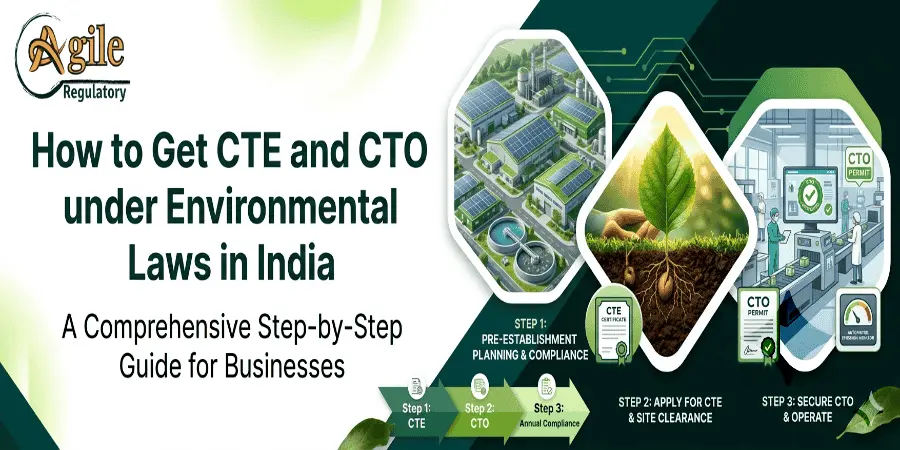
Step one is category identification. Look up CPCB's industry classification list and confirm your category before touching the OCMMS portal.
Registration on the OCMMS portal is next. Every state manages its own instance of the system. Maharashtra uses the MPCB portal, Uttar Pradesh uses UPOCMMS, and Delhi applicants use the DPCC's system at dpccocmms.nic.in. Create your facility account, enter business and activity details, and confirm which acts apply to your discharge types.
Filling and submitting the CTE application requires a completed application form, a site layout plan (drawn to scale, showing distances from boundaries and water bodies), a process flowchart, etc. For expansion applications, a compliance history and prior consent copies are also required.
Pay the consent fee online through the portal. Fees are calculated based on category and capital investment in plant and machinery, not on total project cost. As per CPCB directions, SPCBs cannot increase fees by more than 10% at a time and not more than once every two years.
After fee payment, submit. For new Green and Orange category units, CTE is typically granted without a site inspection. Red category and expansion applications involve an inspection report before the competent authority decides.
Once the CTE is granted and construction is complete, apply for CTO through the same portal. At this stage, upload evidence that pollution control systems are installed and operational lab test reports for effluent quality. A site inspection is conducted before CTO issues.
CTO is issued within 30 to 90 days for most categories once the inspection report is satisfactory. After receipt, download and store the CTO certificate; it must be displayed on the facility premises.
Red category CTOs require renewal annually.
Orange category renews every two years.
Green category, every three years.
The application goes through the same portal with updated compliance documents, recent emission and effluent test reports, waste management records, and proof of adherence to consent conditions.
How to Obtain CTE CTO Certificates from Pollution Control Board Lucknow?
CTE and CTO are environmental law requirements that apply before a business builds and before it operates. They're not interchangeable; they're not optional for non-White category industries, and they expire on schedules that require active calendar management. The CTE/CTO Pollution Control Board framework runs through state portals that differ in interface and processing timeline but the statutory obligations are nationally uniform
If you need guidance on applying for consent, identifying your pollution category, preparing documentation for CTE or CTO, or managing renewals across multiple facilities Agile Regulatory provides end-to-end support for businesses navigating State Pollution Control Board processes across India. Get in touch with us today!


You might also be interested in these articles.
Nishi Chawla
21 Apr 2026
Getting Consent to Establish (CTE) and Consent to Operate (CTO) under environmental laws in India is a mandatory step for industries before starting and running operations. Issued by the State Pollution Control Board, these approvals ensure that businesse
Nishi Chawla
03 Apr 2026
The Central Pollution Control Board regulates pollution standards, conducts research, and ensures industries comply with environmental protection rules across India.
Nishi Chawla
03 Apr 2026
The State Pollution Control Board (SPCB) is a regulatory authority responsible for monitoring, controlling, and preventing environmental pollution at the state level in India. It ensures industries comply with environmental laws, grants necessary clearanc
Nishi Chawla
02 Apr 2026
CTO (Consent to Operate) is legal approval for businesses, ensuring compliance, avoiding penalties, and enabling smooth operations in 2026.
Nishi Chawla
09 Mar 2026
Pollution NOC registration is required for businesses operating in Delhi NCR, including Noida and Gurugram, to ensure compliance with environmental regulations. The certificate is issued by the respective State Pollution Control Boards before starting ind
We simplify compliance through a proven 4-step process: Consultation, Documentation, Submission, and certification. From understanding requirements to getting final approvals, we deliver a smooth, timely, and fully compliant journey for your business.


What our customer says about us

Lavkush Sharma
KTPL Instruments
Agile Regulatory handled my BIS Certification registration smoothly. Their expert team ensured quick approvals, transparent pricing, and a completely stress-free compliance experience.

Nitin Mukesh
Justrack IOT
We are grateful to Agile Regulatory for their excellent support. Their team showed patience, expertise, and professionalism throughout, providing clear guidance and making the entire process smooth and hassle-free.
Pradeep Varma
Coaire Compressor
Being an excellent BIS Certification Consultant provider, they help customers with all requirements such as BIS Certification, CDSCO services, Agile Regulatory support, legal issues, and lab testing with quick results.

Bharat Bachwani
Easy Polymer
With the help of Agile Regulatory, we have made significant progress in our business. Their service is fast, genuine, and reliable. We look forward to continued success together in the future.

Atul Jain
Tarus International
Many thanks to Agile Regulatory for all the support, guidance, and expert advice. Their professional approach and consistent assistance have made a significant difference.

Paramjeet Singh
Anchor Weighing
Top-tier consulting! offered strategic solutions that revolutionized our approach. Their deep expertise and personalized guidance made a significant impact on our success. Highly recommend their services.
Anshul Rathi
AM Capacitor
Agile Regulatory exceeded expectations! Their tailored solutions, expertise, and proactive approach led to remarkable results. Highly recommend for businesses seeking impactful and strategic guidance.

Shekhar Maurya
Imaxx Pro Aquistic
Outstanding service! delivered targeted solutions with professionalism and expertise. Their insights elevated our business strategies, resulting in noticeable growth. Highly recommended for exceptional consultation.
Trusted by over 1,00,000 + Global Brands in the past 15+ years




.webp)



Leave a Reply
Your email address will not be published. Required fields are marked *