


Get Instant Solution By an Expert Advisor
(4.8)
Fast replies · No spam · Real experts
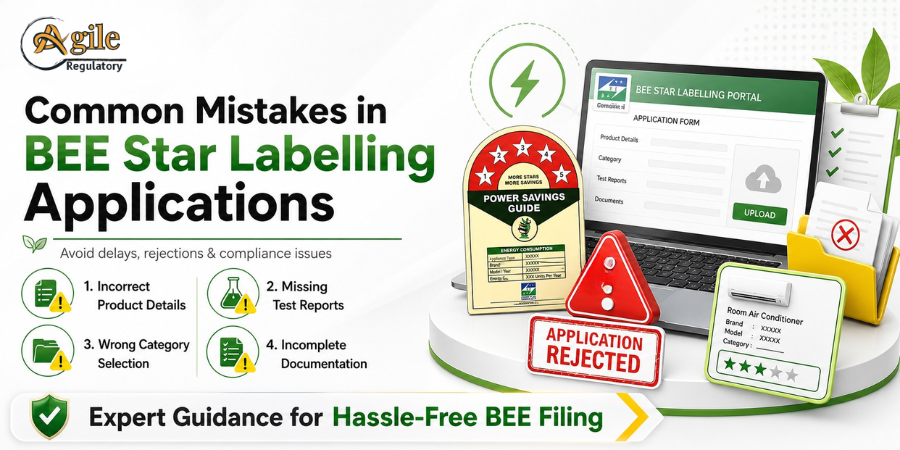
The BEE star label carries real commercial weight in India's appliance market. Consumers buying a BEE star rating refrigerator or comparing a BEE star rating for an air conditioner look at those stars as a government-backed efficiency guarantee. That trust is precisely why BEE enforces the Standards and Labelling programme strictly and why the Bureau's check testing and challenge testing mechanisms can turn an application shortcut into an operational crisis. This article explains where applications go wrong, why, and what you need to do differently.
The Bureau of Energy Efficiency operates under the Ministry of Power, established under the Energy Conservation Act, 2001. Its Standards and Labelling (S&L) programme running since 2006 rates electrical appliances from 1 to 5 stars based on energy performance. Five stars indicate the highest efficiency within a product category; one star is the lowest.
Around 29 product categories are currently covered, split between mandatory and voluntary labelling. For mandatory categories air conditioners, BEE star refrigerator and frost-free variants, LED lamps, washing machines, colour televisions including BEE star rating for led tv, ceiling fans, geysers, and others displaying a valid BEE star label before sale is a legal requirement under the Energy Conservation Act.
Testing at a NABL-accredited laboratory is mandatory for model registration, regardless of any international certifications the product already holds. CE marks, Energy Star ratings, and UL certifications may be submitted as supporting documents, but they do not substitute for India-specific testing against BIS standards.
BEE Registration for Ceiling Fans
These are some of the common mistakes found in BEE star applications
This is the most consequential error in the entire process. BEE's check testing regime where BEE or its designated agency pulls samples randomly from the market tests commercially sold units against the submitted test report. If your registered test report was generated from a pre-production prototype with slightly different components, the production unit fails the market check even if it performs at an equivalent level.
The regulation is explicit: testing must be conducted on actual production models. Not engineering samples. The model submitted for testing and the model that goes to market must be the same configuration.
Not every NABL-accredited laboratory is authorised for every product category under BEE's scheme. BEE maintains a list of empanelled laboratories for specific appliance types. An applicant who submits test reports from an NABL lab that isn't empanelled for their product category gets the application rejected, and the testing fees and time are non-recoverable.
Before sending samples anywhere, verify the laboratory's empanelment against BEE's published list for your specific product category. Confirm both the lab's NABL accreditation status and its BEE empanelment for your category before proceeding.
Selling a mandatory-category product without a BEE certificate is a punishable offence. Yet applications are regularly filed under the voluntary scheme by manufacturers who haven't checked whether their product category has since been moved to mandatory. BEE periodically notifies new products as mandatory as market penetration and energy-saving potential thresholds are met.
The inverse mistake also occurs: applying for mandatory registration when the product is actually voluntary, which introduces unnecessary complexity and cost.
The model number, technical specifications, and performance parameters declared in the portal registration must match exactly what the test report shows. This sounds obvious; it's apparently not, given how often BEE returns applications on this basis.
BEE validates test reports against portal declarations at the model registration stage. Mismatches trigger a clarification cycle which adds weeks to the timeline or outright rejection depending on the severity of the discrepancy.
BEE controls the BEE star label design with no flexibility. Colour palette, typography, icon placement, star dimensions, font sizes, the exact wording of "More stars, more savings" all of these are specified in BEE's label format guidelines.
Non-compliant labels discovered during BEE's check testing where samples are pulled from market shelves can result in directions to withdraw all stock carrying the incorrect label, financial penalties, and publication of the non-compliant product in print media.
BEE certificate validity ranges from one to three years depending on product category. When it lapses, the product can no longer be legally sold under the labelling scheme for mandatory categories, which means an immediate legal violation.
Renewal requires updated test reports if BEE's efficiency standards have been revised since the last certification, which they likely have been, given the one-to-two-year revision cycle. Assuming that renewal is a paperwork exercise rather than a technical compliance checkpoint leads to surprises at the renewal stage.
BEE Registration for Solid State Invertors in 2026
Once you have a BEE registration certificate and products in the market, compliance doesn't end. BEE's check testing programme involves random market sampling. BEE or its designated agency purchases products from retail channels and tests them in third-party NABL labs without warning.
If the tested product fails to meet the star rating declared on its label, BEE can direct the permittee to withdraw all units from market, levy financial penalties, and publish the product's name and model number in newspapers.
Challenge testing is triggered when a competitor or consumer files a written complaint against a label's accuracy. If the model hasn't undergone check testing in the past year, BEE conducts fresh testing. A product that passed registration testing but has since had component substitutions that affect energy performance is vulnerable here.
Companies incorporated outside India cannot register directly on the BEE portal at labeling.beeindia.gov.in. Foreign manufacturers must appoint an Indian authorized representative an Indian-registered entity who takes responsibility for the application, compliance, and label accuracy in India.
The bureau of energy efficiency registration process also requires an agreement on a ₹100 Non-Judicial Stamp Paper between BEE and the label user a document that foreign companies sometimes overlook entirely because it has no equivalent in most international certification processes.
BEE certificate application errors are expensive not because BEE's requirements are unreasonable but because applicants routinely underestimate how precisely those requirements are specified and enforced. Wrong lab, wrong model, wrong label format, each one is a delay at minimum and a market withdrawal at worst.
If you need support with your BEE online registration, model testing coordination, getting a BEE certificate for a new product line, or managing renewals before your current certification lapses, Agile Regulatory provides BEE consulting services for manufacturers and importers across all product categories. Our team handles the documentation, NABL lab coordination, portal filing, and label verification that keeps applications clean the first time.


You might also be interested in these articles.
Nishi Chawla
11 Mar 2026
BEE Registration for Variable Capacity Air Conditioners (Inverter ACs) is a certification process mandated by the Bureau of Energy Efficiency (BEE) in India to ensure that inverter ACs meet defined energy efficiency standards. The registration requires ma
Nishi Chawla
11 Mar 2026
BEE registration for LED Retrofit Lamps is mandatory for manufacturers and importers selling energy-efficient lighting products in India. The certification ensures compliance with Bureau of Energy Efficiency labeling and performance standards. Professio
Nishi Chawla
05 Mar 2026
BEE Registration for diesel generators is mandatory for manufacturers and importers to meet energy efficiency regulations in India. The certification issued by the Bureau of Energy Efficiency (BEE) ensures that generators follow approved performance and
Nishi Chawla
05 Mar 2026
BEE registration for solid-state inverters in 2026 ensures energy efficiency compliance, mandatory certification, and market approval for manufacturers in India.
Nishi Chawala
02 Mar 2026
The BEE Registration for Diesel Engine-Driven Monoset Pumps for Agricultural Purposes refers to the certification process mandated by the Bureau of Energy Efficiency (BEE) to ensure energy performance standards for diesel-operated monoset pumps used in ag
Nishi Chawla
02 Mar 2026
In 2026, ballast products in India are required to comply with energy efficiency standards set by the Bureau of Energy Efficiency (BEE).
Nishi Chawla
26 Feb 2026
Complete guide to BEE registration for laptops and notebooks in 2026, covering process, documentation, compliance requirements, and certification validity.
Nishi Chawla
26 Feb 2026
The Ecomark Rule Update 2024 introduces revised environmental criteria for product certification. Businesses must comply with updated standards to obtain Ecomark Registration in 2026. Expert assistance ensures smooth application and timely approval.
Nishi Chawla
25 Feb 2026
BEE Registration for Induction Motors in 2026 refers to the mandatory certification process set by the Bureau of Energy Efficiency (BEE) to ensure energy efficiency compliance in India.
Nishi Chawla
25 Feb 2026
BEE Registration for Agricultural Pump Sets is mandatory under the Bureau of Energy Efficiency energy efficiency norms. Ensure compliance with updated 2026 guidelines for seamless approval and labeling. Our experts handle end-to-end documentation, testi
We simplify compliance through a proven 4-step process: Consultation, Documentation, Submission, and certification. From understanding requirements to getting final approvals, we deliver a smooth, timely, and fully compliant journey for your business.


What our customer says about us
Lavkush Sharma
KTPL Instruments
Agile Regulatory handled my BIS Certification registration smoothly. Their expert team ensured quick approvals, transparent pricing, and a completely stress-free compliance experience.

Nitin Mukesh
Justrack IOT
We are grateful to Agile Regulatory for their excellent support. Their team showed patience, expertise, and professionalism throughout, providing clear guidance and making the entire process smooth and hassle-free.
Pradeep Varma
Coaire Compressor
Being an excellent BIS Certification Consultant provider, they help customers with all requirements such as BIS Certification, CDSCO services, Agile Regulatory support, legal issues, and lab testing with quick results.

Bharat Bachwani
Easy Polymer
With the help of Agile Regulatory, we have made significant progress in our business. Their service is fast, genuine, and reliable. We look forward to continued success together in the future.

Atul Jain
Tarus International
Many thanks to Agile Regulatory for all the support, guidance, and expert advice. Their professional approach and consistent assistance have made a significant difference.

Paramjeet Singh
Anchor Weighing
Top-tier consulting! offered strategic solutions that revolutionized our approach. Their deep expertise and personalized guidance made a significant impact on our success. Highly recommend their services.
Anshul Rathi
AM Capacitor
Agile Regulatory exceeded expectations! Their tailored solutions, expertise, and proactive approach led to remarkable results. Highly recommend for businesses seeking impactful and strategic guidance.
Shekhar Maurya
Imaxx Pro Aquistic
Outstanding service! delivered targeted solutions with professionalism and expertise. Their insights elevated our business strategies, resulting in noticeable growth. Highly recommended for exceptional consultation.
Trusted by over 1,00,000 + Global Brands in the past 15+ years








Leave a Reply
Your email address will not be published. Required fields are marked *