


Get Instant Solution By an Expert Advisor
(4.8)
Fast replies · No spam · Real experts

If you manufacture or import solid-state inverters in India, 2026 is not the year to ignore energy compliance.
Inverters are no longer seen as simple electronic accessories. They are performance devices. They influence efficiency, system losses, and power stability. Because of this, the Bureau of Energy Efficiency (BEE) has included solid-state inverters under its standards & labeling framework.
This does not automatically mean every inverter must carry a star label. But if you want to claim energy performance, participate in institutional tenders, or display a BEE star rating, registration is not optional. It must follow the official process defined by BEE.
BEE Registration for Induction Motor in 2026
Solid-state inverters are listed under the BEE standards & labeling program. As per the latest published schedule on the official BEE website, this category currently operates under a voluntary phase
Voluntary does not mean casual
It means:
The applicable schedule defines testing conditions, efficiency measurement points, and StarBand criteria. You cannot self-declare performance. It must be verified.
Always check the latest schedule notification on the official BEE portal before proceeding. Standards sometimes evolve.
You might ask whether registration is worth the effort.
From a compliance and market perspective, it usually is.
Many government buyers prefer star-labeled equipment. Large infrastructure projects look for energy performance documentation. Renewable sector clients ask for verified efficiency data.
Even when not compulsory, a registered model carries weight.
Also consider this. Voluntary categories sometimes move toward mandatory regulation over time. Preparing early reduces disruption later.
BEE does not inspect your factory in the same way BIS does. The core focus here is technical performance validation.
For solid-state inverters, testing generally covers the following:
The exact parameters are defined in the relevant schedule document.
Testing must be conducted in a BEE-recognized laboratory. Internal lab reports are not sufficient for registration.
This is where many applications slow down. Either the lab is not recognized or the report format does not align with BEE expectations.
Here is how it moves in practice.
Before registering any model, your company must be registered on the BEE Standards & Labelling portal.
You will need:
Details must match exactly across all submissions. Even minor inconsistencies create portal objections.
Select a laboratory recognized by BEE for inverter testing.
Provide the exact model that you plan to register. The model name in the test report must match your commercial naming.
Do not change technical specifications after testing. If specifications change, testing may need repetition.
The lab will measure efficiency values under prescribed conditions. Based on results, the product falls into a star band category.
Each inverter model requires a separate application.
You upload:
Accuracy matters here. Most delays happen due to mismatched data entries
BEE reviews the application. If clarification is needed, queries are raised through the portal.
You must respond carefully. Vague replies delay approval.
Once cleared BEE grants permission to use the assigned star rating label for that model
You may then print and affix the approved label on the following:
But you must follow the official label format. Size, design, and data fields are regulated.
Registration is not a one-time action
You must:
If technical parameters change you may need fresh testing
Always monitor official updates from BEE. Regulatory updates are published on the official website
Energy efficiency registration requires technical reading, document alignment and structured follow-up
Agile Regulatory assists by
Instead of navigating regulations through trial and error, you move through a guided path
If you deal in solid-state inverters in 2026, ignoring BEE registration limits your market reach. Even in a voluntary phase, energy labelling influences purchasing decisions and institutional eligibility
The process is technical but manageable. Prepare carefully. Test correctly. File accurately
If you want structured guidance from start to finish, Agile Regulatory can support your BEE registration process with clarity and regulatory discipline
When compliance is handled properly, your focus remains on manufacturing and growth.


You might also be interested in these articles.
Nishi Chawla
04 May 2026
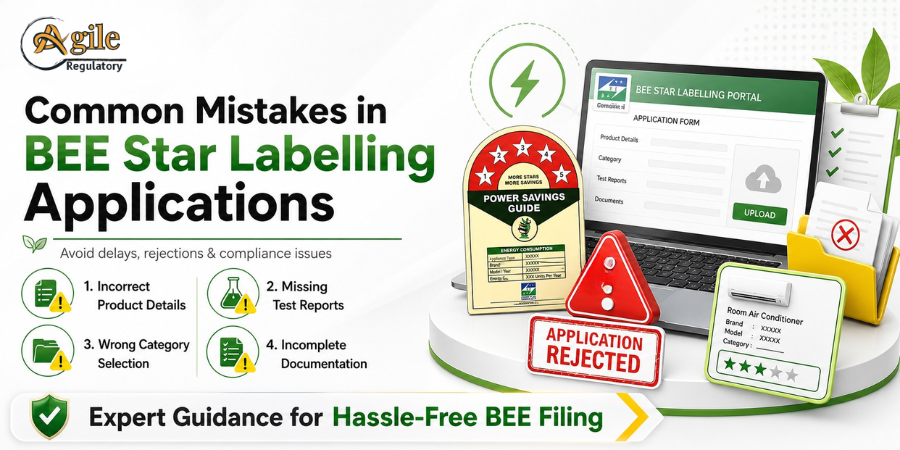
Many applicants face delays or rejections in BEE Star Labelling due to avoidable mistakes. Common errors include submitting incomplete or incorrect documentation, using outdated test reports, and selecting the wrong product category or model details.
Nishi Chawla
11 Mar 2026
BEE Registration for Variable Capacity Air Conditioners (Inverter ACs) is a certification process mandated by the Bureau of Energy Efficiency (BEE) in India to ensure that inverter ACs meet defined energy efficiency standards. The registration requires ma
Nishi Chawla
11 Mar 2026
BEE registration for LED Retrofit Lamps is mandatory for manufacturers and importers selling energy-efficient lighting products in India. The certification ensures compliance with Bureau of Energy Efficiency labeling and performance standards. Professio
Nishi Chawla
05 Mar 2026
BEE Registration for diesel generators is mandatory for manufacturers and importers to meet energy efficiency regulations in India. The certification issued by the Bureau of Energy Efficiency (BEE) ensures that generators follow approved performance and
Nishi Chawala
02 Mar 2026
The BEE Registration for Diesel Engine-Driven Monoset Pumps for Agricultural Purposes refers to the certification process mandated by the Bureau of Energy Efficiency (BEE) to ensure energy performance standards for diesel-operated monoset pumps used in ag
Nishi Chawla
02 Mar 2026
In 2026, ballast products in India are required to comply with energy efficiency standards set by the Bureau of Energy Efficiency (BEE).
Nishi Chawla
26 Feb 2026
Complete guide to BEE registration for laptops and notebooks in 2026, covering process, documentation, compliance requirements, and certification validity.
Nishi Chawla
26 Feb 2026
The Ecomark Rule Update 2024 introduces revised environmental criteria for product certification. Businesses must comply with updated standards to obtain Ecomark Registration in 2026. Expert assistance ensures smooth application and timely approval.
Nishi Chawla
25 Feb 2026
BEE Registration for Induction Motors in 2026 refers to the mandatory certification process set by the Bureau of Energy Efficiency (BEE) to ensure energy efficiency compliance in India.
Nishi Chawla
25 Feb 2026
BEE Registration for Agricultural Pump Sets is mandatory under the Bureau of Energy Efficiency energy efficiency norms. Ensure compliance with updated 2026 guidelines for seamless approval and labeling. Our experts handle end-to-end documentation, testi
We simplify compliance through a proven 4-step process: Consultation, Documentation, Submission, and certification. From understanding requirements to getting final approvals, we deliver a smooth, timely, and fully compliant journey for your business.


What our customer says about us
Lavkush Sharma
KTPL Instruments
Agile Regulatory handled my BIS Certification registration smoothly. Their expert team ensured quick approvals, transparent pricing, and a completely stress-free compliance experience.

Nitin Mukesh
Justrack IOT
We are grateful to Agile Regulatory for their excellent support. Their team showed patience, expertise, and professionalism throughout, providing clear guidance and making the entire process smooth and hassle-free.
Pradeep Varma
Coaire Compressor
Being an excellent BIS Certification Consultant provider, they help customers with all requirements such as BIS Certification, CDSCO services, Agile Regulatory support, legal issues, and lab testing with quick results.

Bharat Bachwani
Easy Polymer
With the help of Agile Regulatory, we have made significant progress in our business. Their service is fast, genuine, and reliable. We look forward to continued success together in the future.

Atul Jain
Tarus International
Many thanks to Agile Regulatory for all the support, guidance, and expert advice. Their professional approach and consistent assistance have made a significant difference.

Paramjeet Singh
Anchor Weighing
Top-tier consulting! offered strategic solutions that revolutionized our approach. Their deep expertise and personalized guidance made a significant impact on our success. Highly recommend their services.
Anshul Rathi
AM Capacitor
Agile Regulatory exceeded expectations! Their tailored solutions, expertise, and proactive approach led to remarkable results. Highly recommend for businesses seeking impactful and strategic guidance.
Shekhar Maurya
Imaxx Pro Aquistic
Outstanding service! delivered targeted solutions with professionalism and expertise. Their insights elevated our business strategies, resulting in noticeable growth. Highly recommended for exceptional consultation.
Trusted by over 1,00,000 + Global Brands in the past 15+ years







Leave a Reply
Your email address will not be published. Required fields are marked *