

To successfully export cooking oil from India in 2026 you must first register your business, secure an Import Export Code (IEC), obtain essential food safety licenses (FSSAI) and comply strictly with the specific health and labelling requirements of the destination country it is a process that needs careful planning.
Exporting any food item especially something sensitive like cooking oil needs careful planning. You cannot just pack the oil and ship it. India has a great history with edible oils. We produce many types, like groundnut oil, sesame oil and castor oil. These oils are used for cooking, but also in many health products. The market for edible oil exports is big. It offers great opportunities for you the business owner. However, international trade has strict rules. You must follow rules from the Indian government and rules from the country you are selling to.
Before you think about selling to a foreign buyer, you must make sure your business is legal in India. This first step is very important, it makes your business real.
You must register your company or firm officially. You need a valid Permanent Account Number (PAN) from the Income Tax Department. The PAN identifies your business for all financial dealings. You cannot move forward without this number, it is the first key.
The most crucial license for any exporter is the Import Export Code (IEC). The Directorate General of Foreign Trade (DGFT) issues this code. You must have this 10-digit number. Every single exporter in India needs it, you cannot ship goods out of India without it. The application process is mostly online now. You need to submit your PAN, your bank account details, and other basic business documents. The IEC is a lifelong registration. It needs no renewal, this is good news.
How to Export Edible Oil from India with IOPEPC Registration in 2025?
Looking oil is a food product. The government regulates food very strictly. The Food Safety and Standards Authority of India (FSSAI) is the main body in charge
You must obtain a valid FSSAI license for your manufacturing or processing unit. This license ensures your oil is made and stored safely. The license depends on your production capacity. If you are a large manufacturer, you need a Central FSSAI License. If you are smaller, a State License may be enough. You must follow the Food Safety and Standards Act, 2006, rules strictly. An FSSAI officer may inspect your premises, they check your hygiene. Your factory must be clean.
The FSSAI also sets rules for the quality of the oil itself. For instance, they define the exact permitted limits for things like acidity, moisture, and specific gravity for each type of oil. Your product must meet these Indian standards before you can export it. You need a Test Certificate from a certified lab proving this quality.
ou need to know who will buy your oil. You cannot sell to every country. You must select a target market.
Mustard Oil Export from India in 2025 with IOPEPC Registration
Your product packaging is the first thing the buyer sees. It must protect the oil. It must also give correct information, this is a very important part.
Cooking oil must be packed in material that does not react with the oil. The packaging must be airtight to stop the oil from going bad. For large shipments you use bulk containers or flexi-tanks. For smaller retail sales, you use glass bottles or plastic containers, but they must be very strong. The packaging must stand up to a long journey by sea or air.
The label must follow the rules of the importing country. For example if you sell to the EU or the US, the label must list all ingredients, the nutritional information and the net weight clearly.
The final stage is moving the oil. This needs good coordination.
Exporting cooking oil successfully in 2026 demands a strong focus on regulatory adherence and quality assurance. The market is ready for high-quality Indian oils. You must however prove you are a serious, compliant exporter.
Do you need help getting your FSSAI license fast? Do you need a partner to check your product labels against international rules? Contact Agile Regulatory today. We simplify the entire export compliance process for food products. We ensure your documentation is flawless. We help you send your cooking oil safely and successfully to any market in the world.


You might also be interested in these articles.
Divya Saxena
19 Aug 2026
A practical guide to GACC Registration for APEDA exporters, covering the registration process, required documents, applicable fees, and approval requirements for exporting food and agricultural products to China.
Nishi Chawla
31 Jul 2026
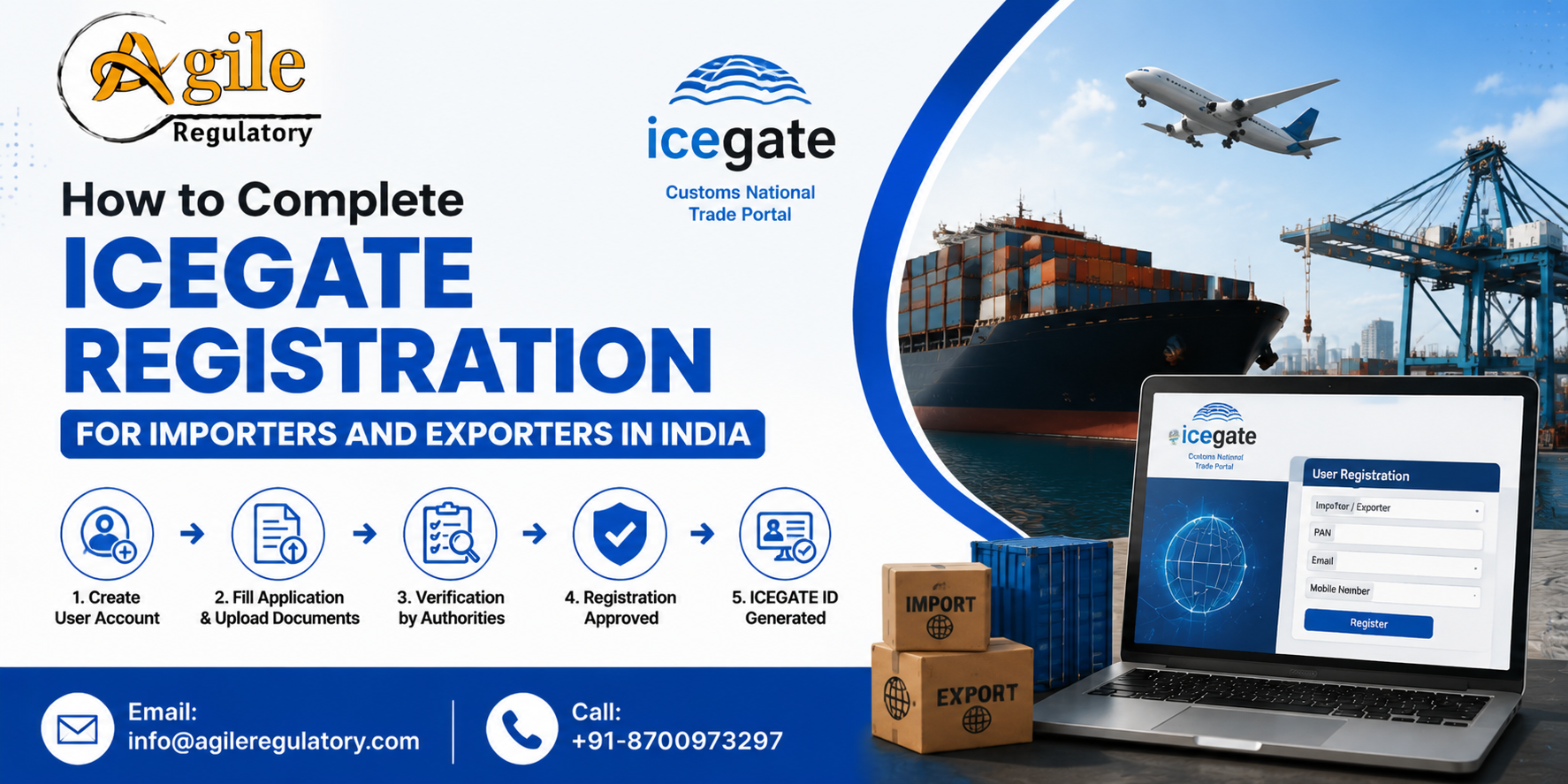
ICEGATE Registration is a mandatory process for importers and exporters in India to access online customs services provided by Indian Customs. This guide explains the complete ICEGATE registration process, eligibility, required documents, step-by-step reg
Nishi Chawla
22 Jun 2026
Discover how Tea Board Registration in Delhi helps tea exporters access global markets, enhance credibility, and streamline export compliance for business growth.
Nishi Chawla
22 Jun 2026
Tea Board Registration in Noida helps tea businesses gain legal recognition, access export opportunities, build buyer trust, and expand into domestic and international markets with ease.
Nishi Chawla
18 Jun 2026
APEDA Registration in Noida plays a crucial role in helping exporters establish a credible and recognized presence in international markets.
Nishi Chawla
11 Jun 2026
GACC Certification for Exporters in Noida is mandatory for food exporters to China. It ensures compliance with Chinese customs regulations, product safety, and smooth export approvals, helping businesses expand internationally in 2026 market growth sector
Nishi Chawla
03 Jun 2026
GJEPC Certificate Registration in Noida helps jewellery exporters obtain RCMC certification, ensuring export compliance, industry recognition, government benefits, and seamless access to global jewellery markets.
Nishi Chawla
30 May 2026
RCMC Registration is an important requirement for exporters in Ghaziabad who want to access export benefits and government schemes. This guide explains the complete application process, eligibility criteria, required documents, and registration procedure
Nishi Chawla
19 May 2026
ICEGATE registration is an essential process for import-export businesses in India. It allows importers, exporters, customs brokers, and logistics companies to access online customs services through the Indian Customs Electronic Gateway (ICEGATE). With re
Nishi Chawla
19 May 2026
Discover the key benefits of GJEPC Membership for jewellery exporters, including export promotion support, international market access, trade fair participation, policy updates, and business growth opportunities.
Nishi Chawla
09 May 2026
APEDA Registration is essential for businesses involved in the export of agricultural and processed food products from India. This complete guide for 2026 explains the APEDA registration process, required documents, eligibility, benefits, and compliance r
Nishi Chawla
29 Apr 2026
Tea Board Registration provides significant advantages to tea manufacturers and exporters in India, including official recognition, export support, and access to global markets. Registered businesses under the Tea Board of India gain credibility, regulato
Nishi Chawla
27 Apr 2026
Coffee Board registration provides coffee growers and exporters with legal recognition, quality certification, and access to government support. It enables businesses to participate in international trade, ensures compliance with export regulations, and e
Nishi Chawla
25 Apr 2026
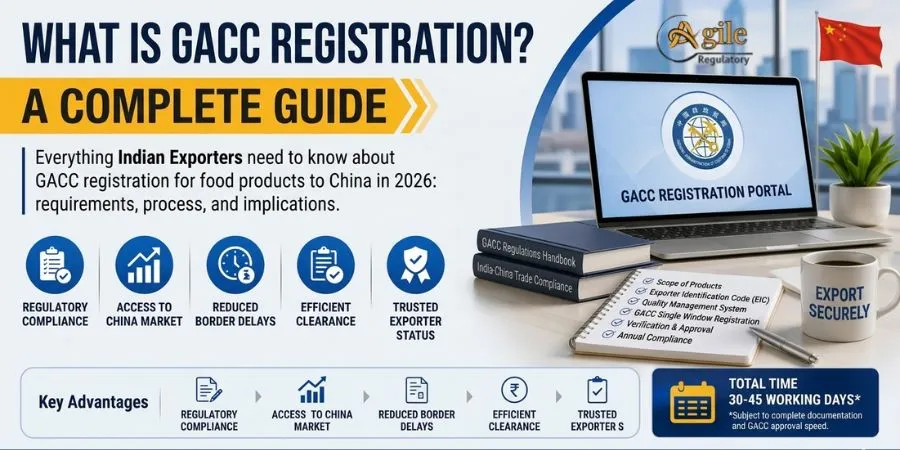
GACC Registration is a mandatory requirement for Indian exporters dealing with food products and certain related categories when exporting to China. Governed by the General Administration of Customs of China (GACC), this registration ensures that foreign
Nishi Chawla
25 Apr 2026
Spices Board India Registration is essential for exporters involved in spice exports from India. It ensures legal compliance, improves export credibility, and helps businesses access global trade opportunities smoothly.
Nishi Chawla
23 Apr 2026
CAPEXIL certification is an important requirement for Indian exporters dealing in chemical and allied products. It is issued by the CAPEXIL to promote exports and ensure compliance with trade regulations. This complete guide explains its benefits, eligibi
Nishi Chawla
23 Apr 2026
CHEMEXCIL Registration is essential for exporters dealing in chemicals, pharmaceuticals, cosmetics, and related products in India. Issued by the Basic Chemicals, Cosmetics & Dyes Export Promotion Council (CHEMEXCIL), this registration helps businesses
Nishi Chawla
07 Apr 2026
Agile Regulatory stands as a trusted export consultancy in Himachal Pradesh, delivering efficient solutions for documentation, approvals, and global trade success.
Nishi Chawla
13 Mar 2026
Import and export consultants help businesses manage international trade compliance smoothly. From IEC registration to DGFT documentation, expert guidance ensures hassle-free global trading. Discover reliable import and export consulting services in Del
Nishi Chawla
13 Mar 2026
Noida and Uttar Pradesh import-export consultants provide compliance support, market insights, customs clearance, and strategies for efficient international trade.
We simplify compliance through a proven 4-step process: Consultation, Documentation, Submission, and certification. From understanding requirements to getting final approvals, we deliver a smooth, timely, and fully compliant journey for your business.


What our customer says about us

Lavkush Sharma
KTPL Instruments
Agile Regulatory handled my BIS Certification registration smoothly. Their expert team ensured quick approvals, transparent pricing, and a completely stress-free compliance experience.

Nitin Mukesh
Justrack IOT
We are grateful to Agile Regulatory for their excellent support. Their team showed patience, expertise, and professionalism throughout, providing clear guidance and making the entire process smooth and hassle-free.
Pradeep Varma
Coaire Compressor
Being an excellent BIS Certification Consultant provider, they help customers with all requirements such as BIS Certification, CDSCO services, Agile Regulatory support, legal issues, and lab testing with quick results.

Bharat Bachwani
Easy Polymer
With the help of Agile Regulatory, we have made significant progress in our business. Their service is fast, genuine, and reliable. We look forward to continued success together in the future.

Atul Jain
Tarus International
Many thanks to Agile Regulatory for all the support, guidance, and expert advice. Their professional approach and consistent assistance have made a significant difference.

Paramjeet Singh
Anchor Weighing
Top-tier consulting! offered strategic solutions that revolutionized our approach. Their deep expertise and personalized guidance made a significant impact on our success. Highly recommend their services.

Anshul Rathi
AM Capacitor
Agile Regulatory exceeded expectations! Their tailored solutions, expertise, and proactive approach led to remarkable results. Highly recommend for businesses seeking impactful and strategic guidance.

Shekhar Maurya
Imaxx Pro Aquistic
Outstanding service! delivered targeted solutions with professionalism and expertise. Their insights elevated our business strategies, resulting in noticeable growth. Highly recommended for exceptional consultation.
Trusted by over 1,00,000 + Global Brands in the past 15+ years




.webp)
.webp)
(1).webp)
.webp)
.png)

.webp)
.webp)
.webp)


Leave a Reply
Your email address will not be published. Required fields are marked *