


Get Instant Solution By an Expert Advisor
(4.8)
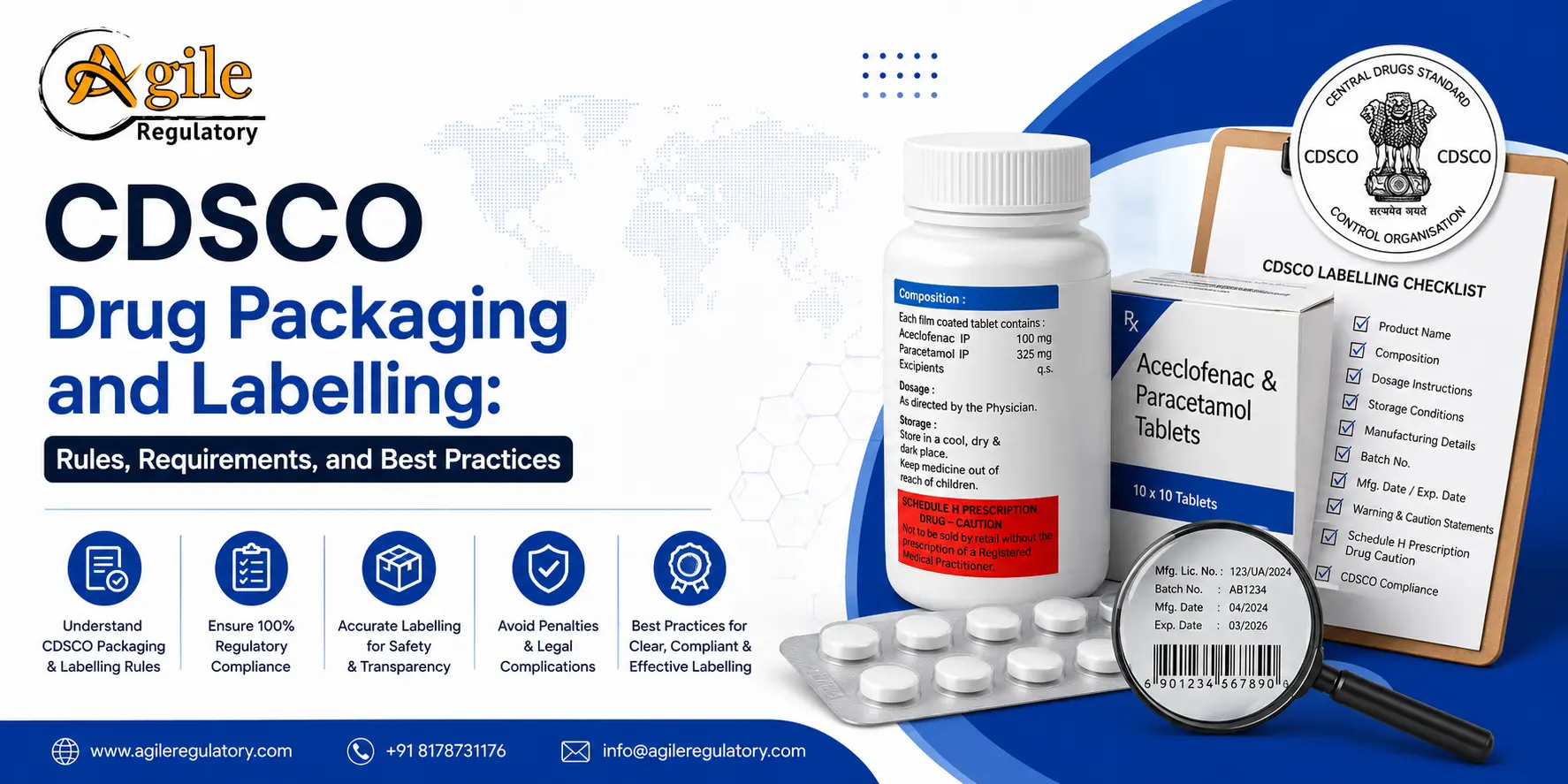

CDSCO enforces labelling and packaging rules through the Drugs and Cosmetics Act 1940 and the Drugs and Cosmetics Rules 1945. Every drug that needs a CDSCO Certificate goes through a label review. Every imported formulation that requires DCGI Approval gets its artwork checked. Errors at this stage don't just delay approvals they send applications back to square one.
Rules 96 and 97 of the Drugs and Cosmetics Rules, 1945 are what most regulatory consultants refer to when a client asks about label compliance. Rule 96 covers the innermost container. Rule 97 deals with the outer carton and the package insert. Together, they define what must appear, in what form, and in what proportion.
For anyone pursuing CDSCO Medical Device Registration or CDSCO Registration for Medical Devices, the Medical Devices Rules, 2017 apply instead with their own set of labelling demands. DCGI Approval, in both cases, is the final sign-off. No product moves to market without it.
One thing that catches importers off guard: changing an approved label after receiving the CDSCO Certificate is not a minor administrative step. It requires fresh DCGI Approval. Even a font change. Even shifting the batch number field. The artwork locked into the dossier is the artwork that goes on the shelf.
What is CDSCO Medical Device Import Certificate?
There is no discretion here. These are fixed requirements under CDSCO norms:
The drug name, both brand and INN, must appear together. The INN, or International Non-proprietary Name, cannot be printed smaller than the brand name. This gets flagged regularly during CDSCO registration review. It sounds simple. It still trips people up.
Active ingredients must be listed with their exact quantities per unit dose. Salt forms matter too. A tablet containing atorvastatin calcium equivalent to 10 mg atorvastatin needs to say exactly that the equivalent phrasing is not optional.
Manufacturer details go beyond a company name. The full address, manufacturing licence number, and for imported drugs, the country of origin and Indian importer's information all of it must be present. Partial information is treated the same as missing information.
Batch number, manufacturing date, and expiry date are traceable markers. If a product is recalled, these are what regulators use to identify affected stock. Expiry must be in month and year format. "Best before" language doesn't work here.
Storage conditions on the label must match what the stability study says. Not approximate it match it. If the dossier states "Store between 2°C and 8°C, protected from light," the label carries exactly that. Cold-chain products face additional scrutiny during CDSCO certification review for this reason.
Schedule classification is the one element that catches first-time applicants most often, especially those going through CDSCO registration in Noida and nearby manufacturing zones for the first time. Schedule H, H1, and X drugs each carry distinct mandatory markings. Prescription-only drugs carry the red strip and "Rx." Leaving this off is not a minor oversight it's a scheduling violation.
MRP must appear inclusive of all taxes, as required under the Legal Metrology (Packaged Commodities) Rules, 2011. This applies even when the product is moving through institutional channels.
The container is not separate from the compliance requirement. Primary packaging whatever makes direct contact with the drug must meet Indian Pharmacopoeia standards or an accepted international equivalent. Injectables go into Type II or Type III glass. Blister packs need approved foil and film specs. These material choices are documented in the dossier submitted for CDSCO Registration and cannot be swapped out after approval without going back to DCGI.
For CDSCO Registered Medical Device products, the packaging has to maintain the device's sterility or functional integrity through the entire stated shelf life. That means validated packaging processes not just using a vendor that seems reliable. The outer carton must be tamper-evident. It cannot carry claims that weren't approved as part of the original application.
Agile Regulatory assists manufacturers, importers and distributors with CDSCO Registration, CDSCO Certification, Medical Device Registration and DCGI Approval across PAN India.
The team reviews label artwork prior to dossier submission, flags issues which would otherwise come back as queries and coordinates directly with CDSCO offices throughout the process. That approach has built a track record with clients in the pharmaceutical, medical device and cosmetics sectors for more than 15 years.
Rules 96 and 97 of the Drugs and Cosmetics Rules, 1945. Rule 96 covers the innermost container, and Rule 97 covers the outer packaging and insert. CDSCO enforces both as part of the registration review.
Not without prior DCGI approval. Any change, including font, layout, or field placement, requires fresh approval before the updated label enters commercial use.
Yes. Material specifications, sterility maintenance, and IFU documentation are all part of the technical dossier reviewed during CDSCO medical device registration.
Depending on the severity, the consequences range from a show-cause notice to product recall or cancellation of the CDSCO Certificate. State Drug Controllers have independent powers to act on labelling non-compliance.
Post Views: 855



Nishi Chawla
25 Jun, 2026
Nishi Chawla
25 Jun, 2026
Nishi Chawla
22 Jun, 2026
.webp)
Nishi Chawla
22 Jun, 2026
(1).webp)
Get Instant Solution By an Expert Advisor
(4.8)
You might also be interested in these articles.
Nishi Chawla
11 May 2026
Looking for a reliable Drug License Consultant in Noida? Professional assistance can simplify the complex licensing process, ensure accurate documentation, and help businesses comply with all regulatory requirements. This blog explains why expert guidance
Nishi Chawla
07 May 2026
A Drug License in India is a mandatory authorization required for businesses involved in the sale, distribution, or manufacturing of pharmaceutical products. Whether you are starting a retail pharmacy, wholesale business, or drug manufacturing unit, obtai
Nishi Chawla
21 Apr 2026
Applying for a drug license online in India has become more streamlined with digital processes introduced by the government.
Nishi Chawla
17 Apr 2026
Obtaining a drug manufacturing licence in India involves a detailed approval process regulated by the Central Drugs Standard Control Organization. This guide explains the step-by-step procedure, including eligibility, documentation, inspection, and compli
Nishi Chawla
31 Mar 2026
Getting a drug license in Delhi requires strict compliance with legal regulations. Professional consultants simplify the application and approval process. Agile Regulatory provides expert guidance and end-to-end support. They handle documentation, fili
Nishi Chawla
31 Mar 2026
Obtain a drug license in Mumbai and Maharashtra by fulfilling eligibility, submitting documents, applying online, and complying with regulatory requirements.
Vanshika Mathur
25 Mar 2026
The CDSCO registration process in Ahmedabad (2026) is conducted entirely online through the SUGAM portal of the Central Drugs Standard Control Organization. Businesses must first create an account, submit applicant and company details, upload required doc
Divya Saxena
25 Mar 2026
CDSCO Forms MD 3, MD 5, MD 7, and MD 9 regulate import, manufacturing, loan licensing, and testing of medical devices.
Nishi Chawla
23 Mar 2026
Retail and wholesale drug license registration in Punjab requires application submission, document verification, regulatory approval, compliance with laws, and renewal.
Nishi Chawla
06 Mar 2026
In 2026, medical devices in India must be registered and licensed under the Medical Devices Rules, 2017 regulated by the Central Drugs Standard Control Organization (CDSCO).
Divya Saxena
02 Mar 2026
The 2026 update on CDSCO classification of medical devices clarifies risk-based categories, expands software and AI regulation, and strengthens compliance requirements.
Nishi Chawla
19 Feb 2026
Expert CDSCO license registration services in Delhi NCR, including Noida and Gurugram. Complete support for medical device and drug approvals, documentation, and regulatory compliance. Fast, reliable, and professional consultancy to simplify your CDSCO
Nishi Chawla
19 Feb 2026
Looking for the Best CDSCO License Registration Consultant in India? Get expert guidance for smooth and hassle-free approval from the Central Drugs Standard Control Organization. From documentation and application filing to compliance support, professiona
We simplify compliance through a proven 4-step process: Consultation, Documentation, Submission, and certification. From understanding requirements to getting final approvals, we deliver a smooth, timely, and fully compliant journey for your business.


What our customer says about us
Lavkush Sharma
KTPL Instruments
Agile Regulatory handled my BIS Certification registration smoothly. Their expert team ensured quick approvals, transparent pricing, and a completely stress-free compliance experience.
Nitin Mukesh
Justrack IOT
We are grateful to Agile Regulatory for their excellent support. Their team showed patience, expertise, and professionalism throughout, providing clear guidance and making the entire process smooth and hassle-free.
Pradeep Varma
Coaire Compressor
Being an excellent BIS Certification Consultant provider, they help customers with all requirements such as BIS Certification, CDSCO services, Agile Regulatory support, legal issues, and lab testing with quick results.
Bharat Bachwani
Easy Polymer
With the help of Agile Regulatory, we have made significant progress in our business. Their service is fast, genuine, and reliable. We look forward to continued success together in the future.
Atul Jain
Tarus International
Many thanks to Agile Regulatory for all the support, guidance, and expert advice. Their professional approach and consistent assistance have made a significant difference.
Paramjeet Singh
Anchor Weighing
Top-tier consulting! offered strategic solutions that revolutionized our approach. Their deep expertise and personalized guidance made a significant impact on our success. Highly recommend their services.
Anshul Rathi
AM Capacitor
Agile Regulatory exceeded expectations! Their tailored solutions, expertise, and proactive approach led to remarkable results. Highly recommend for businesses seeking impactful and strategic guidance.
Shekhar Maurya
Imaxx Pro Aquistic
Outstanding service! delivered targeted solutions with professionalism and expertise. Their insights elevated our business strategies, resulting in noticeable growth. Highly recommended for exceptional consultation.
Trusted by over 1,00,000 + Global Brands in the past 15+ years


 Pinterest
(2).webp)




Leave a Reply
Your email address will not be published. Required fields are marked *