


Get Instant Solution By an Expert Advisor
(4.8)
Fast replies · No spam · Real experts
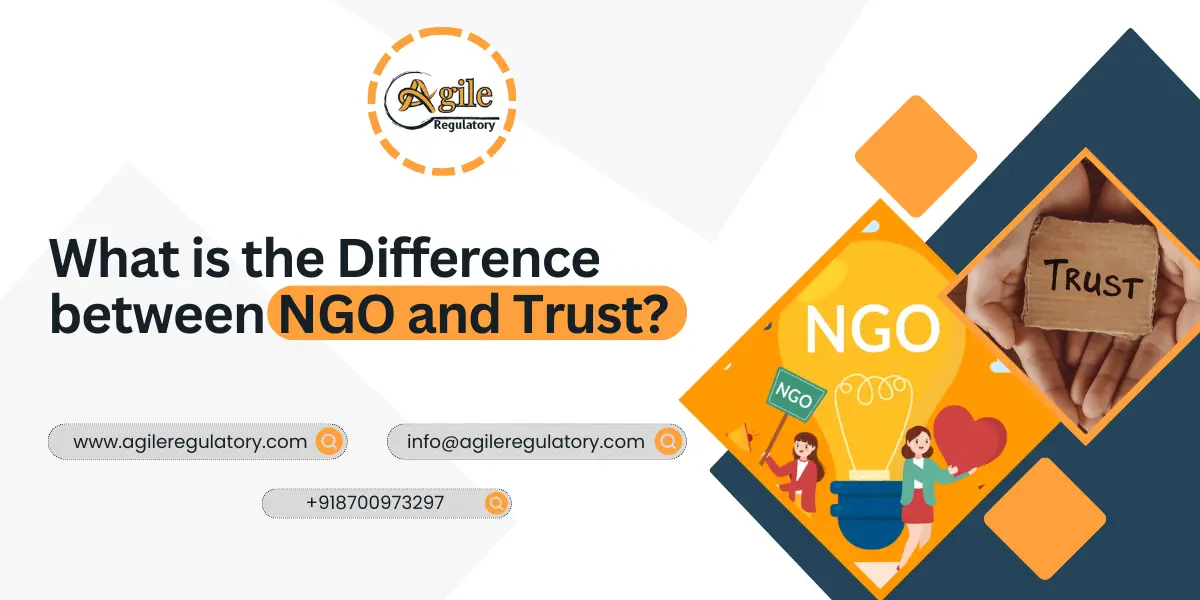
In today’s world, social work and charity play a crucial role in improving lives and supporting communities. When people want to contribute to society, they often consider forming an NGO or a Trust. Both are non-profit organizations aimed at social welfare, but many people confuse the two. Understanding their differences is important for anyone planning to engage in social work or start a charitable organization.
An NGO (Non-Governmental Organization) is a non-profit organization that works independently of the government to address social, educational, environmental, or humanitarian issues. NGOs can operate locally, nationally, or internationally. They often work in areas such as education, healthcare, human rights, poverty alleviation, environmental protection, and disaster relief.
NGOs are not a specific legal form; they can be registered as a trust, society, or non-profit company under Section 8 of the Companies Act. What distinguishes NGOs is their mission-driven approach—they aim to create social impact rather than earn profit. Examples of NGOs include organizations working on women’s empowerment, child education, or climate change advocacy.
A Trust is a legal entity formed to manage property or funds for charitable, religious, or social purposes. It is created under the Trust Act or relevant state laws. In a trust, the trustees manage the assets and ensure they are used for the benefit of beneficiaries.
Trusts are usually simpler in structure and are commonly used for local or family-run charitable activities. They focus on welfare activities such as funding education for underprivileged children, running hospitals, or providing aid to the needy. Unlike NGOs, trusts operate based on a trust deed, which clearly defines their objectives and governance rules.
NGO Darpan Registration in Uttar Pradesh
| Basis | NGO | Trust |
|---|---|---|
| Meaning | NGO (Non-Governmental Organization) is a broad term for non-profit organizations working for social welfare. | A Trust is a legal entity created to manage property or funds for charitable or specific purposes. |
| Legal Status | NGO is not a specific legal form; it can be registered as a trust, society, or Section 8 company. | Trust is a specific legal structure governed by trust laws. |
| Registration Law | Registered under Society Registration Act, Trust Act, or Companies Act (Section 8). | Registered under the Indian Trusts Act or relevant State Trust Act. |
| Governing Body | Managed by a governing council or board of directors. | Managed by trustees. |
| Area of Work | Works in education, health, environment, human rights, rural development, etc. | Mainly focuses on charitable, religious, or welfare activities. |
| Flexibility | More flexible in operations and expansion. | Comparatively less flexible once the trust deed is finalized. |
| Ownership | No individual ownership; operates for public benefit. | Property is held by trustees on behalf of beneficiaries. |
| Profit Distribution | Profits are reinvested for objectives; no distribution allowed. | Income is used only for trust purposes. |
| Public Perception | Often larger in scope and visibility. | Usually smaller and more localized. |
Both NGOs and trusts aim to serve the public good, but their focus differs. NGOs operate across diverse sectors like education, healthcare, and environment, running projects or long-term initiatives. Trusts usually have a specific purpose, such as funding scholarships or supporting a particular community.
How to Start a Trust in India in 2025?
NGOs and Trusts both work for social causes but differ in structure and governance—Trusts are simpler and run by trustees, while NGOs have formal frameworks and stricter compliance. Agile Regulatory makes it easy to set up and manage either, handling registration and compliance so you can focus on your mission.


You might also be interested in these articles.
Vanshika Mathur
18 Mar 2026
Starting an NGO in India in 2026 costs between ₹10,000 and ₹50,000. The cost depends on whether you choose a Trust, Society, or Section 8 Company. Additional expenses include legal fees, documentation, and basic setup.
Vanshika Mathur
24 Feb 2026
Checking NGO registration in India is simple through official government portals. You can verify Trust, Society, or Section 8 Company registration status online. Follow the correct state or central authority website for accurate verification.
Divya Saxena
23 Feb 2026
Apply for DARPAN registration in India in 2026 by registering your NGO on the NGO DARPAN portal and submitting required documents.
We simplify compliance through a proven 4-step process: Consultation, Documentation, Submission, and certification. From understanding requirements to getting final approvals, we deliver a smooth, timely, and fully compliant journey for your business.


What our customer says about us
Lavkush Sharma
KTPL Instruments
Agile Regulatory handled my BIS Certification registration smoothly. Their expert team ensured quick approvals, transparent pricing, and a completely stress-free compliance experience.
Nitin Mukesh
Justrack IOT
We are grateful to Agile Regulatory for their excellent support. Their team showed patience, expertise, and professionalism throughout, providing clear guidance and making the entire process smooth and hassle-free.
Pradeep Varma
Coaire Compressor
Being an excellent BIS Certification Consultant provider, they help customers with all requirements such as BIS Certification, CDSCO services, Agile Regulatory support, legal issues, and lab testing with quick results.

Bharat Bachwani
Easy Polymer
With the help of Agile Regulatory, we have made significant progress in our business. Their service is fast, genuine, and reliable. We look forward to continued success together in the future.
Atul Jain
Tarus International
Many thanks to Agile Regulatory for all the support, guidance, and expert advice. Their professional approach and consistent assistance have made a significant difference.

Paramjeet Singh
Anchor Weighing
Top-tier consulting! offered strategic solutions that revolutionized our approach. Their deep expertise and personalized guidance made a significant impact on our success. Highly recommend their services.
Anshul Rathi
AM Capacitor
Agile Regulatory exceeded expectations! Their tailored solutions, expertise, and proactive approach led to remarkable results. Highly recommend for businesses seeking impactful and strategic guidance.

Shekhar Maurya
Imaxx Pro Aquistic
Outstanding service! delivered targeted solutions with professionalism and expertise. Their insights elevated our business strategies, resulting in noticeable growth. Highly recommended for exceptional consultation.
Trusted by over 1,00,000 + Global Brands in the past 15+ years






Leave a Reply
Your email address will not be published. Required fields are marked *