


Get Instant Solution By an Expert Advisor
(4.8)
Fast replies · No spam · Real experts
.webp)
Disposable medical devices are widely used in hospitals, clinics, diagnostic centres and healthcare facilities because they help reduce the risk of cross-contamination and support safe medical procedures. Products such as disposable syringes, needles, catheters, surgical gloves, blood collection sets, masks and other single-use devices may come under India's medical device regulatory framework depending on their intended use and classification.
For manufacturers and importers, understanding the regulatory requirements before placing a product in the Indian market is important. The Central Drugs Standard Control Organization (CDSCO), under the Ministry of Health and Family Welfare, regulates medical devices under the Medical Devices Rules, 2017. CDSCO classifies medical devices into four risk categories: Class A, Class B, Class C and Class D.
This guide explains the regulatory pathway, documents, application process, applicable licences and the role of an authorised representative for disposable medical devices in India.
CDSCO registration is the regulatory process through which eligible manufacturers and importers obtain the required approval, licence or registration for medical devices intended for the Indian market.
The exact requirement depends on the device's risk classification, whether it is manufactured in India or imported, and whether any specific exemption applies.
It is important to understand that the term "registration" is often used broadly. For many regulated medical devices, the actual regulatory approval may be an import licence or manufacturing licence rather than a simple registration certificate.
CDSCO's current regulatory pathway provides separate routes for commercial manufacturing and import. For example, applications for an import licence are submitted in Form MD-14 and the resulting import licence is issued in Form MD-15.
A disposable product is not automatically regulated simply because it is intended for single use. Its regulatory status depends on its intended purpose and whether it falls within the definition and notified scope of a medical device.
Common examples can include:
Before applying, the manufacturer or importer should identify the correct product category, intended use and applicable classification.
What is CDSCO Medical Device Import Certificate?
Medical devices in India are classified according to the level of risk associated with them:
The classification directly affects the regulatory pathway and licensing authority. CDSCO states that Class A devices are low-risk, while Class D devices represent the highest-risk category.
There is also an important exemption for Class A non-sterile and non-measuring medical devices. These devices are exempted from the licensing regime subject to the applicable registration and compliance requirements under the Medical Devices Rules.
Therefore, classification should be completed before deciding which application to file.
The regulatory requirements vary according to the product and application type. In general, an applicant should be prepared with technical, manufacturing, quality and legal information.
The application may require information such as:
CDSCO's medical-device framework specifically refers to technical, legal and regulatory documents, including the Device Master File and Plant/Site Master File.
The exact document checklist depends on the product, classification and application.
For an imported disposable medical device, documents can generally include:
For Class A non-sterile and non-measuring imported devices, the Medical Devices Rules prescribe specific information and self-certification requirements, including device details, compliance with essential principles and applicable standards.
The application process is carried out through the applicable online medical-device regulatory portal.
A typical process involves the following steps:
Determine whether the product qualifies as a medical device and establish its intended use.
Classify the device as Class A, B, C or D according to the applicable classification rules.
The applicant must determine whether the product requires registration, an import licence or a manufacturing licence.
Compile product, manufacturing, testing, quality, safety and performance documents.
For an overseas manufacturer, the appropriate Indian authorised representative/importer arrangement must be established.
Submit the applicable application through the prescribed online system with the required documents and government fee.
The application and supporting documents are reviewed by the competent licensing authority. Additional information or clarification may be requested if deficiencies are identified.
Once the application meets the applicable requirements, the relevant registration, permission or licence is issued.
CDSCO's published pathway identifies different forms for manufacturing and importing medical devices and confirms that applications are submitted through the designated online medical-device systems.
Importance of CDSCO Online Registration
Foreign manufacturers generally need an Indian regulatory representative for their medical-device activities in India. The authorised representative acts as the regulatory link between the overseas manufacturer and the Indian authorities.
A CDSCO agent may assist with:
Choosing an experienced representative is particularly important when the overseas manufacturer is unfamiliar with India's Medical Devices Rules.
The compliance route can differ significantly depending on the risk class.
For manufacturing, CDSCO's regulatory pathway identifies MD-3/MD-5 and MD-4/MD-6 routes for certain Class A and B manufacturing applications, while MD-7/MD-9 and MD-8/MD-10 routes apply to Class C and D manufacturing through the relevant licensing authorities.
For imports, Form MD-14 is used for the application and Form MD-15 is the import licence issued by the Central Licensing Authority.
This is why applicants should not select a form simply based on the product name. Classification and regulatory pathway should be established first.
For regulated medical devices imported for marketing in India, the applicable CDSCO import requirements generally need to be fulfilled.
CDSCO's FAQ states that an import licence is required for importing medical devices for marketing in India. It also specifically notes the different treatment applicable to Class A non-sterile and non-measuring medical devices, for which registration requirements apply instead of the standard licensing regime.
Therefore, importers should verify the classification and current regulatory requirement before commercialising the product.
An overseas manufacturer or its authorised Indian representative may need to obtain the applicable import licence before bringing regulated medical devices into India for commercial sale.
The import application is submitted in Form MD-14, and the corresponding licence is issued in Form MD-15 by the Central Licensing Authority.
The application may require comprehensive information about the device, manufacturing facility, quality system, product safety and performance, along with prescribed supporting documents.
Indian manufacturers also need to follow the appropriate licensing route before manufacturing regulated medical devices for sale or distribution.
The applicable form depends on the device classification and whether the application is being handled by the State Licensing Authority or Central Licensing Authority.
For example, CDSCO's regulatory pathway identifies MD-7 and MD-8 applications leading to MD-9 and MD-10 manufacturing licences for Class C and D devices.
A manufacturing facility must also demonstrate compliance with the applicable quality and technical requirements under the Medical Devices Rules.
The government fee depends on the type of application, device classification and number or category of devices covered. The Medical Devices Rules prescribe applicable fees under the Second Schedule.
Therefore, there is no single fixed CDSCO registration fees amount that applies to every disposable medical device.
The total professional cost may also include expenses related to:
Applicants should calculate the applicable government fee only after determining the correct regulatory route.
Businesses commonly search for terms such as CDSCO certificate, CDSCO certification and CDSCO registration certificate. However, the actual regulatory document depends on the nature of the approval.
For example, an imported medical device may receive an import licence in Form MD-15, while an Indian manufacturer may receive the appropriate manufacturing licence.
So, businesses should avoid assuming that every medical device receives a document officially titled a "CDSCO certificate."
Medical-device applications involve technical documents, classification, regulatory forms and product-specific compliance requirements. An experienced CDSCO consultant can help businesses understand the correct pathway before submission.
A professional consultant can support:
For foreign manufacturers, a consultant can also coordinate with the Indian authorised representative and help maintain communication during the application process.
Applicants can face delays when the submitted information is incomplete or inconsistent. Common problems include:
Preparing the dossier carefully before submission can reduce avoidable deficiencies.
Agile Regulatory provides regulatory compliance support for businesses seeking medical-device approvals in India. Our team can assist manufacturers, importers and overseas companies with product classification, documentation, application preparation and regulatory coordination.
Whether you need support for CDSCO medical device registration, an import application or a manufacturing approval, the regulatory route should be selected according to the device classification and applicable requirements.
Agile Regulatory can also assist businesses looking for CDSCO registration consultants, documentation support and regulatory guidance throughout the application process.
Disposable medical devices play an important role in healthcare, but their commercialisation in India requires appropriate regulatory compliance. The first step is to understand whether the product qualifies as a medical device and determine its risk classification.
Depending on the product and applicant, the applicable route may involve registration, import licensing or manufacturing licensing. CDSCO's Medical Devices Rules, 2017 provide the regulatory framework, while CDSCO's published guidance explains the relevant forms, documents and pathways.
Businesses should prepare the technical dossier carefully, select the correct regulatory route and ensure that all information submitted to the authority is accurate and consistent. With support from Agile Regulatory, manufacturers and importers can manage the compliance process more efficiently and work toward obtaining the appropriate approval for their disposable medical devices.
No. The requirement depends on whether the product falls within the regulated medical-device framework, its classification and whether a specific exemption applies. Class A non-sterile and non-measuring devices have specific registration provisions.
Form MD-14 is used to apply for an import licence, while Form MD-15 is the corresponding import licence.
An import licence permits the eligible applicant to import regulated medical devices into India, while a manufacturing licence relates to manufacturing medical devices for sale or distribution in India.
Foreign manufacturers involved in regulated medical-device activities in India need to follow the applicable authorised representative and importer requirements under the regulatory framework.
A professional consultant can assist with classification, document preparation, application filing, regulatory queries and coordination throughout the approval process. The exact support required depends on the device and its regulatory route.


You might also be interested in these articles.
Sonal Sharma
29 Sep 2026
A CDSCO Test License is required for eligible medical devices manufactured or imported for testing, evaluation, clinical investigation, demonstration, or training. This guide explains MD-12, MD-13, MD-16 and MD-17, documents, application process, fees, an
Sonal Sharma
28 Sep 2026
CDSCO registration is important for businesses manufacturing or importing orthopaedic implantable devices in India. The process involves device classification, documentation, technical requirements, application submission, and regulatory review. Understan
Divya Saxena
27 Aug 2026
CDSCO Registration for IVD Devices in India ensures regulatory compliance for in-vitro diagnostic products. Get expert assistance with documentation, application filing, approval, and complete CDSCO registration requirements.
Nishi Chawla
29 Jun 2026
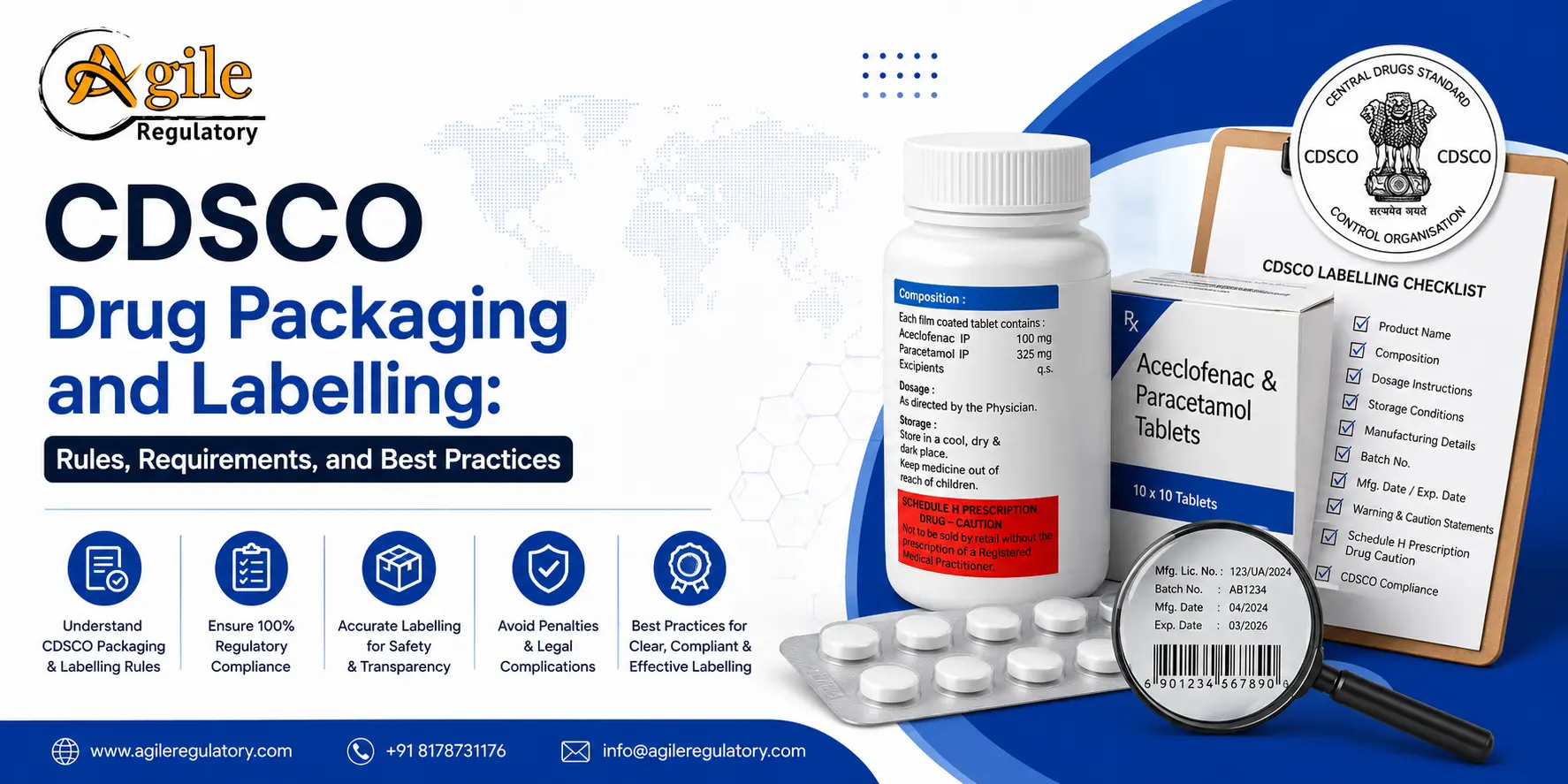
CDSCO drug packaging and labelling requirements play a crucial role in ensuring the safety, quality, and traceability of pharmaceutical products in India. This blog explains the key CDSCO rules, mandatory labelling requirements, packaging standards, and b
Nishi Chawla
06 Jun 2026
MD 42 License in Noida is essential for medical device manufacturers and importers to ensure legal compliance, build market credibility, avoid penalties, and expand business opportunities.
Nishi Chawla
05 Jun 2026
MD 42 License is a mandatory authorization for importing medical devices into India. Businesses in Ghaziabad involved in medical device imports must comply with CDSCO regulations and obtain the necessary approvals before importing products.
Vanshika Mathur
25 Mar 2026
The CDSCO registration process in Ahmedabad (2026) is conducted entirely online through the SUGAM portal of the Central Drugs Standard Control Organization. Businesses must first create an account, submit applicant and company details, upload required doc
Divya Saxena
25 Mar 2026
CDSCO Forms MD 3, MD 5, MD 7, and MD 9 regulate import, manufacturing, loan licensing, and testing of medical devices.
Nishi Chawla
06 Mar 2026
In 2026, medical devices in India must be registered and licensed under the Medical Devices Rules, 2017 regulated by the Central Drugs Standard Control Organization (CDSCO).
Divya Saxena
02 Mar 2026
The 2026 update on CDSCO classification of medical devices clarifies risk-based categories, expands software and AI regulation, and strengthens compliance requirements.
We simplify compliance through a proven 4-step process: Consultation, Documentation, Submission, and certification. From understanding requirements to getting final approvals, we deliver a smooth, timely, and fully compliant journey for your business.


What our customer says about us
Lavkush Sharma
KTPL Instruments
Agile Regulatory handled my BIS Certification registration smoothly. Their expert team ensured quick approvals, transparent pricing, and a completely stress-free compliance experience.

Nitin Mukesh
Justrack IOT
We are grateful to Agile Regulatory for their excellent support. Their team showed patience, expertise, and professionalism throughout, providing clear guidance and making the entire process smooth and hassle-free.
Pradeep Varma
Coaire Compressor
Being an excellent BIS Certification Consultant provider, they help customers with all requirements such as BIS Certification, CDSCO services, Agile Regulatory support, legal issues, and lab testing with quick results.
Bharat Bachwani
Easy Polymer
With the help of Agile Regulatory, we have made significant progress in our business. Their service is fast, genuine, and reliable. We look forward to continued success together in the future.
Atul Jain
Tarus International
Many thanks to Agile Regulatory for all the support, guidance, and expert advice. Their professional approach and consistent assistance have made a significant difference.

Paramjeet Singh
Anchor Weighing
Top-tier consulting! offered strategic solutions that revolutionized our approach. Their deep expertise and personalized guidance made a significant impact on our success. Highly recommend their services.
Anshul Rathi
AM Capacitor
Agile Regulatory exceeded expectations! Their tailored solutions, expertise, and proactive approach led to remarkable results. Highly recommend for businesses seeking impactful and strategic guidance.
Shekhar Maurya
Imaxx Pro Aquistic
Outstanding service! delivered targeted solutions with professionalism and expertise. Their insights elevated our business strategies, resulting in noticeable growth. Highly recommended for exceptional consultation.
Trusted by over 1,00,000 + Global Brands in the past 15+ years


.webp)



Leave a Reply
Your email address will not be published. Required fields are marked *