


Get Instant Solution By an Expert Advisor
(4.8)
Fast replies · No spam · Real experts
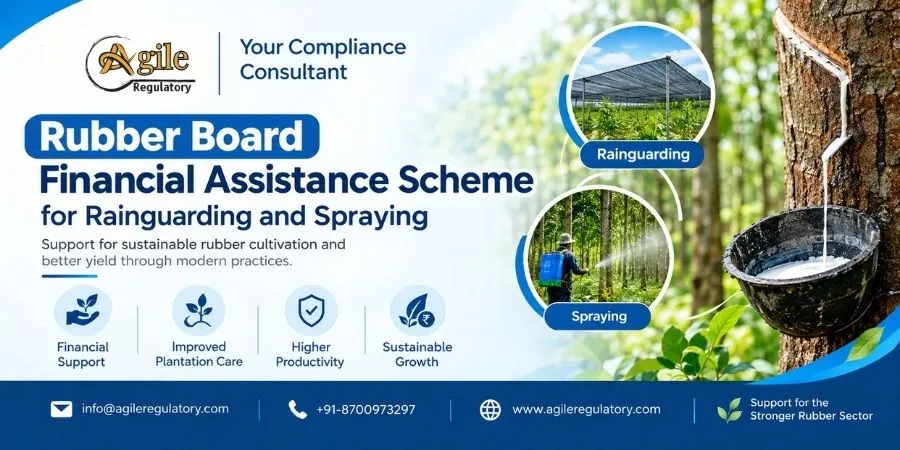
Rainfall and plant diseases can play a major role in natural rubber production, especially when the tapping operations are interrupted by the monsoon, or when timely disease-control measures need to be taken in the plantations. The Rubber Board has been assisting the growers through schemes and programs to enhance the productivity and better plantation management through rain-guarding, spraying and other recommended agricultural operations..
The Rubber Board Financial Assistance Scheme for Rainguarding and Spraying is therefore relevant for rubber growers looking to adopt these practices and understand the assistance available under applicable Rubber Board programmes. The Board has previously implemented financial support for rain guarding and spraying through Rubber Producers’ Societies (RPSs), with the objective of improving productivity and encouraging the adoption of recommended practices.
Because scheme guidelines, eligibility requirements, application windows and assistance components can change, applicants should verify the current notification and applicable conditions before submitting an application.
The Rubber Board, under the Ministry of Commerce and Industry, undertakes development and extension activities for the natural rubber sector. Its programmes can include support for growers, productivity improvement, training, farm practices and other activities connected with rubber cultivation.
Rain guarding is an important plantation practice because it helps protect the tapping panel from rain and can allow tapping to continue during suitable rainy conditions. Historical Rubber Board material explains that rain guarding can provide additional tapping days and contribute to improved productivity.
Spraying is also important for disease management. Appropriate plant-protection measures can help growers manage diseases and maintain healthier foliage and productive plantations.
The assistance is not necessarily a permanent fixed subsidy available to every grower at all times. The applicable benefit depends on the scheme, notification, eligibility criteria, implementation mechanism and period for which applications are invited.
IS 10702:1992 - BIS Certification For Rubber Hawai Chappal
Rain could interfere with tapping through effects on the tapping panel , latex collection and working conditions . During periods of frequent rainfall, growers may lose potential tapping days.
Rain guarding involves protecting the tapping area from rain so that tapping can be undertaken when conditions permit.
Some important benefits include:
The Rubber Board has historically treated rain guarding as an important productivity-enhancing agricultural practice. Its annual reports also document programmes supporting growers with rain-guarding materials.
Rubber plantations can be affected by diseases and other plant-health issues. Timely spraying, when recommended by agricultural experts, can help in disease-management programmes.
The Rubber Board has previously supported the availability and use of inputs for spraying through programmes involving Rubber Producers’ Societies. Its reports also mention disease-control measures and spraying-related inputs as part of productivity-enhancement activities.
Growers should use only appropriate products and follow the recommended application method, dosage and safety requirements rather than treating financial assistance as a substitute for technical guidance.
Eligibility depends on the particular Rubber Board scheme or notification. Assistance may be linked to eligible rubber growers, plantation activities, grower groups or implementation arrangements through Rubber Producers’ Societies.
In earlier programmes, the Board used RPSs as an implementation channel for certain financial-support initiatives. For example, the Rubber Board's 2021–22 annual report describes support for rain guarding and related activities through RPSs and records participation by registered growers.
Therefore, applicants should check:
Registration-related requirements can become important when growers or businesses want to access Rubber Board services. However, registration and financial assistance should not automatically be treated as the same process.
A grower may need to establish the required identity, plantation or beneficiary details before applying under a particular programme. The exact process depends on the scheme notification.
The rubber board online registration process may be relevant for applicants who need to access eligible online services or submit information through the Board's digital systems.
Before beginning an application, applicants should check the official Rubber Board portal for the current service, form and instructions. The Board's website provides dedicated sections for forms, links, publications and other services.
For applicants who are entering the system for the first time, rubber board new registration may be required depending on the service or activity involved.
New applicants should keep their business or grower information, identity documents, address details and other applicable records ready before starting the registration process.
It is important to select the correct category because grower-related services and commercial licensing activities are different regulatory requirements.
Rubber board registration can refer to registration or enrolment requirements associated with different Rubber Board services. The exact requirements depend on whether the applicant is a grower, dealer, processor or another regulated participant.
Applicants should therefore identify the relevant service before completing the application.
The registration form of the rubber board should be filled up as per the instructions applicable to the particular service/scheme.
Depending on the application, information may be:
Applicants shall not submit incomplete, inconsistent information. Any discrepancy between the application and the supporting documents can result in queries, corrections or delays.
On the official website of the Rubber Board, there is a particular section for forms. Therefore, it is important to use the latest valid form and not an old copy.
Is a Rubber Board License Required?
A rubber board licence is different from a grower-focused financial assistance application.
The Rubber Board's Licensing Division deals with licences for activities such as rubber dealing and processing. According to the Board's published information, dealer licences are issued and renewed under the applicable Rubber Rules and licensing procedures.
Therefore, a rubber grower applying for an eligible plantation assistance programme should not assume that a dealer licence is automatically required.
The requirement depends on the nature of the applicant's activity.
How Rubber Board Registration Boosts Business
A rubber dealer license is relevant to persons or businesses carrying out regulated rubber-dealing activities rather than simply cultivating rubber.
The Rubber Board states that its Licensing Division handles fresh and renewal licences for rubber dealers and processors. Its published licensing information states that a dealer applying for a licence in Form C has to submit the prescribed application and applicable fee.
The Board’s 2023–24 annual report also notes the issue and renewal of dealer licences, saying dealer licences are generally first issued for three years and renewed for five years.
Businesses should therefore distinguish between:
Activities associated with growing and producing natural rubber.
Rubber dealer activity: Commercial buying/dealing activity which may be subject to licensing under the relevant regulatory framework of the Rubber Board.
Processing activities that may be subject to a separate processor licensing requirement.
This distinction is important when determining which Rubber Board service applies to a particular business.
Application for Financial Assistance for Rainguarding and Spraying
The application process can differ depending on the active scheme. A practical approach is to take the following steps:
Check the Latest Scheme Notification
First, check whether the financial-assistance program for the activity in question is open today . Do not rely solely on an old subsidy announcement because schemes and application periods can change.
Check whether you qualify as an eligible grower or beneficiary and whether the activity, plantation area or implementation arrangement meets the scheme conditions.
Some programmes may be implemented through Rubber Producers’ Societies or other authorized channels. The Rubber Board's historical programme records demonstrate the use of RPSs for certain grower-support initiatives.
Keep the relevant identity, plantation, bank and other supporting records ready according to the current notification.
Use the latest application or registration form specified by the Rubber Board. If you are required to submit your application online, please be sure to complete your application through the designated portal.
After submission, keep the acknowledgment or application reference, if available. Respond within the period specified if verification or further information is requested.
Where the application is approved, assistance is provided according to the applicable scheme rules and payment mechanism. Rubber Board procedural material indicates that subsidy-related payments can be transferred through PFMS/DBT under applicable schemes.
The exact documentation depends on the current scheme. Applicants may be asked for information such as:
Because documentation can differ between schemes, applicants should follow the latest official checklist instead of relying on a generic document list.
Applicants should be careful about several common issues when seeking Rubber Board assistance.
An earlier financial-assistance programme may have different eligibility conditions or assistance limits. Always check the current notification.
Grower registration, scheme applications and commercial dealer licensing are different regulatory activities. Selecting the wrong service can create unnecessary delays.
Forms and procedures can be updated. Use the version currently provided through the official Rubber Board portal.
Where assistance is transferred electronically, incorrect beneficiary or bank information can create payment problems.
If a particular programme is implemented through a Rubber Producers’ Society, individual applicants should understand the role of the relevant society before submitting documents.
Rubber growers and businesses may need help understanding whether they require registration, a licence or assistance under a particular Rubber Board programme.
Agile Regulatory can assist applicants with understanding the applicable Rubber Board registration and licensing requirements, preparing documentation and guiding them through the relevant application process.
It is important for business firms carrying on rubber trading to ascertain whether a rubber dealer licence or any other Rubber Board licence is required by them depending on the nature of their commercial activity.
Professional assistance can also help reduce errors in application forms and documentation while keeping the process aligned with the applicable regulatory requirements.
The Rubber Board's support for rain guarding and spraying reflects the importance of improved plantation management, productivity and disease-control practices in natural rubber cultivation. Historical Rubber Board programmes have provided financial or input-related support for rain guarding and spraying, including implementation through Rubber Producers’ Societies.
However, growers should verify the current scheme notification, eligibility criteria, application window and assistance conditions before applying. Requirements can differ between programmes.
If you need rubber board online registration, rubber board new registration, rubber board registration, rubber board registration form or guidance regarding rubber board licence or rubber dealer license, knowing the exact regulatory category is the first step toward a smoother rubber board online registration.
For assistance with Rubber Board registration, licensing documentation and application support, Agile Regulatory can help you understand the applicable requirements and documentation for your business or activity.
It refers to Rubber Board programmes that have supported recommended rubber plantation practices such as rain guarding and spraying. The exact assistance, eligibility and application process depend on the applicable scheme and notification.
Eligible growers may be able to receive assistance when a relevant Rubber Board programme is open and they satisfy its conditions. Some previous programmes were implemented through Rubber Producers’ Societies.
Rubber board online registration generally refers to completing an applicable Rubber Board registration or service through its online system.Applicants should first determine the specific service because the registration requirements differ by activity.
“Yeah. Generally, new registration means that an applicant applies for registration to a particular registration/service for the first time. Renewal means an existing registration or licence is being renewed. The exact procedure is depending on the Rubber Board service.
The Rubber Board website provides a Forms section and related service information. Applicants should use the latest form applicable to their particular service or scheme.
Not necessarily. A plantation grower and a commercial rubber dealer or processor may be subject to different regulatory requirements. The Licensing Division of Rubber Board is exclusively concerned with the licensing of dealers and processors.
Businesses or persons carrying out regulated rubber-dealing activities may require a dealer licence under the Rubber Board's applicable framework. The Board publishes licensing requirements and procedures for dealers.
The Rubber Board's published information states that a dealer licence is ordinarily issued initially for three years and renewed for five years. Applicants should verify the current applicable rules and licence conditions at the time of application.
So better check the current notification first. Current entitlement should not be considered as a matter of historical scheme, as previous schemes may have different application periods, eligibility requirements and assistance conditions.
Yes . Depending on the nature of the applicant’s activity and the current regulatory requirements, Agile Regulatory can advise on the relevant Rubber Board registration, documentation and licensing process.


We simplify compliance through a proven 4-step process: Consultation, Documentation, Submission, and certification. From understanding requirements to getting final approvals, we deliver a smooth, timely, and fully compliant journey for your business.


What our customer says about us

Lavkush Sharma
KTPL Instruments
Agile Regulatory handled my BIS Certification registration smoothly. Their expert team ensured quick approvals, transparent pricing, and a completely stress-free compliance experience.

Nitin Mukesh
Justrack IOT
We are grateful to Agile Regulatory for their excellent support. Their team showed patience, expertise, and professionalism throughout, providing clear guidance and making the entire process smooth and hassle-free.

Pradeep Varma
Coaire Compressor
Being an excellent BIS Certification Consultant provider, they help customers with all requirements such as BIS Certification, CDSCO services, Agile Regulatory support, legal issues, and lab testing with quick results.

Bharat Bachwani
Easy Polymer
With the help of Agile Regulatory, we have made significant progress in our business. Their service is fast, genuine, and reliable. We look forward to continued success together in the future.

Atul Jain
Tarus International
Many thanks to Agile Regulatory for all the support, guidance, and expert advice. Their professional approach and consistent assistance have made a significant difference.
Paramjeet Singh
Anchor Weighing
Top-tier consulting! offered strategic solutions that revolutionized our approach. Their deep expertise and personalized guidance made a significant impact on our success. Highly recommend their services.

Anshul Rathi
AM Capacitor
Agile Regulatory exceeded expectations! Their tailored solutions, expertise, and proactive approach led to remarkable results. Highly recommend for businesses seeking impactful and strategic guidance.

Shekhar Maurya
Imaxx Pro Aquistic
Outstanding service! delivered targeted solutions with professionalism and expertise. Their insights elevated our business strategies, resulting in noticeable growth. Highly recommended for exceptional consultation.
Trusted by over 1,00,000 + Global Brands in the past 15+ years





Leave a Reply
Your email address will not be published. Required fields are marked *