


Get Instant Solution By an Expert Advisor
(4.8)
BIS CRS Registration is mandatory for manufacturers of electronic and IT products notified under the Compulsory Registration Scheme (CRS) before they can manufacture, import, or sell them in India. The registration process includes product testing in a BIS-recognized laboratory, submission of technical documents, and BIS approval. Once certified, manufacturers can use the Standard Mark on eligible products. BIS CRS Registration ensures compliance with Indian safety standards, enhances consumer confidence, prevents the sale of non-compliant products, and enables hassle-free access to the Indian market.





Get personalized guidance in minutes - no waiting, no bots.


10000 +
Projects Completed for Our Respected Clients.

15 +
Years Experienced Advisors in Indian Compliance.

98.9%
Project Delivery Ratio for Our Valuable Clients.

99.9%
Satisfied Customers All Over India.
The BIS Compulsory Registration Scheme (CRS) is a product certification program introduced by the Bureau of Indian Standards (BIS) in collaboration with the Ministry of Electronics and Information Technology (MeitY) in 2012. It is specifically designed for electronic and IT products covered under Quality Control Orders (QCOs). Before these products can be manufactured, imported, or sold in India, manufacturers must obtain BIS CRS Registration.
Unlike other BIS certification schemes, CRS does not require a physical factory audit. Instead, certification is granted based on successful product testing at a BIS-recognized laboratory and the manufacturer's self-declaration of conformity.
|
Scheme |
Applies To |
Basis of Certification |
|
Scheme-I (ISI Mark) |
General industrial and consumer products |
Factory audit + lab testing |
|
Scheme-II (CRS) |
Electronics and IT goods under QCO |
Self-declaration + lab testing |
|
FMCS |
Foreign manufacturers, industrial goods |
Factory audit + lab testing |
|
Scheme-X |
Machinery and electrical equipment |
Factory audit + lab testing |
Among all BIS certification schemes, CRS is the only one that eliminates the requirement for a factory inspection, making the registration process faster while still ensuring product safety and compliance through accredited laboratory testing and document verification.
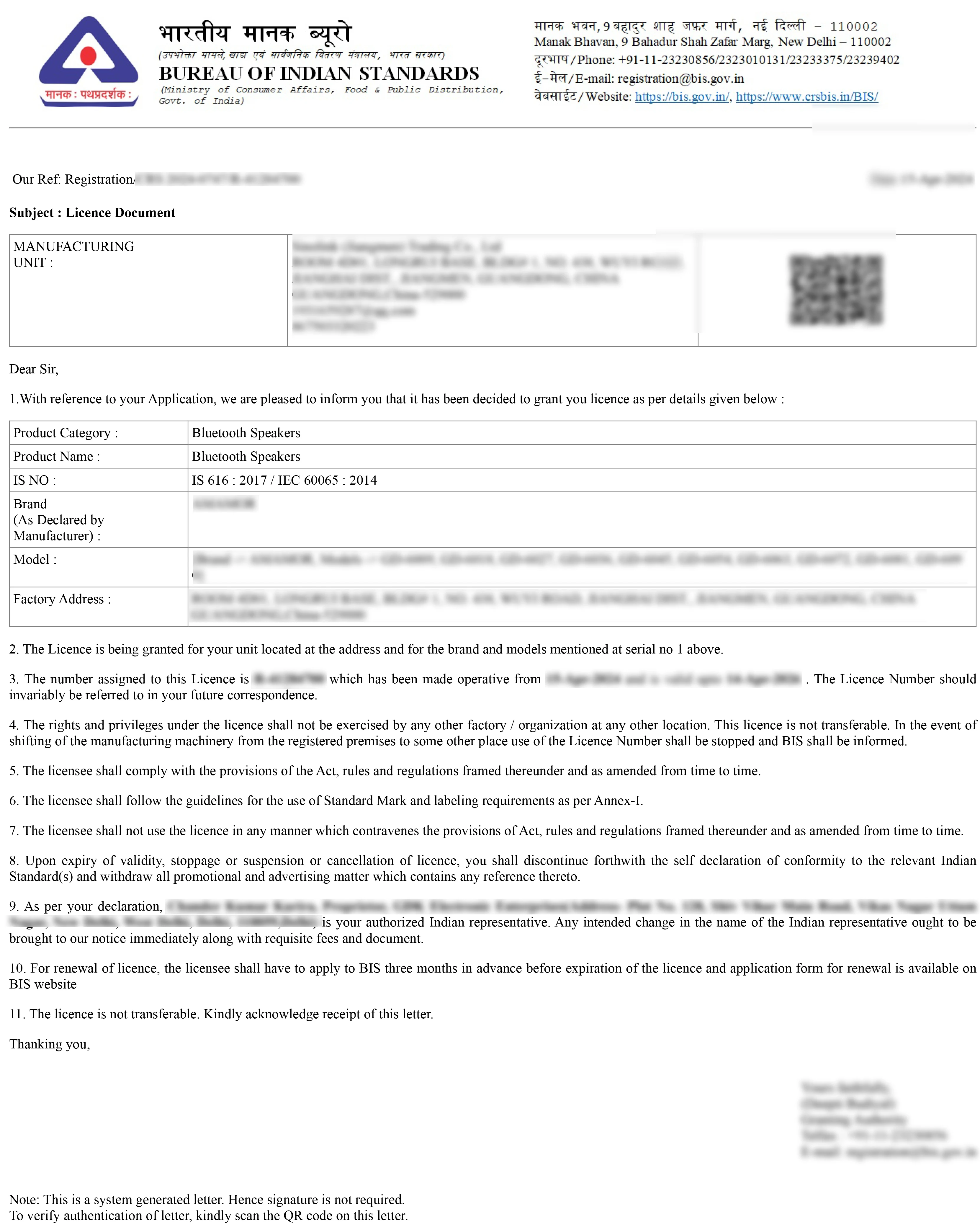
BIS CRS, short for the Compulsory Registration Scheme, is the certification pathway that applies to electronics and IT products notified under a Quality Control Order. Instead of a factory inspection, manufacturers test their product at a BIS-recognised laboratory and self-declare conformity to the applicable Indian Standard. Once BIS reviews the application and test report, it issues a registration certificate, and the manufacturer can affix the Standard Mark with a unique registration number. This applies to laptops, mobile phones, LED products, power banks, and dozens of similar categories sold in India.
Getting CRS certification follows a fairly linear sequence, and most delays trace back to one of two things an incomplete document set or a test report that doesn't match the exact model being registered.
Identify the applicable Indian Standard for the product, since testing and the entire application depend on this.
Register on the BIS CRS portal using valid business credentials.
Get the product tested at a BIS-recognised laboratory against the relevant standard.
Submit the application on the portal with the test report and supporting documents.
Respond to BIS queries, if raised, with complete and accurate information.
Receive the registration certificate once BIS is satisfied with the submission.
Apply the Standard Mark on the product, along with the assigned registration number.
The benefits of the BIS registration include the following:
|
Sl. |
Product |
Indian Standard (IS) No. |
|
1 |
Amplifiers with input power 2000w and above |
IS 616:2010* |
|
2 |
Automatic data processing machine |
IS 13252(Part 1):2010* |
|
3 |
Electronic clocks with mains power |
IS 302-2-26:2014* |
|
4 |
Electronic games (video) |
IS 616:2010* |
|
5 |
Electronic musical systems with input power 200w and above |
IS 616:2010* |
|
6 |
Laptop/notebook/tablet |
IS 13252(Part 1):2010* |
|
7 |
Microwave ovens |
IS 302-2-25:2014* |
|
8 |
Optical disc players with built in amplifiers of input power 200w and above |
IS 616:2010* |
|
9 |
TVs - Plasma, LCD, or LED screens that are 32" or larger |
IS 616:2010* |
|
10 |
Printers, plotters |
IS 13252(Part 1):2010* |
|
11 |
Scanners |
IS 13252(Part 1):2010* |
|
12 |
Set top box |
IS 13252(Part 1):2010* |
|
13 |
Telephone answering machines |
IS 13252(Part 1):2010* |
|
14 |
Visual display units, videos monitors of screen size 32" and above |
IS 13252(Part 1):2010* |
|
15 |
Wireless keyboards |
IS 13252(Part 1):2010* |
|
16 |
Cash registers |
IS 13252(Part 1):2010* |
|
17 |
Copying machines/duplicators |
IS 13252(Part 1):2010* |
|
18 |
Passport reader |
IS 13252(Part 1):2010* |
|
19 |
Point of sale terminals |
IS 13252(Part 1):2010* |
|
20 |
Machinery for processing mail, printing, and framing |
IS 13252(Part 1):2010* |
|
21 |
Power banks for use in portable applications |
IS 13252(Part 1):2010* |
|
22 |
Smart card reader |
IS 13252(Part 1):2010* |
|
23 |
Mobile phones |
IS 13252(Part 1):2010* |
|
24 |
Self-ballasted led lamps for general lighting services |
IS 16102(Part 1):2012* |
|
25 |
DC or AC-supplied electronic control gear for led modules |
IS 15885(Part 2/Sec 13):2012* |
|
26 |
Power adaptors for audio, video & similar electronic apparatus |
IS 616:2010* |
|
27 |
Power adaptors for IT equipment |
IS 13252(Part 1):2010* |
|
28 |
Fixed general purpose LED luminaires |
IS 10322(Part 5/Sec 1):2012* |
|
29 |
Ups/invertors of rating <= 5kva |
IS 16242(Part 1):2014* |
|
30 |
Part 1: Nickel-Systems Sealed secondary cells/batteries using non-acid electrolytes, such as alkaline ones, for portable applications |
IS 16046:2018* |
|
31 |
Part 2: Lithium Systems Sealed Secondary Cells and Batteries with Alkaline or Other Non-Acid Electrolytes for Portable Use |
IS 16046:2018* |
|
32 |
Indian language support for mobile phone handsets |
IS 16333 (Part 3): 2016* |
|
33 |
Recessed LED Luminaries |
IS 10322 (Part 5/Section 2):2012 |
|
34 |
LED Luminaires for Road and Street lighting |
IS 10322 (Part 5/Section 3):2012 |
|
35 |
LED Flood Lights |
IS 10322 (Part 5/Section 5):2013 |
|
36 |
LED Hand lamps |
IS 10322 (Part 5/Section 6):2013 |
|
37 |
LED Lighting Chains |
IS 10322 (Part 5/Section 7):2013 |
|
38 |
LED Luminaires for Emergency Lighting |
IS 10322 (Part 5/Section 8):2013 |
|
39 |
UPS/Inverters of rating <= 10kVA |
IS 16242 (Part 1):2014 |
|
40 |
Plasma/ LCD/LED Television of screen size up to 32 |
IS 616:2010 |
|
41 |
Visual Display Units, Video Monitors of screen size up to 32 |
IS 13252 (Part 1):2010 |
|
42 |
CCTV Cameras/CCTV Recorders |
IS 13252 (Part 1):2010 |
|
43 |
Adapters for home appliances and other such electrical devices |
IS 302 (Part 1):2008 |
|
44 |
USB-powered Iris scanners, optical fingerprint scanners, barcode readers, and barcode scanners |
IS 13252 (Part 1):2010 |
|
45 |
Smartwatches |
IS 13252 (Part 1):2010 |
|
46 |
Crystalline Silicon Terrestrial Photovoltaic (PV) modules (Si wafer-based) |
IS 14286:2010/ IEC 61215 : 2005, IS/IEC 61730 (Part 1) : 2004 & IS/IEC 61730 (Part 2) : 2004 |
|
47 |
Thin-Film Terrestrial Photovoltaic (PV) Modules (a-Si, CiGs and CdTe) |
IS 16077:2013/ IEC 61646: 2008, IS/IEC 61730 (Part 1): 2004 & IS/IEC 61730 (Part 2) : 2004 |
|
48 |
Solar power systems, power inverters |
IS 16221 (Part 2):2015 |
|
49 |
Utility-Interconnected Photovoltaic inverters |
IS 16221 (Part 2): 2015 & IS 16169:2014 |
|
50 |
Storage battery |
IS 16270:2014 |
|
51 |
Independent LED Modules for General Lighting |
IS 16103 (Part 1):2012 |
|
52 |
Lighting Chain (Rope Lights) |
IS 10322 (Part 5/Sec 9):2017 |
|
53 |
Keyboard |
IS 13252 (Part 1):2010 |
|
54 |
Induction Stove |
IS 302-2-6:2009 |
|
55 |
Automatic Teller Cash dispensing machines |
IS 13252 (Part 1):2010 |
|
56 |
External Hard Disk Drive - USB Type |
IS 13252 (Part 1):2010 |
|
57 |
Wireless Headphone and Earphone |
IS 616:2017 |
|
58 |
External Solid-State Storage Devices - USB Type (above 256 GB capacity) |
IS 13252 (Part 1):2010 |
|
59 |
Electronic music system with less than 200 watts of input power |
IS 616:2017 |
|
60 |
Standalone Switch Mode Power Supplies (SMPS) with output voltage 48V (max) |
IS 13252 (Part 1):2010 |
|
61 |
Television other than Plasma/ LCD/LED TVs |
IS 616:2017 |
|
62 |
Rice Cooker |
IS 302-2-15:2009 |
|
63 |
Wireless Microphone |
IS 616:2017 |
|
64 |
Digital Camera |
IS 13252 (Part 1):2010 |
|
65 |
Video Camera |
IS 616:2017 |
|
66 |
Webcam (Finished Product) |
IS 616:2017 |
|
67 |
Smart Speakers (with and without Display) |
IS 616:2017 |
|
68 |
Dimmers for LED products |
|
|
69 |
Bluetooth Speakers |
IS 616:2017 |
|
70 |
Ortho Phosphoric Acid |
IS 798:2020 |
|
71 |
Polyphosphoric Acid |
IS 17439:2020 |
|
72 |
Cotton Bales |
IS 12171:2019 |
|
73 |
Trimethyl Phosphite Technical Grade |
IS 17412:2020 |
|
74 |
Television Sets |
IS 18112:2022 |
Timeline: Most CRS applications move through review in 4 to 8 weeks, assuming the test report and documentation are complete on first submission. Applications with missing or mismatched documents commonly take longer, simply due to the query-and-response cycle.
Cost:
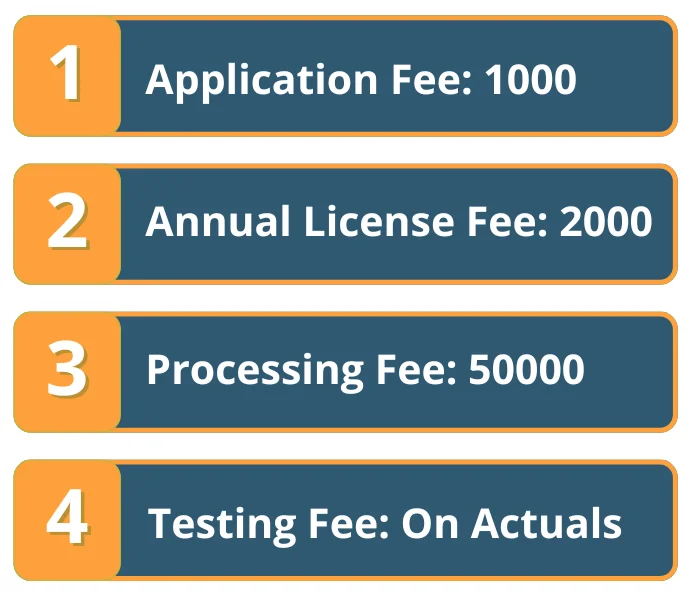
|
Fee Type |
New Application |
Renewal |
|
Application Fee |
₹1,000 |
₹1,000 |
|
Processing Fee |
₹50,000 (2 test reports) |
₹50,000 |
|
Registration Fee |
₹2,000 |
₹2,000 |
|
Total |
₹53,000 |
₹53,000 |
Each additional test report beyond the standard two adds ₹20,000 to the processing fee. Lab testing charges are billed separately by the laboratory and aren't included in this table.
Validity: A CRS registration is granted for a minimum of two years from the date of issue.
Renewal: Applications should be filed before the current registration expires, since a lapsed certificate can't be revived after the fact it requires a fresh application and retesting. BIS allows renewal for a further term of two, three, or five years, depending on what the applicant requests.
If manufacturers and factory owners are producing the specified commodities, they must apply for a license under the BIS Compulsory Registration Scheme. These things are announced by the central government in the official gazette. There are now 81 entries on this list, which may be categorized into five groups because they are from five separate Indian government ministries. Obtaining the Bureau of Indian Standards CRS registration is a must if your factory produces any of these goods. These five groups are listed in the following order:
When applying for a license under the mandatory registration system, a manufacturer must provide the following documentation:
The steps to obtain a CRS BIS registration certificate in India are as follows:
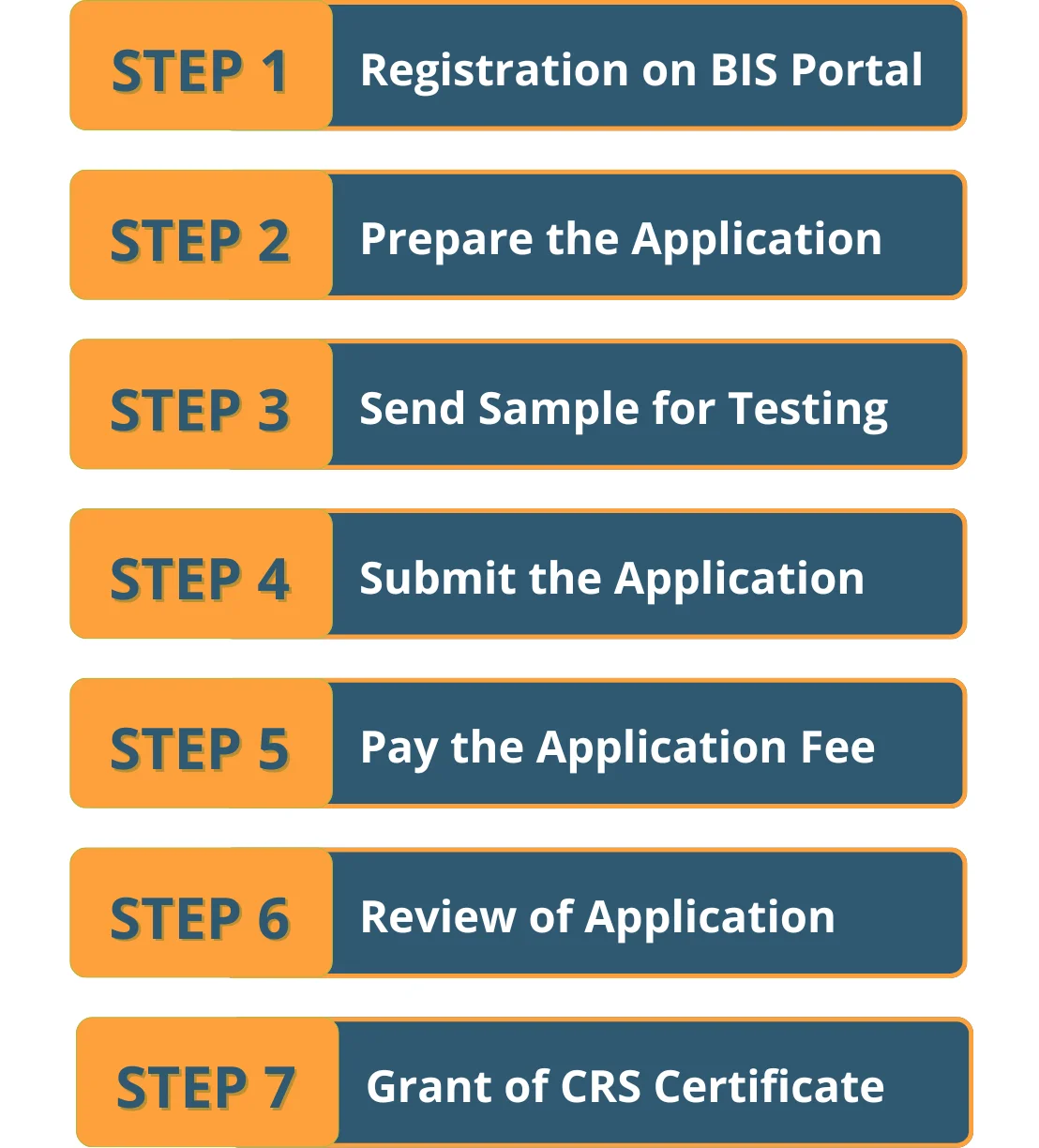
Create your account on the BIS online portal for CRS registration.
Fill out and submit the online application.
Send in the samples to a Bureau of Indian Standards-approved lab for testing
Submit the test report along with mandatory documents to the portal.
Bureau of Indian Standards will examine your application in detail
The Bureau of Indian Standards will issue a certificate post-verification.
A specific level of quality should be met by all goods sold in India. So that consumers don't feel that they haven't received a sufficient return on investment, they should be safe to use and offer optimal value. Furthermore, the information technology tools that are offered should be of the greatest calibre, as India continues to move towards digitalization. Because of this, it is essential that all electronic products have a BIS CRS Registration certificate and be included in the Bureau of Indian Standards CRS list. The only way the product will be approved for sale by the government is in this manner.
Our experts at Agile Regulatory will complete the BIS CRS registration process in accordance with MeitY requirements and verify if the product qualifies for the CRS list. With years of experience, our team of professionals at Agile Regulatory can quickly choose the necessary product code and complete the application. We ensure that there won't be any obstacles in your way throughout the registration process. By adhering to the official government protocol, we are dedicated to completing the BIS CRS registration process on time.
Get Instant Solution By an Expert Advisor
(4.8)
Every manufacturer registered under the BIS Compulsory Registration Scheme receives a Unique Registration number from the BIS. For every single product made by the manufacturer at a certain site, the registration number is given. It is never given to an importer, and is always given to product manufacturer.
CRS Certificate only applies to finished goods; it does not apply to the tools or materials that were used to create them.
ISI mark certification is a certification mark that signifies that a product meets the quality and safety requirements established by BIS. In order to ensure that specific items meeting the defined quality and safety criteria set by BIS are supplied in India, BIS CRS registration is a mandated certification program.
CRS Stands for Compulsory Registration scheme.
The BIS grants a two-year validity period for its BIS certification. When the relevant items and recommended standards remain unchanged, the producers or manufacturers are eligible to renew their BIS CRS certification.
An applicant need to submit company registration documents, KYC, Product Specification, Test Report, etc.
There are 74 items currently present in the list of products covered under BIS CRS scheme and it is mandatory to take BIS CRS for all of these products.
It is true that each brand must have its own registration under the BIS CRS. A shared test report for several brands may be filed if the product and the manufacturing site are the same. In the test report, every brand should be included together with the corresponding model number.
A desktop computer is classified as automated data processing equipment under the mandatory list of products. On the other hand, desktop and personal computers are specifically not covered under this list.
The official BIS CRS portal is where all applications, renewals, and status tracking take place it's the single platform for the entire process.
CRS has its own dedicated portal and login credentials, separate from the systems used for Scheme-I, FMCS, or Scheme-X applications, since each scheme is administered through its own workflow.
Yes each registered model needs its own valid, current certificate, and renewal has to be filed separately for each before its individual expiry date.
Proven 4-step Process: Consultation, Documentation, Submission, and Certification.


Startups to large enterprises, we deliver end-to-end solutions business compliance needs.
 One-Stop Compliance Solution:
From BIS, CDSCO, Drug License, EPR, BEE, WPC, LMPC, PSARA, Startup Compliance, Pollution Certificates, Factory License, Fire NOC, Export Licenses and more.
End-to-End Support:
we manage the complete process which includes a proper Consultation & Requirement Analysis, Complete Documentation & Application Filing, Face to Face Coordination with Department Authorities, Certification, Renewal & Post-approval Support.
Clear and set prices:
There are no extra fees or last-minute surprises, because our prices are straightforward, competitive, and set in stone.
Focus on the client:
Each client has a dedicated project manager who keeps them up to date and makes sure communication goes smoothly.
Support for Indian and Foreign Companies:
We offer customized compliance plans and authorized representative services to both Indian businesses that are growing in India and foreign manufacturers that want to enter the Indian market.
One-Stop Compliance Solution:
From BIS, CDSCO, Drug License, EPR, BEE, WPC, LMPC, PSARA, Startup Compliance, Pollution Certificates, Factory License, Fire NOC, Export Licenses and more.
End-to-End Support:
we manage the complete process which includes a proper Consultation & Requirement Analysis, Complete Documentation & Application Filing, Face to Face Coordination with Department Authorities, Certification, Renewal & Post-approval Support.
Clear and set prices:
There are no extra fees or last-minute surprises, because our prices are straightforward, competitive, and set in stone.
Focus on the client:
Each client has a dedicated project manager who keeps them up to date and makes sure communication goes smoothly.
Support for Indian and Foreign Companies:
We offer customized compliance plans and authorized representative services to both Indian businesses that are growing in India and foreign manufacturers that want to enter the Indian market.


What our customer says about us

Lavkush Sharma
KTPL Instruments
Agile Regulatory handled my BIS Certification registration smoothly. Their expert team ensured quick approvals, transparent pricing, and a completely stress-free compliance experience.

Nitin Mukesh
Justrack IOT
We are grateful to Agile Regulatory for their excellent support. Their team showed patience, expertise, and professionalism throughout, providing clear guidance and making the entire process smooth and hassle-free.
Pradeep Varma
Coaire Compressor
Being an excellent BIS Certification Consultant provider, they help customers with all requirements such as BIS Certification, CDSCO services, Agile Regulatory support, legal issues, and lab testing with quick results.
Bharat Bachwani
Easy Polymer
With the help of Agile Regulatory, we have made significant progress in our business. Their service is fast, genuine, and reliable. We look forward to continued success together in the future.

Atul Jain
Tarus International
Many thanks to Agile Regulatory for all the support, guidance, and expert advice. Their professional approach and consistent assistance have made a significant difference.

Paramjeet Singh
Anchor Weighing
Top-tier consulting! offered strategic solutions that revolutionized our approach. Their deep expertise and personalized guidance made a significant impact on our success. Highly recommend their services.

Anshul Rathi
AM Capacitor
Agile Regulatory exceeded expectations! Their tailored solutions, expertise, and proactive approach led to remarkable results. Highly recommend for businesses seeking impactful and strategic guidance.
Shekhar Maurya
Imaxx Pro Aquistic
Outstanding service! delivered targeted solutions with professionalism and expertise. Their insights elevated our business strategies, resulting in noticeable growth. Highly recommended for exceptional consultation.

