

Selling batteries in India? Then Indian law dictates you must take take crae of the battery waste too by registering for EPR with CPCB. If your company makes, imports, or sells batteries or any product with a battery inside it, you are legally responsible for what happens to those batteries when they die down. That responsibility is called EPR (Extended Producer Responsibility).





10000 +
Projects Completed for Our Respected Clients.

15 +
Years Experienced Advisors in Indian Compliance.

98.9%
Project Delivery Ratio for Our Valuable Clients.

99.9%
Satisfied Customers All Over India.
To prove you are following the law, you need EPR registration for battery waste from the Central Pollution Control Board (CPCB). Agile Regulatory handles the entire process for you from document preparation to final approval on the CPCB portal, and the year-round compliance that follows.
EPR for battery waste means the company that puts a battery into the Indian market must make sure an equal quantity of used batteries is collected and recycled properly. You cannot simply sell a battery and forget about it.
This idea comes from the Battery Waste Management Rules, 2022, notified by the Ministry of Environment, Forest and Climate Change (MoEFCC) on 22 August 2022. These rules replaced the older Batteries (Management and Handling) Rules, 2001.
Two things make the 2022 rules very different from the old ones:
They cover every battery: The rules apply to all types of batteries regardless of chemistry, shape, volume, weight, material composition, and use. Lead-acid, lithium-ion, nickel-based, dry cells, all of them.
They come with real targets: You must meet collection and recycling targets set out in Schedule II of the rules, and prove it digitally.
EPR registration for batteries is simply the official permission issued by CPCB that allows you to operate legally under this system. It is often also called EPR authorization for battery waste.
The rules divide batteries into four groups. Find yours below.
|
Category |
Simple explanation |
Common examples |
|
Portable |
Small, sealed batteries you can carry |
Mobile phone cells, laptop packs, remote batteries, power banks, torch cells |
|
Automotive |
Starter batteries in vehicles |
Car, bike, truck and tractor batteries |
|
Industrial |
Large batteries for industry and backup |
Inverter and UPS batteries, telecom tower batteries, solar storage banks |
|
Electric Vehicle (EV) |
Traction batteries that drive a vehicle |
E-scooter, e-rickshaw, e-car and e-bus battery packs |
If your product contains a battery, even if you are not its manufacturer, you are still treated as the producer of that battery in India.
The Extended Producer Responsibility or EPR initiative has been implemented by the Indian government, which calls for battery importers and producers to manage and dispose of the battery waste in a way that is environmentally conscious whilst simultaneously holding them accountable for the volume of waste they produce throughout the products' shelf lives.
In light of this, it is the responsible party's obligation under the regulations to assure that batteries are recycled through CPCB-authorized recyclers and to acquire an EPR certificate from recyclers that reflects the quantity of batteries recycled.
For the purposes of the guidelines and rules, waste batteries may include the used and/or end-of-life batteries and/or their components, spares, parts, or consumables, which could or couldn't be harmful; and Utilized and/or end-of-life batteries and/or their components or spares.
Pre-consumer Off-Spec Battery, together with any of its spare parts, supplies, or components; Battery whose date of suitable usage has passed; and Batteries that have been abandoned by the user.
Registration of Producers and Importers: According to the aforementioned regulations, a producer is referred to as an entity that produces, sells, imports, and uses batteries, including used batteries, within devices, either its brand or a brand that has been produced by other suppliers or manufacturers.
Every producer is responsible under EPR for collecting, recovering, and reconditioning spent batteries, as well as using recovered waste materials for producing new batteries. Rule 4 of the BWM Rules 2022, every producer and anyone or entity engaged in the production of batteries must register with the CPCB via a centralized online portal.
Registration of Refurbishers and Recyclers: The State Pollution Control Board requires that all recyclers and refurbishers register on the centralized portal to acquire a one-time registration.
Streamline Supply Chain and Waste Management: EPR authorization allows businesses to identify and improve points of weakness in the waste distribution system. This reduces overhead costs and places fewer demands on budget-conscious organizations. EPR license enables the accessibility of a definite framework that allows businesses to operate effectively while eliminating needless inefficiencies and expenses.
Optimise Waste Management Methods: EPR permission provides entities with greater clarity on how waste should be collected, handled, recycled, or disposed of. It enables them to reinforce their existing waste management structure while rendering it more effective and smoother.
Enhance Interaction with Affiliate Units: High costs are unavoidable in the early stages of EPR implementation. By strengthening collaboration with linked units, this can be reduced. Under EPR authorization, the company has a clear grasp of how to carry out waste management activities, such as directing battery waste to recycling and disposal facilities.
Higher Business Goodwill: The approval of EPR has a favorable impact on the company's image and goodwill. Having EPR certification at disposal indicates the business is devoted to environmentally friendly resource usage and lower waste generated by their battery products. To strengthen their reputation in the industry, most of the major players devote careful consideration to these standards.
Ensure Cost-Cutting in Waste Management: Waste management and cost-cutting are often viewed as incompatible, but EPR authorization can overcome complexities and make waste management more cost-efficient. This allows entities to focus on cost-efficient activities while maintaining productivity.
Keep clear, readable scans ready. Mismatched details are the number one reason applications get sent back.
For producers
Company PAN
GST certificate
Certificate of Incorporation / Partnership Deed / Udyam (MSME) registration
Company IEC (Import Export Code) — for importers
CIN and authorised signatory details, with authorisation letter and ID proof
Details of the battery brands and models sold
Battery chemistry and material composition (weight of each battery type)
Sales data for previous financial years, battery-wise and category-wise
Battery labelling and marking artwork (barcode / QR code)
Consent to Establish and Consent to Operate — for those manufacturing in India
Address proof of registered office and warehouses
EPR plan/action plan for collection and recycling
Additional for recyclers and refurbishers
Consent to Establish and Consent to Operate from the State Pollution Control Board
Hazardous waste authorisation, where applicable
Details of plant capacity, process flow and pollution control equipment
Land documents and factory licence
Proof of technology and recovery capability
Document lists are updated by CPCB from time to time. We confirm the current checklist against the portal before you pay any fee.
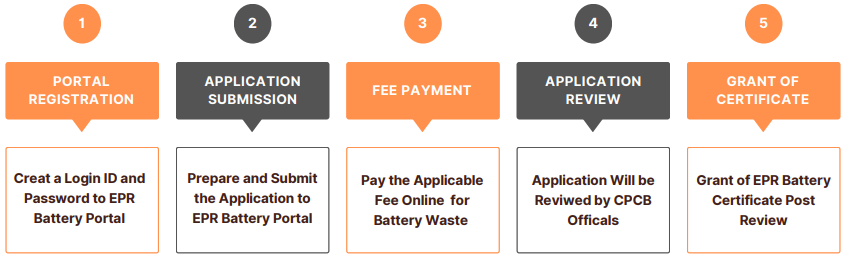
Here is how CPCB EPR registration online works for batteries:
Step 1 — Confirm your role: Decide whether you are applying as a producer, recycler or refurbisher. Applying under the wrong role means starting again.
Step 2 — Create your account on the EPR battery portal: The official portal is the EPR Portal for Battery Waste Management run by CPCB. Single Sign-On (SSO) for EPR portals is now live, and users are asked to log in through the SSO at epr.cpcb.gov.in to access all EPR portals.
CPCB advises users to register with the dedicated email ID and mobile number of the authorised person, and states that contact details of a consultant, agent or other agency working on behalf of the producer, recycler or refurbisher should not be provided. Your EPR battery login must stay in your company's control, even when a consultant does the filing work.
Step 3 — Fill the application: Enter company details, battery categories, chemistry, material composition and sales data. Sales figures should match your GST and import records, because CPCB cross-checks.
Step 4 — Upload documents and pay the fee: Upload the checklist above and pay the prescribed application fee online. Fees depend on category and quantity and are revised from time to time, so we confirm the exact amount before filing.
Step 5 — Respond to CPCB queries: CPCB reviews the file and often raises questions or asks for clarifications. Replying quickly and correctly is what decides whether you get approval in weeks or months.
Step 6 — Receive your EPR registration certificate: Once approved, you get a registration number. This number must be printed on your battery labels and used in every future filing.
Step 7 — Start meeting your obligations: Registration is the starting line, not the finish. Targets, labelling and returns begin immediately.
Realistic timeline: Most complete applications move in roughly 30 to 90 days. The variable is not the portal but how quickly queries are answered and how clean the sales data is. Nobody, including us, can promise a fixed approval date, because approval rests with CPCB.
The EPR battery portal is where your entire compliance process takes place including registration, targets, certificate purchase, returns, and notices.
A few practical points about EPR battery CPCB login:
Use one official company email and mobile number. Personal or consultant numbers cause access loss when staff changes.
Your battery waste login credentials should be documented internally and shared with at least two responsible people.
If you cannot get in, use the "Forgot Password" option on the portal before raising a complaint. CPCB advises users facing login issues to use the "Forgot Password" feature and re-login after changing the password.</cite>
For anything the portal cannot fix, all producers, recyclers and refurbishers are asked to lodge their tickets and issues through the ticketing module on the Battery Waste EPR Portal.
CPCB also runs an EPR helpline on 011-43102350, available 9:30 AM to 6:00 PM, Monday to Friday.
Producers, Manufacturers, Recyclers have to submit a request for renewal 60 days before their registration expires, accompanied by the necessary documents. Then, CPCB will renew the authorization granted to the Producer for a term of five years within fifteen business days after receiving of complete application from the Producer. While granting renewal of the EPR registration certificate, the following shall be taken into consideration. Annual Returns must be completed by June 30th of the following year (by the rules) for the interim Registration term; otherwise, the application for renewal will not be entertained, and the Findings of the Audit completed by the CPCB.
This is the part most businesses find confusing:
1. You get a target: Based on your past sales, CPCB assigns you a quantity of waste batteries (in kilograms) that must be collected and recycled in a given year. Targets step up over the years under Schedule II of the rules.
2. You meet it with certificates: When a registered recycler processes waste batteries, the portal generates EPR certificates in that recycler's account. You buy these certificates to show your target has been met. Producers are required to fulfil their EPR obligation by ensuring waste batteries are recycled through certified recyclers, obtaining EPR certificates from recyclers according to the quantity recycled, and using such certificates to meet their targets.
3. Certificate prices have a floor and a ceiling: Under the 2025 amendment, CPCB fixes the highest and lowest price for EPR certificates at 100% and 30% respectively of the environmental compensation payable for non-fulfilment of EPR obligations. This was done partly because a price that is too low pushes genuine recyclers out of business.
4. Buy only from genuine capacity: CPCB checks certificates against a recycler's registered processing capacity. Cheap certificates from a recycler who has already exhausted capacity can be rejected, and the liability comes back to you.
The Battery Waste Management Amendment Rules, 2025 were notified on 24 February 2025. The headline change for most producers is labelling: producers must print a barcode or QR code containing the EPR registration number on batteries or battery packs, on equipment containing batteries, and on the packaging of the battery or equipment, and the EPR registration number must also be printed on the product information brochure.
In practice, this means artwork changes, printing changes, and vendor instructions.
Here are the compliance obligations applied after registering under CPCB:
|
What |
Who |
When |
|
Filing returns on the portal |
Producers, recyclers, refurbishers |
Periodic filing during the year; the annual return for the previous financial year is generally due by 30 June |
|
Buying and retiring EPR certificates |
Producers |
Against each year's target |
|
Barcode / QR labelling with EPR number |
Producers |
On all covered products and packaging |
|
Record keeping — sales, collection, recycling |
All |
Continuous |
|
Updating brand, model or capacity changes |
All |
As and when they occur |
Note: Deadlines are sometimes extended by CPCB, but extensions are announced late and should never be part of your plan. We confirm live dates on the portal each cycle.
Non-compliance is not treated as a small paperwork slip.
Environmental Compensation (EC) is charged on the shortfall between your target and what you actually achieved.
Paying EC does not delete the obligation. The shortfall is generally carried forward, so you end up paying and still owing the recycling.
Registration can be suspended or cancelled, which affects imports, marketplace listings and B2B contracts.
Action can follow under the Environment (Protection) Act, 1986, which is the parent law behind these rules.
The honest summary: the cost of doing this properly is far lower than the cost of fixing it after a notice arrives.
Many businesses also need EPR registration for e-waste. If you are unsure which applies to your product list, send us your catalogue — we will map it category by category.
You need EPR battery registration if you fall into any of these groups.
Battery manufacturers in India
Importers of batteries or battery cells
Brand owners who sell batteries under their own name
OEMs whose products come with a battery inside — EV makers, phone brands, laptop brands, toy makers, inverter brands, medical device firms, e-commerce private labels
Important: An importer who buys finished battery-powered goods from abroad and sells them here is a producer under the rules. Many businesses miss this and get notices later.
Facilities that break down waste batteries and recover materials such as lead, lithium, cobalt or nickel.
Businesses that repair or rebuild used batteries so they can be used again.
Producers, recyclers and refurbishers must register through the online centralised portal developed by CPCB. Recyclers and refurbishers must also register with the concerned State Pollution Control Board or Pollution Control Committee on the same centralised portal.
Placing batteries in the market without valid registration puts your business at risk of environmental compensation and enforcement action from CPCB and State Pollution Control Boards. Here’s why you must register:
Customs and buyers ask for it: Large corporates, government tenders and e-commerce marketplaces increasingly ask for the EPR registration number before they onboard a supplier. Importers may face clearance questions without it.
Protects your brand: Old batteries contain lead, acid and lithium. When they are broken open in unsafe backyard units, they poison soil and water and cause fires. Showing a clean, traceable recycling chain is now a serious reputational advantage.
Builds a circular supply chain: Recovered lithium, cobalt and lead go back into new batteries. India imports most of these metals, so recovery is a genuine cost and security benefit with paperwork.
EPR authorization acts as a basic requirement for the country's plastic and EEE producers. Holding EPR authorization means that responsible entities and persons must follow the underlying legislation of the relevant authorities to manage waste effectively. Hence, though it is a legal requirement for a business, EPR authorization could act for the benefit of the business by saving its costs and increasing its goodwill. If you require consultation, guidance, or assistance to obtain an EPR registration, feel free to contact Agile Regulatory.
We handle EPR registration for battery waste management end-to-end.
Assessment: We study your product list, imports and sales to confirm whether you are a producer, recycler or refurbisher, and which battery categories apply.
Documentation: We prepare and verify every document, and reconcile your sales data before filing, so queries are avoided rather than answered.
Filing: We complete your EPR registration for battery waste online on the CPCB portal, in your company's own account, and track it to approval.
Query handling: We draft and file replies to CPCB observations, and follow up until the certificate is issued.
After approval: Target planning, certificate sourcing from verified recyclers, labelling guidance, return filing and a compliance calendar so nothing is missed.
Amendments and renewals: New brands, new models, capacity changes and renewal — all managed.
EPR objectives are the number of batteries placed on the market by the producer/manufacturer. Schedule II of the Battery Waste Management Rules, 2022, contains further information regarding the same
Under EPR for BWM, all sorts of batteries are covered, including portable batteries, electric vehicle batteries, automotive batteries, and industrial batteries
Producer refers to a person or entity-
Who manufactures and sells batteries, including refurbished batteries along with equipment under his brand name.
Sells batteries, including refurbished batteries, such as in equipment, under its brand manufactured by different producers or suppliers; or
Imports batteries and equipment containing batteries
Producer ( including importer)
Battery Manufacturers
Battery Recyclers and Refurbishers
There must be a PAN for the authorized individual.
Do Battery producers have any battery-related obligations?
Manufacturers are required to comply with EPR obligations under the following conditions:
► Manufacturers who sell the batteries on the market under their own brand name.
► Manufacturers supply batteries to other manufacturers/dealers, and the other manufacturers/dealers sell these batteries in the market using the brand name granted by the original manufacturers.
► Battery manufacturers sell directly to large consumers.
► However, battery manufacturers supplying batteries to other manufacturers/dealers to sell under their own brand name shall not be responsible for EPR obligations.
► Self-attested copy of GST Certificate
► TIN number
► CIN number
► Aadhar card of the authorized person
► PAN card of the company
Yes. Under the Battery Waste Management Rules, 2022, producers, recyclers and refurbishers must register with CPCB on its centralised online portal before operating.
Manufacturers, importers and brand owners who place batteries in the Indian market — including companies that sell products with batteries already inside them.
CPCB's EPR Portal for Battery Waste Management. Access is now through CPCB's common Single Sign-On at epr.cpcb.gov.in.
No. CPCB specifically asks that the dedicated email ID and mobile number of your authorised person be used, not those of a consultant or agent.
Typically around 30 to 90 days for a complete, clean application. The timeline depends on CPCB's review and how fast queries are resolved.
There is a government fee that varies by category and quantity, plus professional fees if you use a consultant. Government fees are revised from time to time, so ask for a current quote rather than relying on an old figure.
Registrations are granted for a defined period and must be renewed. Renewal terms are set by CPCB and have changed over time — check your certificate for your specific validity.
You buy EPR certificates from registered recyclers through the portal. If there is still a shortfall, environmental compensation applies, and the shortfall is generally carried forward.
If you sell electronics containing batteries, usually yes — the device falls under e-waste rules and the battery under battery waste rules, on separate portals.
There is no general small-business exemption for producers under these rules. If you place batteries in the market, obligations apply.
Use the "Forgot Password" option on the portal first. If the problem continues, raise a ticket through the portal's ticketing module or contact the CPCB EPR helpline.
Proven 4-step Process: Consultation, Documentation, Submission, and Certification.


Startups to large enterprises, we deliver end-to-end solutions business compliance needs.
 One-Stop Compliance Solution:
From BIS, CDSCO, Drug License, EPR, BEE, WPC, LMPC, PSARA, Startup Compliance, Pollution Certificates, Factory License, Fire NOC, Export Licenses and more.
End-to-End Support:
we manage the complete process which includes a proper Consultation & Requirement Analysis, Complete Documentation & Application Filing, Face to Face Coordination with Department Authorities, Certification, Renewal & Post-approval Support.
Clear and set prices:
There are no extra fees or last-minute surprises, because our prices are straightforward, competitive, and set in stone.
Focus on the client:
Each client has a dedicated project manager who keeps them up to date and makes sure communication goes smoothly.
Support for Indian and Foreign Companies:
We offer customized compliance plans and authorized representative services to both Indian businesses that are growing in India and foreign manufacturers that want to enter the Indian market.
One-Stop Compliance Solution:
From BIS, CDSCO, Drug License, EPR, BEE, WPC, LMPC, PSARA, Startup Compliance, Pollution Certificates, Factory License, Fire NOC, Export Licenses and more.
End-to-End Support:
we manage the complete process which includes a proper Consultation & Requirement Analysis, Complete Documentation & Application Filing, Face to Face Coordination with Department Authorities, Certification, Renewal & Post-approval Support.
Clear and set prices:
There are no extra fees or last-minute surprises, because our prices are straightforward, competitive, and set in stone.
Focus on the client:
Each client has a dedicated project manager who keeps them up to date and makes sure communication goes smoothly.
Support for Indian and Foreign Companies:
We offer customized compliance plans and authorized representative services to both Indian businesses that are growing in India and foreign manufacturers that want to enter the Indian market.


What our customer says about us

Lavkush Sharma
KTPL Instruments
Agile Regulatory handled my BIS Certification registration smoothly. Their expert team ensured quick approvals, transparent pricing, and a completely stress-free compliance experience.

Nitin Mukesh
Justrack IOT
We are grateful to Agile Regulatory for their excellent support. Their team showed patience, expertise, and professionalism throughout, providing clear guidance and making the entire process smooth and hassle-free.
Pradeep Varma
Coaire Compressor
Being an excellent BIS Certification Consultant provider, they help customers with all requirements such as BIS Certification, CDSCO services, Agile Regulatory support, legal issues, and lab testing with quick results.

Bharat Bachwani
Easy Polymer
With the help of Agile Regulatory, we have made significant progress in our business. Their service is fast, genuine, and reliable. We look forward to continued success together in the future.

Atul Jain
Tarus International
Many thanks to Agile Regulatory for all the support, guidance, and expert advice. Their professional approach and consistent assistance have made a significant difference.

Paramjeet Singh
Anchor Weighing
Top-tier consulting! offered strategic solutions that revolutionized our approach. Their deep expertise and personalized guidance made a significant impact on our success. Highly recommend their services.
Anshul Rathi
AM Capacitor
Agile Regulatory exceeded expectations! Their tailored solutions, expertise, and proactive approach led to remarkable results. Highly recommend for businesses seeking impactful and strategic guidance.

Shekhar Maurya
Imaxx Pro Aquistic
Outstanding service! delivered targeted solutions with professionalism and expertise. Their insights elevated our business strategies, resulting in noticeable growth. Highly recommended for exceptional consultation.

