


Get Instant Solution By an Expert Advisor
(4.8)
Fast replies · No spam · Real experts
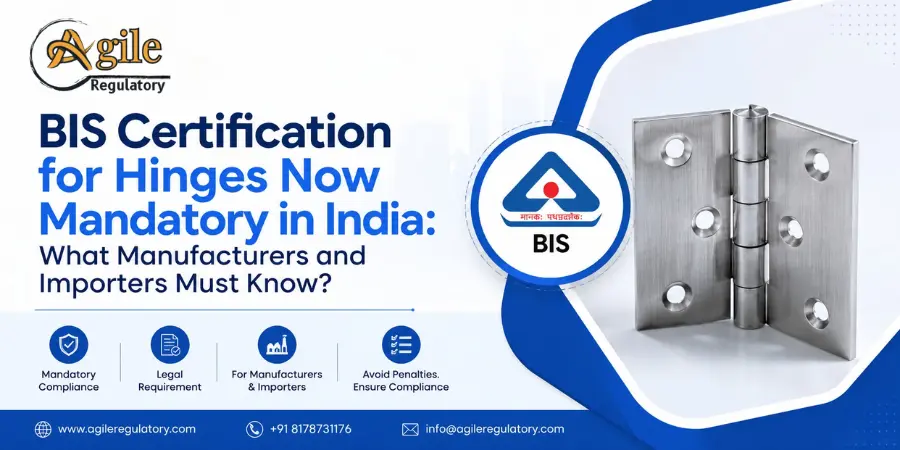
Anyone still manufacturing, importing, storing, selling or distributing covered hinge products without a valid BIS license is operating outside the law as of today.
This order doesn't blanket every hinge sold in India. It names specific categories and ties each one to its governing Indian Standard.
|
Hinge Type |
Indian Standard |
|
Cabinet Hinges. |
IS 18297:2023 |
|
Stainless Steel Butt Hinges |
IS 12817:2020 |
|
Steel Butt Hinges. |
IS 1341:2018 |
|
Non-Ferrous Metal / Brass Hinges |
IS 205 |
|
Double Acting Spring Hinges |
IS 453:1993 |
|
Continuous / Piano Hinges |
IS 3818:1992 |
|
Steel Back Flap Hinges |
IS 3843:1995 |
Two carve-outs exist. Hinges manufactured in India purely for export don't fall under this requirement. Manufacturers can also bring in up to 200 units a year for research and development without certification, as long as those units never reach the commercial market and import records stay available for government review.
Hinges carry load in places where failure has real consequences. Doors, cabinets, gates. A weak hinge isn't a minor defect; it's a structural one. The order's stated aim is reducing substandard imports and bringing domestic and foreign hinge supply onto the same quality footing.
For businesses that get certified properly, there's a commercial upside too. ISI mark certification opens up government tender eligibility, and increasingly, buyers are checking for it before they place orders at all. Compliance and credibility move together here.
Getting a hinge product certified runs through a defined sequence.
Match your specific hinge type against its Indian Standard from the table above.
Send the product for testing at a BIS-recognized laboratory. This is where build quality and material composition either hold up or don't.
Put together technical and compliance documentation covering your manufacturing process and test results.
File the BIS application through the relevant scheme.
Where applicable, BIS conducts a factory inspection to look at manufacturing conditions and quality control on-site.
Once approved, the BIS license and ISI mark clear for use on the product.
None of these steps are optional shortcuts. Skipping the lab testing stage, for instance, almost guarantees a rejected application later.
Importers don't get a watered-down version of these standards. The product still has to meet the same Indian Standard. What changes is the route to certification: overseas manufacturers go through the Foreign Manufacturers Certification Scheme (FMCS) and must appoint an Authorized Indian Representative (AIR) located in India. The AIR handles compliance correspondence and carries liability for the foreign manufacturer's obligations under this order. No AIR, no FMCS application moving forward.
Authorities have the power to seize non-compliant products and pursue legal action against sellers. Beyond the immediate penalty, a business caught without certification risks losing market access until the product clears certification, and that process has its own timeline once testing and inspection enter the picture.
For manufacturers, importers, and foreign suppliers of hinges, the compliance question isn't whether this rule applies anymore. It's whether your products are certified yet. The seven hinge categories listed under the order need a valid BIS license and ISI mark to stay in the Indian market legally, with the only exceptions being export-only production and small-scale R&D imports.
Agile Regulatory helps manufacturers and importers work through BIS certification for hinges, from identifying the right standard to FMCS registration for overseas suppliers. Get your products reviewed before this turns into an enforcement problem instead of a paperwork one.


Proven 4-step Process: Consultation, Documentation, Submission, and Certification


What our customer says about us

Lavkush Sharma
KTPL Instruments
Agile Regulatory handled my BIS Certification registration smoothly. Their expert team ensured quick approvals, transparent pricing, and a completely stress-free compliance experience.

Nitin Mukesh
Justrack IOT
We are grateful to Agile Regulatory for their excellent support. Their team showed patience, expertise, and professionalism throughout, providing clear guidance and making the entire process smooth and hassle-free.
Pradeep Varma
Coaire Compressor
Being an excellent BIS Certification Consultant provider, they help customers with all requirements such as BIS Certification, CDSCO services, Agile Regulatory support, legal issues, and lab testing with quick results.

Bharat Bachwani
Easy Polymer
With the help of Agile Regulatory, we have made significant progress in our business. Their service is fast, genuine, and reliable. We look forward to continued success together in the future.

Atul Jain
Tarus International
Many thanks to Agile Regulatory for all the support, guidance, and expert advice. Their professional approach and consistent assistance have made a significant difference.
Paramjeet Singh
Anchor Weighing
Top-tier consulting! offered strategic solutions that revolutionized our approach. Their deep expertise and personalized guidance made a significant impact on our success. Highly recommend their services.

Anshul Rathi
AM Capacitor
Agile Regulatory exceeded expectations! Their tailored solutions, expertise, and proactive approach led to remarkable results. Highly recommend for businesses seeking impactful and strategic guidance.

Shekhar Maurya
Imaxx Pro Aquistic
Outstanding service! delivered targeted solutions with professionalism and expertise. Their insights elevated our business strategies, resulting in noticeable growth. Highly recommended for exceptional consultation.
Trusted by over 1,00,000 + Global Brands in the past 12 years


 The Hinges (Quality Control) Order 2025 is issued by DPIIT under the Ministry of Commerce and Industry. The new update made BIS certification for hinges and ISI marking compulsory from July 1 2025. The order replaced its 2024 predecessor. It also pushed back an original January 2025 enforcement date by six months giving manufacturers a runway that has now closed.

Leave a Reply
Your email address will not be published. Required fields are marked *