EPR Compliance for Importers in India: Registration, MSTC Trading, and Rules Explained
Page Contents (6)
Importing into India in 2026 involves a compliance layer that didn't exist five years ago and that customs officers are now actively checking. Since July 2 2025 when CBIC issued Instruction No. 21/2025-Customs importers of plastic packaging and plastic raw materials (resins, pellets, films, preforms) must show proof of EPR registration on CPCB's centralized portal before a consignment clears. No registration, no clearance. The rule isn't a guideline waiting to be enforced. It's live, it's being checked, and first-time importers who don't know about it find out at the port.
What EPR Means for Importers
EPR certificate full form is Extended Producer Responsibility certificate. EPR registration full form expands identically Extended Producer Responsibility registration. The framework itself isn't complicated: anyone who introduces plastic packaging, electronic equipment, batteries, or tyres into the Indian market.
EPR certificate means you've registered this obligation with CPCB and received a registration number that authorises you to operate. You can't legally import plastic-packaged goods, electronics, batteries or tyres without one
The categories that create an EPR registration for import obligation:
-
Plastic: Anyone importing plastic packaging or plastic raw material for use in packaging manufacture expanded under Plastic Waste Management (Amendment) Rules, 2024
-
E-waste: Importers of electrical and electronic equipment listed in Schedule I of E-Waste (Management) Rules, 2022 EPR certificate for e waste applies here
-
Battery: Importers of all battery types under Battery Waste Management Rules 2022
-
Tyre: Importers of new tyres under Hazardous Waste Rules (Amendment), 2022
CPCB Registration vs. MSTC Trading
New importers often conflate these two steps. They're separate systems serving different purposes and both are necessary.
CPCB portal registration is your legal authorization the EPR license that CBIC checks at customs and that CPCB uses to assign your annual recycling targets. You get your EPR registration certificate here. This is the step you cannot import without.
MSTC's EPR Electronic Trading Platform (ETP) is where you fulfil those targets. If your own collection and recycling capacity doesn't cover your annual obligation which is the case for most importers who don't own recycling infrastructure you purchase EPR certificates from registered recyclers through the MSTC platform.
Get Free Consultation!
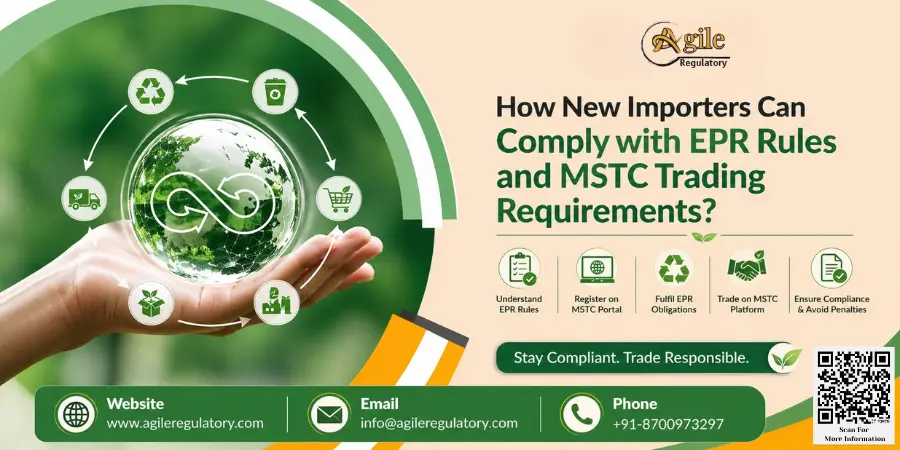
Step-by-Step: From Zero to Compliant
Step 1: Identify Your Category and Applicable Portal
Before creating any account, confirm which waste category applies to your imports. The correct portal for each:
-
Plastic packaging: eprplastic.cpcb.gov.in
-
E-waste: ewasteportal.cpcb.gov.in
-
Battery: eprbattery.cpcb.gov.in
-
Tyre: eprtyres.cpcb.gov.in
If you import products covered by more than one category say, electronics with plastic packaging you need separate registrations on each relevant portal. They're independent systems.
Step 2: Gather Documents Before Starting
The portal doesn't save draft applications reliably. Going in without complete documents means restarting.
|
Document |
Required For |
Notes |
|
Certificate of Incorporation / MSME Certificate |
All categories |
Must match GST-registered entity name |
|
PAN Card |
All categories |
Company or proprietorship PAN |
|
GST Registration Certificate |
All categories |
Active GSTIN |
|
IEC (Import Export Code) |
All categories |
Issued by DGFT |
|
Authorised Signatory ID Proof + Letter |
All categories |
Director/partner/proprietor |
|
Waste Management Plan |
Plastic, E-waste, Battery |
Outlines collection/recycling strategy |
|
MOU with Registered Recycler or PRO |
Plastic, E-waste |
Not mandatory at registration but needed for compliance |
|
Product/Plastic Category Details |
Plastic |
Category I–IV classification |
|
Schedule-I Product List |
E-waste |
Confirms which EEE items are covered |
|
Bank Account Details |
All categories |
For fee payment |
Step 3: Register on the CPCB Portal.
Go to the relevant portal select "PIBO Registration" (for plastic) or the importer category for your waste type, and create an account using PAN/GSTIN/CIN. OTP verification confirms the account. Once logged in fill the application form company details, product/import details, waste management plan and recycling target projections
Upload documents, pay the applicable fee online and submit. Expected processing time: 30 to 90 days depending on document completeness and whether CPCB raises queries
Responding to CPCB queries within 7 to 10 days is the single most controllable factor in keeping your approval timeline short
Step 4: Receive Your EPR Registration Certificate.
Once approved download your EPR registration certificate from the portal. This is the document CBIC requires for customs clearance under Instruction No. 21/2025-Customs. Keep it accessible you may need to present it before each consignment for plastic-related imports.
Step 5: Register on the MSTC EPR Trading Platform
CPCB registration and MSTC registration are separate. To trade EPR certificates, you need a distinct account on the MSTC platform. Registration there requires your CPCB EPR registration certificate, PAN, GSTIN, KYC documents, and bank details. Once your MSTC account is active, you can buy certificates from registered recyclers to meet your annual target.
Step 6: File Returns on Schedule
EPR certificate online reporting runs on two cycles depending on your category. Plastic PIBOs file annual returns in Form-1 by June 30 (extended to September 30, 2025 for FY 2024-25 under MoEF&CC's June 2025 notification). E-waste importers file quarterly returns. Battery producers file annual Form-3 returns, while recyclers file quarterly Form-4.
What Happens Without Registration?
Operating without a valid EPR license after CBIC's July 2025 instruction means customs holds your consignment. Beyond that immediate clearance problem: importers found to have submitted false data face a one-year business ban and blacklisting from future registration under CPCB's enforcement framework. Environmental Compensation charges apply for target shortfalls even after registration. And for EPR certificate in customs purposes, a registration that's active but showing compliance gaps in the annual return is increasingly being flagged during clearance checks the portal data is live and accessible.
EPR Certificate Requirements: A Practical Compliance Checklist
For new importers, the compliance obligations that keep your EPR certification in good standing are:
-
Active CPCB portal registration with current details
-
Import volumes declared accurately at registration and updated if they change materially
-
MOU with a CPCB-registered recycler or PRO covering your target quantities
-
Monthly or quarterly invoice uploads (depending on category) to maintain credit position
-
Timely EPR certificate purchases on MSTC to cover any target gap
-
Annual return filed on time with reconciled data
-
Renewal initiated 60 days before expiry not after
The EPR certificate for customs documentation specifically needs to be current and downloadable. A valid certificate with an expired status or a portal account showing pending queries creates clearance complications that take weeks to resolve.
Conclusion
EPR registration for import is not a one-time administrative step it's the foundation of a compliance cycle that runs every financial year. Getting it right from the start means registering on the correct CPCB portal, declaring accurate import volumes, connecting with registered recyclers before your targets come due, and using the MSTC platform to purchase certificates when your own collection falls short.
If you're a new importer working through this for the first time or an established importer who needs to register urgently before your next consignment Agile Regulatory provides end-to-end support across all EPR categories. As experienced EPR consultants and EPR authorization consultants, our team handles registration, MSTC onboarding, return filing, and ongoing compliance management.

About the Author
View ProfileNishi Chawla
Content Writer & Compliance Specialist
Nishi is an expert content writer with expertise in Business Legal Compliances, Certifications, and Registrations — BIS, EPR, Medical Devices, Cosmetics, Drugs, and Import Export. She holds a B.Com from the University of Delhi and has been writing industry content since 2019.