

Get Instant Solution By an Expert Advisor
(4.8)
 Before a factory begins construction. Before a plant lays down its first brick. Before a business even installs a single machine. It must seek a certificate known as Consent to Establish, or CTE. This isn't a procedural formality. It’s a critical environmental compliance step that every business must fulfill when starting a new industrial or infrastructure project in India.
Many entrepreneurs, especially first-time project proponents, overlook the legal impact of environmental approvals. They believe pollution control comes later—after setting up. But this is where things don’t work out. The law requires you to take environmental clearance before you establish the project.
Let’s break down everything you need to know about this certificate—the law behind it, who needs it, how to apply, and how to stay compliant.
Haryana Pollution Consent CTE CTO
The Consent to Establish (CTE) is a certificate given under the Water (Prevention and Control of Pollution) Act 1974 and Air (Prevention and Control of Pollution) Act 1981. It is issued by the State Pollution Control Board (SPCB) of the state where the project is located
The first step in a two-stage clearance process is:
The CTE checks if your planned unit will follow pollution norms. The SPCB examines location, waste generation, air emissions, water use, proximity to residential areas, and much more.
How to Get a Pollution NOC Certificate
Any business planning to start an industrial, infrastructure, or commercial project must obtain a CTE from the SPCB. This includes:
If your project generates trade effluents, air emissions, or handles hazardous substances, you cannot proceed without CTE approval.
The SPCB classifies industries into four categories based on their pollution potential:
|
Category |
Pollution Potential |
CTE Requirement |
|
Red |
High |
Mandatory |
|
Orange |
Medium |
Mandatory |
|
Green |
Low |
Mandatory |
|
White |
Negligible |
Exempted |
If your project falls under the white category (like solar power units), you don’t need to apply for CTE. For all other categories, CTE is compulsory before setup.
To apply for a CTE, you must submit detailed information about your project. Key documents include:
If you’re setting up in an industrial area, you may also need a No Objection Certificate (NOC) from the local development authority.
Most State Pollution Control Boards now have an online application process. Here's a step-by-step outline:
The validity period depends on your project category and state policy. Common durations are:
Red category: to 5 years
Before the certificate expires, you must either complete construction or apply for renewal.
Acquiring CTE is not the end of your responsibility. After receiving it:
Starting construction without Consent to Establish can cause serious trouble:
It’s always safer and smarter to follow the legal route from the start.
Getting the Consent to Establish certificate is very important for any responsible project in India. It keeps your business legally safe, environmentally responsible, and eligible for further permissions.
If you are planning to set up a new project and want expert help with the CTE process—our team is here to assist. We help businesses handle compliance with State Pollution Control Boards across India.
Reach out to us today to start your CTE application right—with zero delays and 100% compliance.
Post Views: 972


.webp)
Nishi Chawla
08 May, 2026
.webp)
Nishi Chawla
08 May, 2026
Nishi Chawla
07 May, 2026
Nishi Chawla
07 May, 2026
Nishi Chawla
07 May, 2026
Get Instant Solution By an Expert Advisor
(4.8)
You might also be interested in these articles.
Nishi Chawla
07 May 2026
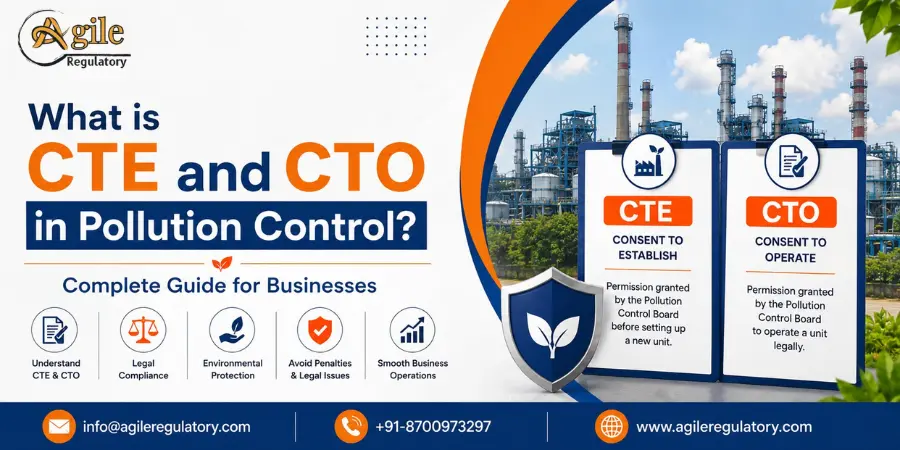
CTE (Consent to Establish) and CTO (Consent to Operate) are mandatory pollution control approvals required for industries before starting and operating a business. This guide explains their importance, process, and compliance requirements for businesses i
Nishi Chawla
03 Apr 2026
The Central Pollution Control Board regulates pollution standards, conducts research, and ensures industries comply with environmental protection rules across India.
Nishi Chawla
03 Apr 2026
The State Pollution Control Board (SPCB) is a regulatory authority responsible for monitoring, controlling, and preventing environmental pollution at the state level in India. It ensures industries comply with environmental laws, grants necessary clearanc
Nishi Chawla
09 Mar 2026
Pollution NOC registration is required for businesses operating in Delhi NCR, including Noida and Gurugram, to ensure compliance with environmental regulations. The certificate is issued by the respective State Pollution Control Boards before starting ind
We simplify compliance through a proven 4-step process: Consultation, Documentation, Submission, and certification. From understanding requirements to getting final approvals, we deliver a smooth, timely, and fully compliant journey for your business.


What our customer says about us
Lavkush Sharma
KTPL Instruments
Agile Regulatory handled my BIS Certification registration smoothly. Their expert team ensured quick approvals, transparent pricing, and a completely stress-free compliance experience.

Nitin Mukesh
Justrack IOT
We are grateful to Agile Regulatory for their excellent support. Their team showed patience, expertise, and professionalism throughout, providing clear guidance and making the entire process smooth and hassle-free.
Pradeep Varma
Coaire Compressor
Being an excellent BIS Certification Consultant provider, they help customers with all requirements such as BIS Certification, CDSCO services, Agile Regulatory support, legal issues, and lab testing with quick results.

Bharat Bachwani
Easy Polymer
With the help of Agile Regulatory, we have made significant progress in our business. Their service is fast, genuine, and reliable. We look forward to continued success together in the future.
Atul Jain
Tarus International
Many thanks to Agile Regulatory for all the support, guidance, and expert advice. Their professional approach and consistent assistance have made a significant difference.

Paramjeet Singh
Anchor Weighing
Top-tier consulting! offered strategic solutions that revolutionized our approach. Their deep expertise and personalized guidance made a significant impact on our success. Highly recommend their services.
Anshul Rathi
AM Capacitor
Agile Regulatory exceeded expectations! Their tailored solutions, expertise, and proactive approach led to remarkable results. Highly recommend for businesses seeking impactful and strategic guidance.

Shekhar Maurya
Imaxx Pro Aquistic
Outstanding service! delivered targeted solutions with professionalism and expertise. Their insights elevated our business strategies, resulting in noticeable growth. Highly recommended for exceptional consultation.
Trusted by over 1,00,000 + Global Brands in the past 15+ years


.webp)


Leave a Reply
Your email address will not be published. Required fields are marked *