


Get Instant Solution By an Expert Advisor
(4.8)
Fast replies · No spam · Real experts
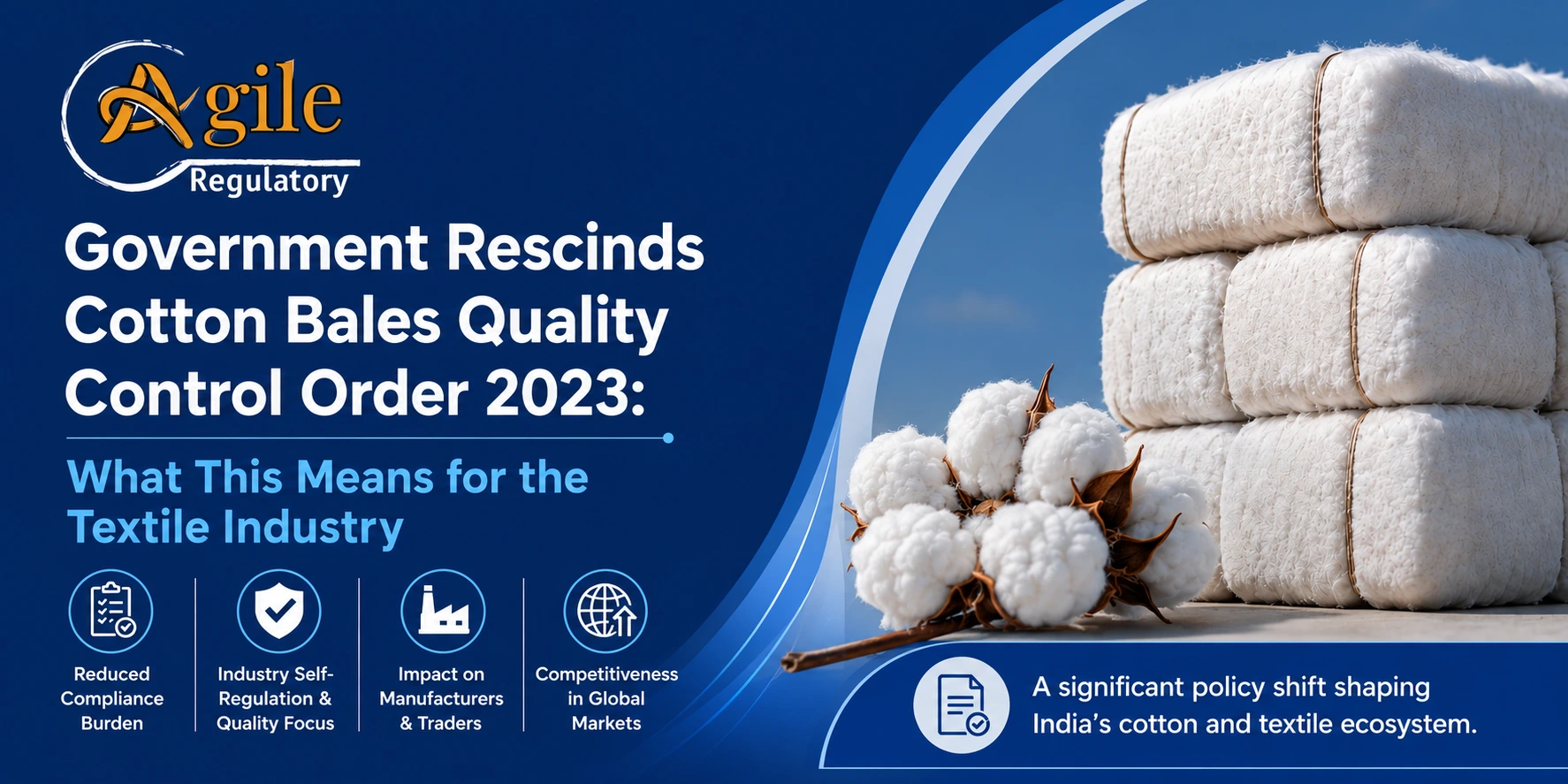
Yet on June 9 2026, that is exactly what happened. The Ministry of Textiles issued S.O. 2956(E) and pulled the Cotton Bales Quality Control Order off the books entirely. The notification that started this whole compliance cycle S.O. 948(E) from February 2023, no longer exists in operative law. Manisha Chatterjee, Joint Secretary signed the order. It took effect the same day it was published
For ginners, cotton merchants and spinning mills that spent three years trying to hit a deadline that kept shifting the immediate question is simple: what now?
Before getting to what changes it helps to recall what was actually being mandated.
Under the QCO every cotton bale manufactured, sold, stored or imported in India had to carry the ISI mark under a valid BIS license. IS 12171:2019 was the governing standard. It covered how bales are measured, packed, weighed and labeled along with quality parameters like fiber strength, moisture content and trash levels.
Domestic producers went through the BIS conformity assessment route under Scheme II of the 2018 Regulations. Foreign suppliers faced the same product-level bar using the Foreign Manufacturers Certification Scheme. Only one category got a pass: cotton bales made specifically for export and meeting a foreign buyer's stated specifications.
BIS held central enforcement authority. State-level officers at District Industries Centres, General Manager rank and above had concurrent powers. Penalties ran from product seizure through fines to imprisonment under the BIS Act 2016.
What follows in the gazette record explains why the government eventually chose withdrawal over another extension.
February 28 2023 was when S.O. 948(E) was published with enforcement. It was expected six months later in August 2023. That deadline was pushed before it even arrived. Then pushed again. Then again after that.
|
Notification |
Date |
Revision |
|
S.O. 948(E) |
28 Feb 2023 |
Original order enforcement from Aug 28 2023 |
|
S.O. 3557(E) |
7 Aug 2023 |
Shifted to Nov 27 2023. |
|
S.O. 3830(E) |
28 Aug 2023 |
Shifted to Aug 27 2024 |
|
S.O. 3469(E) |
13 Aug 2024 |
Shifted to Aug 27 2025 |
|
S.O. 2996(E) |
3 Jul 2025 |
Extended further |
|
S.O. 2956(E) |
9 Jun 2026 |
Order rescinded |
Small and mid-sized ginning units drove most of the resistance. Getting IS 12171:2019 certification in place across a fragmented supply chain, where testing infrastructure was uneven and documentation capacity varied widely proved harder than the original timeline assumed. Four extensions later the government chose withdrawal over a fifth delay.
Three groups need to read this section carefully.
Manufacturers and ginners no longer have a legal obligation to hold BIS certification for cotton bales. Any application in progress can be stopped. Any certification already granted stays on record but carries no legal mandate behind it going forward.
Importers face no ISI marking requirement at customs for cotton bales under this specific order. That condition has been lifted.
Spinning mills and downstream buyers should check their procurement contracts. If those agreements included BIS certification as a supply condition, the commercial clause may still apply depending on how it was drafted even if the regulatory requirement is gone.
One point that must not be misread: the rescission does not undo what came before. Actions taken penalties imposed or proceedings initiated under the original order before June 9, 2026 remain legally valid. The savings clause in the gazette notification is explicit on this.
This matters. The rescission arrived without a simultaneous replacement framework. No revised QCO, no updated standard and no transitional arrangement was published alongside it.
As of June 9, 2026 cotton bales sit entirely outside the mandatory BIS certification regime. Whether the Ministry of Textiles intends to issue a revised order built around more realistic implementation timelines is unknown. Until something appears in the Gazette there is nothing to comply with.
Businesses that voluntarily maintained IS 12171:2019 certification may find commercial reasons to keep it. Some buyers will still ask for it by contract. But no law currently requires it.
Agile Regulatory monitors gazette notifications across sectors and product categories. If this rescission affects your compliance position or raises questions about existing BIS licenses contact our team for a direct review.
No. The order is gone prospectively, from June 9 2026 onwards. Obligations, penalties and proceedings from before that date are unaffected. The savings clause in S.O. 2956(E) makes this clear.
Nothing has been published alongside this rescission. There is no official announcement of a replacement though the Ministry may issue a revised framework at some point.
Existing licenses are not cancelled by the rescission. What has been removed is the legal requirement to hold one. Existing licensees can retain certification voluntarily.
Yes. The FMCS certification requirement for imported cotton bales was part of the same order that has now been rescinded.
Only if buyers require it by contract or if voluntary quality assurance has internal business value. There is no legal compulsion to do so from June 9 2026 onwards.


Proven 4-step Process: Consultation, Documentation, Submission, and Certification


What our customer says about us
Lavkush Sharma
KTPL Instruments
Agile Regulatory handled my BIS Certification registration smoothly. Their expert team ensured quick approvals, transparent pricing, and a completely stress-free compliance experience.
Nitin Mukesh
Justrack IOT
We are grateful to Agile Regulatory for their excellent support. Their team showed patience, expertise, and professionalism throughout, providing clear guidance and making the entire process smooth and hassle-free.
Pradeep Varma
Coaire Compressor
Being an excellent BIS Certification Consultant provider, they help customers with all requirements such as BIS Certification, CDSCO services, Agile Regulatory support, legal issues, and lab testing with quick results.
Bharat Bachwani
Easy Polymer
With the help of Agile Regulatory, we have made significant progress in our business. Their service is fast, genuine, and reliable. We look forward to continued success together in the future.

Atul Jain
Tarus International
Many thanks to Agile Regulatory for all the support, guidance, and expert advice. Their professional approach and consistent assistance have made a significant difference.
Paramjeet Singh
Anchor Weighing
Top-tier consulting! offered strategic solutions that revolutionized our approach. Their deep expertise and personalized guidance made a significant impact on our success. Highly recommend their services.
Anshul Rathi
AM Capacitor
Agile Regulatory exceeded expectations! Their tailored solutions, expertise, and proactive approach led to remarkable results. Highly recommend for businesses seeking impactful and strategic guidance.

Shekhar Maurya
Imaxx Pro Aquistic
Outstanding service! delivered targeted solutions with professionalism and expertise. Their insights elevated our business strategies, resulting in noticeable growth. Highly recommended for exceptional consultation.
Trusted by over 1,00,000 + Global Brands in the past 12 years


 Nobody in the cotton trade expected a rescission. Another extension maybe. A revised timeline perhaps. Not a full withdrawal.

Leave a Reply
Your email address will not be published. Required fields are marked *