


Get Instant Solution By an Expert Advisor
(4.8)
Fast replies · No spam · Real experts
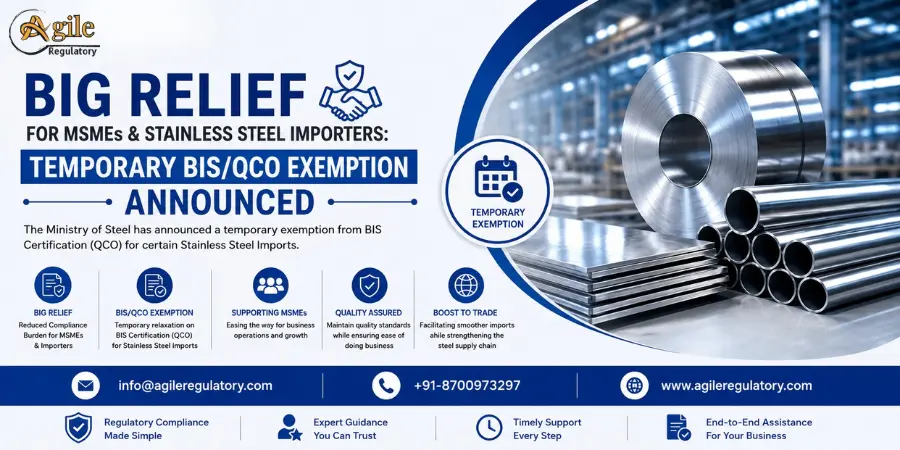
The normal rules are that products covered by a Quality Control Order has to conform to the relevant Indian Standard. This means for imported goods the foreign manufacturer needs a BIS license or a certificate of conformity before the product can legally enter India. This means that BIS has to physically inspect the facilities overseas which is a time consuming and often expensive process for smaller buyers.
This requirement is temporarily suspended by the order of 27 April 2026 for four specific categories of stainless steel flat products. Such imported products need not be mandatory BIS/QCO compliant provided the Bill of Lading carries a shipped-on-board date on or before 26 October 2026.
The exemption applies to four Indian Standards:
IS 6911 covers stainless steel plates, sheets, and strips the broadest category, widely used across industrial and consumer manufacturing.
IS 5522 covers stainless steel sheets and strips specifically intended for utensil manufacturing. This standard is directly relevant to the cookware and kitchenware supply chain.
IS 15997 covers low nickel austenitic stainless steel products for utensils and kitchen appliances a category where domestic availability has been tight as newer grades are still being absorbed into local production capacity.
IS 14650 covers intermediate stainless steel flat products, which feed into downstream fabrication and component manufacturing.All four fall under the stainless steel flat products category. Bars, rods, tubes, and structural sections are not covered and remain subject to their own applicable standards.
The main beneficiaries are importers sourcing any of the four product categories listed above, provided that their shipment has a Bill of Lading with a shipped-on-board date on or before 26 October 2026. What matters is the date of Bill of lading and not the date of customs clearance at India. A consignment that loads before the cutoff date and reaches an Indian port in November is still eligible.
MSMEs are the intended focus of this order. Smaller businesses typically lack the resources to manage BIS certification cycles for foreign suppliers, and mandatory compliance had been creating procurement delays and cost overruns precisely where supply chains could least absorb them.
Domestic capacity for 200 and 300 series stainless steel flat products is still ramping up. The gap between what Indian manufacturers currently produce and what the downstream industry needs has created genuine sourcing pressure. Mandatory BIS certification requirements compounded this foreign suppliers unwilling to undergo inspection meant fewer compliant sources, higher prices, and longer lead times.
This exemption removes that barrier for the next six months. You can source from international suppliers without waiting for BIS facility inspections. Customs clearance becomes faster. Supply chain planning becomes more predictable.
The exemption is time-bound and product-specific. Three conditions define whether your import qualifies. First, the product must fall under IS 6911, IS 5522, IS 15997, or IS 14650. Second, the Bill of Lading must show a shipped-on-board date on or before 26 October 2026. Third, this is an input-level exemption final product quality standards under separate QCOs may still apply depending on what you manufacture with these materials.
This is not a permanent waiver. Once the exemption window closes, full BIS and QCO compliance requirements return. Treating this period as anything other than temporary would be a planning mistake.
Use this window to clear pending orders and stabilise your inventory position. Simultaneously, begin mapping your compliance requirements for the post-October period. If your foreign suppliers do not yet hold BIS certification, now is the time to initiate that process not after the exemption ends. BIS facility inspections take time, and arriving at November 2026 without a compliance plan means supply disruption.
For guidance on BIS certification, QCO compliance planning, or import documentation under this exemption, contact Agile Regulatory. We assist businesses across Noida, Ghaziabad, Greater Noida, Gurugram, and Faridabad with end-to-end regulatory compliance so you are ready both during the exemption and after it closes.


Proven 4-step Process: Consultation, Documentation, Submission, and Certification


What our customer says about us
Lavkush Sharma
KTPL Instruments
Agile Regulatory handled my BIS Certification registration smoothly. Their expert team ensured quick approvals, transparent pricing, and a completely stress-free compliance experience.

Nitin Mukesh
Justrack IOT
We are grateful to Agile Regulatory for their excellent support. Their team showed patience, expertise, and professionalism throughout, providing clear guidance and making the entire process smooth and hassle-free.
Pradeep Varma
Coaire Compressor
Being an excellent BIS Certification Consultant provider, they help customers with all requirements such as BIS Certification, CDSCO services, Agile Regulatory support, legal issues, and lab testing with quick results.

Bharat Bachwani
Easy Polymer
With the help of Agile Regulatory, we have made significant progress in our business. Their service is fast, genuine, and reliable. We look forward to continued success together in the future.
Atul Jain
Tarus International
Many thanks to Agile Regulatory for all the support, guidance, and expert advice. Their professional approach and consistent assistance have made a significant difference.

Paramjeet Singh
Anchor Weighing
Top-tier consulting! offered strategic solutions that revolutionized our approach. Their deep expertise and personalized guidance made a significant impact on our success. Highly recommend their services.
Anshul Rathi
AM Capacitor
Agile Regulatory exceeded expectations! Their tailored solutions, expertise, and proactive approach led to remarkable results. Highly recommend for businesses seeking impactful and strategic guidance.

Shekhar Maurya
Imaxx Pro Aquistic
Outstanding service! delivered targeted solutions with professionalism and expertise. Their insights elevated our business strategies, resulting in noticeable growth. Highly recommended for exceptional consultation.
Trusted by over 1,00,000 + Global Brands in the past 12 years


 If your business imports stainless steel flat products, there’s a window worth acting on in April 2026. The Ministry of Steel, Government of India, has given an order dated 27 April 2026, granting a temporary exemption from mandatory BIS and Quality Control Order compliance for certain stainless steel flat products. This is direct, practical relief for

Leave a Reply
Your email address will not be published. Required fields are marked *