


Get Instant Solution By an Expert Advisor
(4.8)
Fast replies · No spam · Real experts
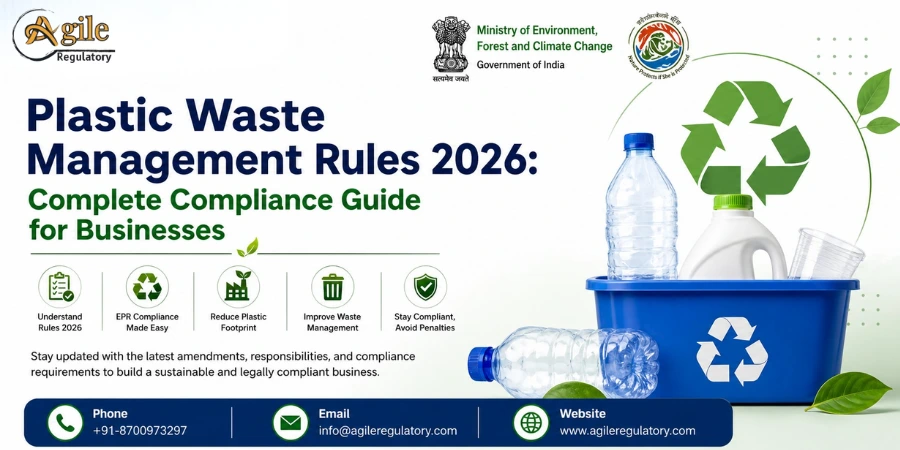
On 31 March 2026, the Ministry of Environment, Forest, and Climate Change published Plastic Waste Management Rules 2026, formally notified as the Plastic Waste Management (Amendment) Rules, 2026, vide G.S.R. 237(E) in the Gazette of India. The rules came into force the same day. If your business produces, imports, brands, or sells plastic packaging in any form, the obligations that took effect that date are not a future planning item. They're current compliance requirements
The single most consequential change is the mandatory recycled content obligation. For the first time EPR plastic waste management rules 2026 impose a legally binding minimum on how much recycled plastic must be present in packaging, not just how much plastic must be collected afterward
Six definitions were substituted or newly introduced in Rule 3 of the Principal Rules:
End-of-Life Disposal now explicitly covers waste-to-energy, co-processing in cement and steel industries, waste-to-oil conversion, and road construction. Conversion into new plastic products is classified separately as recycling, not disposal
Plastic Waste Processor was expanded from covering only recyclers to including entities engaged in end-of-life disposal. Waste-to-energy operators and co-processors now fall within the regulatory net
Reuse is defined as using an object again for the same or a different purpose without changing its structure. Reuse targets for rigid packaging are now mandatory
Registered Environment Auditor is introduced and defined under the Environment Audit Rules, 2025. These auditors can independently verify EPR compliance and recycled content use, operating alongside the existing designated agency verification channel
Seller is a new obligated entity category covering persons selling plastic raw materials such as resins or pellets. For the first time, upstream material suppliers must register and report, creating full traceability from feedstock to final packaging.
Recycling now includes "generation of energy" in addition to transformation into new products, a definitional change with significant implications for how co-processors can claim processing credit.
EPR compliance with plastic waste in India is now measured not just by collection but by actual recycled content in production. The targets apply to producers, importers, and brand owners (PIBOs) across all four plastic categories:
|
Plastic Category |
2025-26 Recycled Content Target |
2026-27 |
2027-28 |
2028-29 onwards |
|
Category I (Rigid Plastic) |
30% |
40% |
50% |
60% |
|
Category II (Flexible Plastic) |
Target set by CPCB notification |
Escalating |
Escalating |
Escalating |
|
Category III (Multi-Layered Plastic) |
Applies to plastic component only |
Escalating |
Escalating |
Escalating |
|
Category IV (Extended & Other) |
Target set by CPCB notification |
Escalating |
Escalating |
Escalating |
|
Rigid Packaging Reuse (Category I) |
10% reuse minimum |
15% |
20% |
25% |
|
Large Drinking Water Packaging |
85% reuse |
85% |
85% |
85% |
The plastic waste compliance for businesses in India framework under the 2026 amendment involves more reporting granularity than previous cycles. Annual returns filed on the CPCB centralized portal must now cover:
Total plastic packaging introduced into the market
Virgin plastic content used by category
Recycled plastic content used by category and percentage
Reuse data for Category I rigid packaging
EPR certificates purchased where own recycled content fell short
Any exemption claims with the specific law or Indian standard cited as justification.
IS 14534:2023 compliance is mandatory for all recycled plastic packaging. Products must carry labeling indicating recycled content. Food-contact applications face additional requirements under FSSAI guidelines above and beyond the standard label requirement.
QR codes and barcodes on packaging introduced through the January 2025 amendment and integrated into the current framework enable regulators and consumers to verify origin, recycled content percentage and the EPR registration status of the producer in real time
PWM amendment rules 2026 allow PIBOs to carry forward unfulfilled recycled plastic content targets specifically from FY 2025-26 for up to three financial years (2026-27, 2027-28, and 2028-29). The condition is non-negotiable: at least one-third of the carried-forward shortfall must be fulfilled each year. Carry-forward doesn't reduce the obligation; it spreads enforcement timing while requiring annual progress demonstration.
State-level monitoring committees must now be established by every state government and UT administration, chaired by the chief secretary, with members from urban, rural, and environment departments; Pollution Control Board representatives; and industry and NGO experts. Enforcement is no longer a CPCB-only responsibility; it's operationalized at the state level with committee-driven accountability.
Urban local bodies, Gram Panchayats, and District Panchayats are now explicitly empowered to enforce plastic waste rules, including bans on prohibited plastic items. Ground-level enforcement has teeth that previous rules didn't give local authorities clearly.
Registered environment auditors verify that EPR claims are real, not paper-only. The 2026 rules include specific anti-fraud intent audit and verification guidelines that are to be issued by CPCB within six months of the rules' notification date (i.e., by September 2026).
Suppliers of plastic raw materials, resins, pellets, and intermediate materials used in plastic packaging manufacture are brought under plastic packaging rules in India in 2026 for the first time as a regulated entity category. Sellers must:
Register on the CPCB portal
Report sales of plastic raw materials with traceability data
Ensure records are available for regulatory verification
The Plastic Waste Management Rules 2026 mark a shift from aspirational EPR to measurable, audited, annually escalating obligations. This new structure constitutes a framework that assumes businesses are tracking their plastic use at a level of precision many haven't established yet.
The companies that navigate this well will be those who build that tracking infrastructure now before September 2026.
If you need support with EPR registration of plastic waste in India, CPCB portal filing, recycled content target calculation, or end-to-end plastic waste compliance services in India, Agile Regulatory provides complete support to operate under the 2026 framework.


Proven 4-step Process: Consultation, Documentation, Submission, and Certification


What our customer says about us

Lavkush Sharma
KTPL Instruments
Agile Regulatory handled my BIS Certification registration smoothly. Their expert team ensured quick approvals, transparent pricing, and a completely stress-free compliance experience.

Nitin Mukesh
Justrack IOT
We are grateful to Agile Regulatory for their excellent support. Their team showed patience, expertise, and professionalism throughout, providing clear guidance and making the entire process smooth and hassle-free.
Pradeep Varma
Coaire Compressor
Being an excellent BIS Certification Consultant provider, they help customers with all requirements such as BIS Certification, CDSCO services, Agile Regulatory support, legal issues, and lab testing with quick results.

Bharat Bachwani
Easy Polymer
With the help of Agile Regulatory, we have made significant progress in our business. Their service is fast, genuine, and reliable. We look forward to continued success together in the future.

Atul Jain
Tarus International
Many thanks to Agile Regulatory for all the support, guidance, and expert advice. Their professional approach and consistent assistance have made a significant difference.

Paramjeet Singh
Anchor Weighing
Top-tier consulting! offered strategic solutions that revolutionized our approach. Their deep expertise and personalized guidance made a significant impact on our success. Highly recommend their services.
Anshul Rathi
AM Capacitor
Agile Regulatory exceeded expectations! Their tailored solutions, expertise, and proactive approach led to remarkable results. Highly recommend for businesses seeking impactful and strategic guidance.

Shekhar Maurya
Imaxx Pro Aquistic
Outstanding service! delivered targeted solutions with professionalism and expertise. Their insights elevated our business strategies, resulting in noticeable growth. Highly recommended for exceptional consultation.
Trusted by over 1,00,000 + Global Brands in the past 12 years





Leave a Reply
Your email address will not be published. Required fields are marked *