

Get Instant Solution By an Expert Advisor
(4.8)
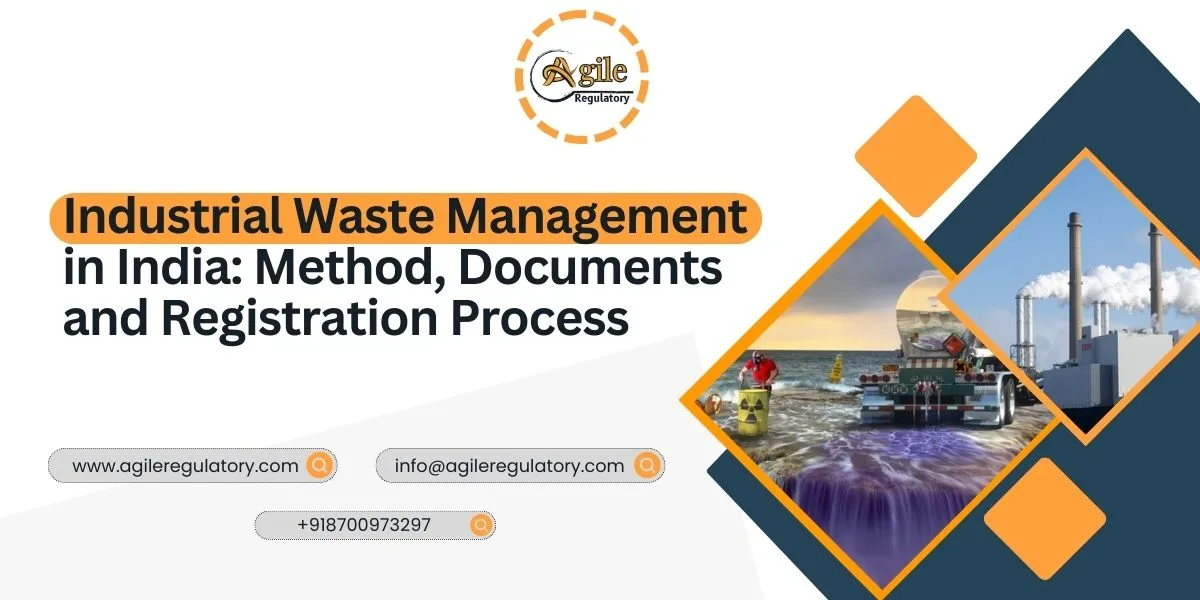

“Industrial waste… sounds boring, right?” someone might say. But pause for a second — this topic affects industries, the environment and communities across India. And in 2026, industrial waste management isn’t what it was a decade ago. With updated rules like the Solid Waste Management Rules, 2026 and an increased emphasis on digital tracking & polluter responsibility, things are changing.
Let’s break this down — methods, documents, and the entire consent and registration process — like we’re just sitting over chai and talking it through.
Think of industrial waste as the leftovers from factories — it can be liquid effluent, solid refuse, hazardous chemicals, metals, sludge, or even gases. It’s not just about throwing stuff in a bin — it needs to be dealt with in a way that protects people, soil, air, and water.
In India, industrial waste management goes beyond general waste rules. Industrial units must comply with multiple regulations including:
Every industrial unit — big or small — needs to know where it falls and what obligations apply.
You: Okay, I understand the process — but who actually regulates all this?
Me: Great question. Industrial waste management in India is supervised at multiple levels:
The Central Pollution Control Board (CPCB) frames national guidelines, standards, and technical directions.
Every state has its own State Pollution Control Board (SPCB) or Pollution Control Committee (PCC). These bodies:
The Ministry of Environment, Forest and Climate Change (MoEFCC) drafts environmental laws and policy updates.
So compliance is not just paperwork — it’s regulated through a structured hierarchy.
“Wait… paperwork?” Yes. And here’s the realistic breakdown.
Before setting up your plant:
✔ Application to the Pollution Control Board
✔ Site plan, layout and land documents
✔ Process flow diagram
✔ Manufacturing details and water balance plan
✔ List of machinery
✔ GST / incorporation certificates
✔ Undertakings and fees
✔ Any other compliance documents
Before you begin production:
✔ CA-certified balance sheet
✔ Lab analysis reports for effluent/emissions
✔ Details of pollution control devices
✔ Copies of CTE and environmental clearances
Most SPCBs have now moved to online portal systems that streamline applications, monitoring, and renewals.
Alright, here’s how it usually goes, step by step:
First, your unit is categorized based on pollution potential — White, Green, Orange, or Red. The higher the pollution risk, the more stringent the requirements.
Before building or installing anything:
Almost like the license:
Most consents need renewal periodically — and must be applied for at least 90 days before expiry to avoid lapses.
Annual or quarterly return filings, self-monitoring reports, waste manifests, digital tracking — all go through the CPCB/SPCB portals.
The 2026 SWM rules also empower authorities to levy environmental compensation if you operate without registration, submit fake reports, or dispose of waste improperly.
Himachal Pollution Control Board CTE, CTO, and NOC
If you want to go beyond minimum compliance, here are some expert tips:
✅ Conduct internal environmental audits every 6 months
✅ Install IoT-based monitoring systems for emissions
✅ Train staff regularly on waste handling
✅ Partner only with authorized recyclers
✅ Maintain digital documentation backups
✅ Implement ESG (Environmental, Social & Governance) reporting
Forward-thinking companies now treat waste management as part of brand reputation and investor confidence.
Industrial waste management in India isn’t just a checklist — it’s a journey of planning, compliance, monitoring, and continuous improvement. From segregating waste at the source to seeking consents (CTE/CTO), registering on tracking portals, and staying updated with the latest rules like the SWM Rules, 2026, transparent processes drive environmental responsibility.
At AgileRegulatory, we believe compliance should be smart and future-ready — combining digital reporting, proactive document management, and performance tracking so businesses don’t just follow rules, they lead sustainability practices.
So, if you’re planning an industrial setup or improving your waste management systems, focus on documentation, digital tracking, stakeholder coordination and above all, consistent adherence to evolving environmental regulations.
Grow sustainably. Stay compliant. Lead responsibly.
Post Views: 923


.webp)
Nishi Chawla
21 May, 2026
Nishi Chawla
19 May, 2026

Nishi Chawla
19 May, 2026
.webp)
Nishi Chawla
15 May, 2026
Nishi Chawla
11 May, 2026
Get Instant Solution By an Expert Advisor
(4.8)
We simplify compliance through a proven 4-step process: Consultation, Documentation, Submission, and certification. From understanding requirements to getting final approvals, we deliver a smooth, timely, and fully compliant journey for your business.


What our customer says about us
Lavkush Sharma
KTPL Instruments
Agile Regulatory handled my BIS Certification registration smoothly. Their expert team ensured quick approvals, transparent pricing, and a completely stress-free compliance experience.

Nitin Mukesh
Justrack IOT
We are grateful to Agile Regulatory for their excellent support. Their team showed patience, expertise, and professionalism throughout, providing clear guidance and making the entire process smooth and hassle-free.
Pradeep Varma
Coaire Compressor
Being an excellent BIS Certification Consultant provider, they help customers with all requirements such as BIS Certification, CDSCO services, Agile Regulatory support, legal issues, and lab testing with quick results.

Bharat Bachwani
Easy Polymer
With the help of Agile Regulatory, we have made significant progress in our business. Their service is fast, genuine, and reliable. We look forward to continued success together in the future.
Atul Jain
Tarus International
Many thanks to Agile Regulatory for all the support, guidance, and expert advice. Their professional approach and consistent assistance have made a significant difference.

Paramjeet Singh
Anchor Weighing
Top-tier consulting! offered strategic solutions that revolutionized our approach. Their deep expertise and personalized guidance made a significant impact on our success. Highly recommend their services.
Anshul Rathi
AM Capacitor
Agile Regulatory exceeded expectations! Their tailored solutions, expertise, and proactive approach led to remarkable results. Highly recommend for businesses seeking impactful and strategic guidance.

Shekhar Maurya
Imaxx Pro Aquistic
Outstanding service! delivered targeted solutions with professionalism and expertise. Their insights elevated our business strategies, resulting in noticeable growth. Highly recommended for exceptional consultation.
Trusted by over 1,00,000 + Global Brands in the past 15+ years


Leave a Reply
Your email address will not be published. Required fields are marked *