

Get Instant Solution By an Expert Advisor
(4.8)
BIS Certification in India is one of the most important regulatory approvals for manufacturers and importers as well as businesses selling product in the Indian market. The certification is awarded by Bureau of Indian Standards (BIS), the national standards body of India to ensure that products meet the prescribed safety, quality and performance standards.Products such as electronics, electrical appliances, steel products, toys, kitchen appliances, chemicals, and industrial materials require mandatory BIS approval before they can be manufactured, imported, distributed or sold in India.
If a business does not have the BIS certification for the regulated product, the company may be penalized, the product may be seized, or sales may be restricted.Agile Regulatory provides end to end BIS certification consultancy services to Indian and foreign manufacturers. The firm assists in documentation, testing, application filing, compliance management and approval process under various BIS schemes.





150+
Expert Advisors

200+
Compliance Services
Get personalized guidance in minutes - no waiting, no bots.

10000 +
Projects Completed for Our Respected Clients.

15 +
Years Experienced Advisors in Indian Compliance.

98.9%
Project Delivery Ratio for Our Valuable Clients.

99.9%
Satisfied Customers All Over India.


BIS certification in India is issued by the Bureau of Indian Standards, which sets the benchmark for product quality and safety. It confirms that what you’re manufacturing or importing meets specific Indian standards
When your product clears the required checks, you receive a BIS certificate and permission to use the relevant mark, like ISI or CRS. This is not optional for many categories. Without proper BIS registration, your product may not even be allowed to enter the market
A BIS License is essentially proof that your product meets defined standards consistently, not just once during testing
The government has made BIS certification compulsory for certain products to keep unsafe or low-quality goods out of the market. This applies across sectors: electronics, appliances, construction materials and imports
If your product falls under mandatory certification, you can’t skip the BIS certification process. Goods can be stopped at customs, removed from shelves, or penalized if compliance is missing. So when you apply for BIS certification, you’re securing your ability to operate without interruptions.
Not all products follow the same route. The scheme depends on what you make and where it is manufactured.
|
Scheme |
Who it applies to |
What it involves |
|---|---|---|
|
ISI Mark Certification |
Indian manufacturers |
Testing + factory inspection |
|
BIS CRS Registration |
Electronics products |
Lab testing + online filing |
|
FMCS BIS Certification |
Foreign manufacturers |
Inspection + compliance |
|
Hallmark Registration |
Jewellery sellers |
Purity verification |
|
Ecomark Scheme |
Eco-friendly products |
Environmental standards |
Selecting the wrong scheme is one of the most common mistakes and can increase your BIS certification fees unnecessarily.
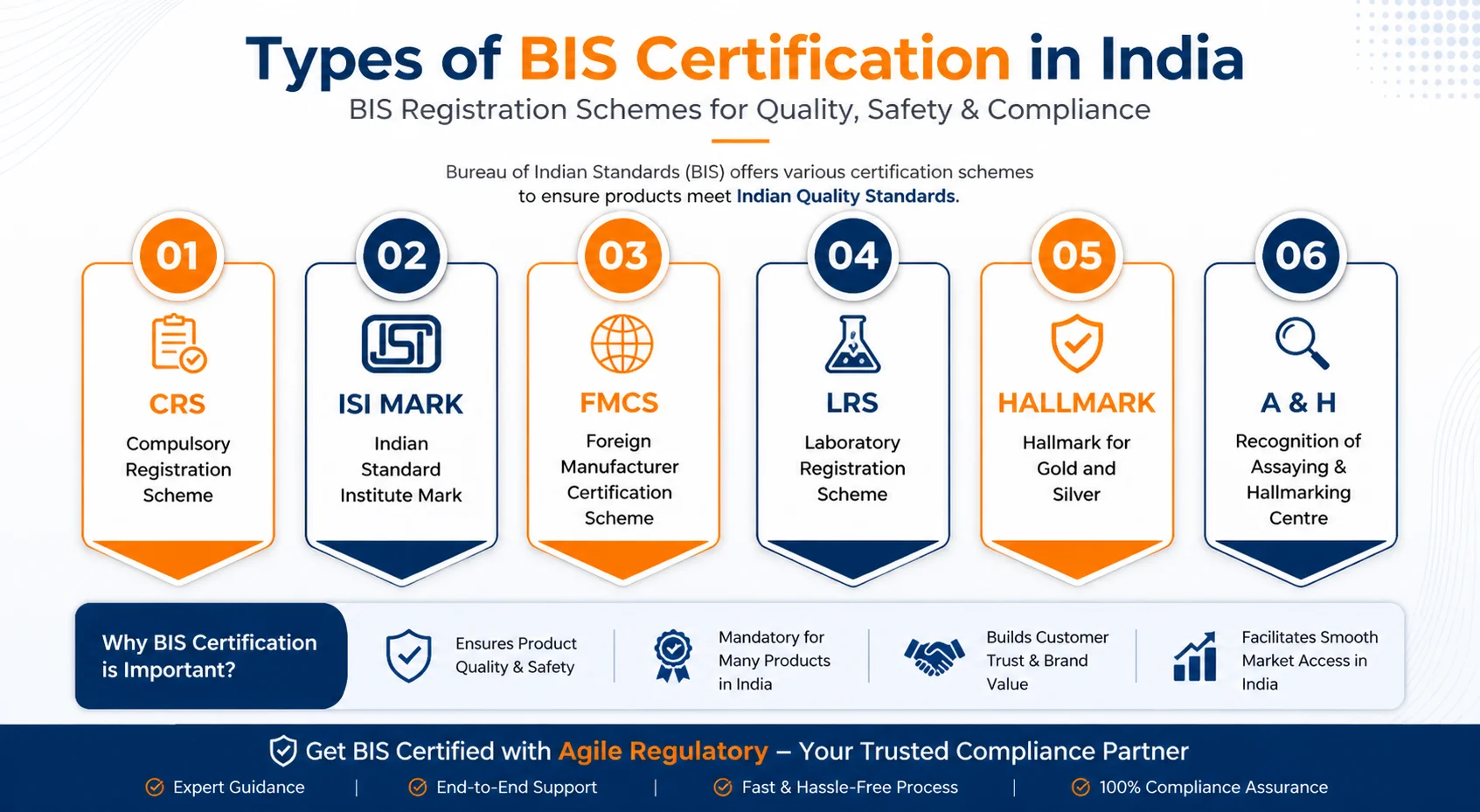
ISI Mark Certification is a product quality certification issued by Bureau of Indian Standards (BIS) of India. ISI mark ensures that the product is conforming to the relevant Indian Standard (IS) in respect of safety, quality, durability and performance. It is one of the oldest and most trusted certification marks in India and is mandatory for various products before they can be sold in the Indian market.
The main aim of ISI Certification is to secure the consumers from unsafe or inferior quality products and to see that the manufacturers follow standardised production procedures. Products with ISI mark are considered reliable as these are tested and verified as per the BIS regulations.
ISI Certification is a must for several products. They are as follows:
Electrical household goods
Cement & construction materials
Pressure-cookers
Steel and products of steel
Households goods
Machinery industry
Wires, cables
Gas appliances
The manufacturers applying for ISI Certification shall conform to the applicable Indian Standard (IS Code) for their product category. The certification process includes testing of the product at BIS approved laboratories, submission of technical documents and inspection of the manufacturing facility by BIS officials.
At the time of factory inspection, BIS authorities check:
Processes of manufacture
Infrastructure for quality control
Test facilities (in-house)
Raw Materials Management
Capacity of production
Once the verification is successful and the approval is given, BIS issues the ISI license to the manufacturer for using the ISI mark on the certified products.
Important aspects of ISI mark certification Mandatory for regulated products
Most of the products notified under Quality Control Orders (QCOs) need to be mandatorily covered under ISI certification before sale or distribution in India.
Products undergo testing in BIS recognized laboratories to ensure conformity to Indian safety and quality standards.
BIS conducts factory inspections to check the manufacturing practices and quality control measures.
Certified manufacturers are regularly subjected to surveillance inspections and testing to verify ongoing compliance.
The ISI mark boosts the confidence of consumers and enhances the credibility of the products in the market.
ISI certification assists businesses to comply with the regulatory requirements of India and helps them avoid penalties or restrictions.
BIS CRS Registration mainly applies to electronics such as LED lights, mobile chargers, laptops, and similar equipment. Under this scheme, products cannot be sold in the Indian market unless they have been tested and registered in advance. The focus here is on product safety. Manufacturers are required to get samples tested from BIS-recognized labs and complete registration before launch. It is commonly used for fast-moving electronic goods where large-scale distribution is involved.
If your products are manufactured outside India, FMCS BIS certification becomes necessary. This route is meant for foreign companies looking to enter the Indian market. Unlike CRS, it does not stop at lab testing. BIS officials physically inspect the manufacturing unit to verify that production processes meet Indian standards on a consistent basis. Because the manufacturing happens overseas, the checks are more detailed and involve direct coordination with Indian authorities.
Required for BIS Certification for Import
Includes factory inspection by BIS
Needs an Authorized Indian Representative Without this, imported goods won’t clear entry into India.
Jewelry businesses must follow hallmarking rules. This requirement is in place to make sure that gold and silver items sold in the market match the purity levels being claimed. Sellers, whether manufacturers or retailers, cannot offer hallmarked jewelry unless they are registered. It brings a level of standardization that protects buyers from getting lower-purity metal than what they paid for.
Confirms purity of gold and silver
Mandatory for sellers
Improves buyer confidence
These centers test the purity of precious metals before hallmarking. They function as independent testing units approved by BIS, where jewelry is checked for its actual metal content. Only after passing this stage can a product receive a hallmark stamp. This step ensures that purity claims are not based on assumption but on verified testing.
Work under BIS authorization
Essential for jewellery compliance
This applies to products that meet environmental standards. It is meant for goods that are produced with lower environmental impact compared to regular alternatives. The scheme looks at factors like how raw materials are sourced, how energy is used during production, and how waste is handled. Products that meet these conditions can carry the Ecomark alongside standard BIS certification
Works alongside regular BIS Certification
Focuses on reduced environmental impact
Only BIS-approved labs can test products. This ensures that the testing process follows a fixed standard and that the results submitted for certification are reliable. If a product is tested at a lab that is not recognized by BIS, the report will not be accepted regardless of the outcome. This rule exists to avoid inconsistencies in testing quality
Ensures accurate results
Required for certification approval If your test report is not from a recognized lab, your BIS Registration will not move forward
This scheme focuses on systems rather than products. It is used by organizations that want to show that their internal processes, especially around quality and operations, follow a structured approach. Instead of testing individual products, the emphasis is on how consistently the organization manages its work, from production to delivery.
Certifies quality management processes
Helps improve operational control
The BIS certification process is a regulatory approval system implemented by the Bureau of Indian Standards to ensure that products sold in India meet defined safety, quality, and performance standards.
This certification is mandatory for many products such as electronics, household appliances, industrial goods, cement, steel, and more.
The entire process follows a step-by-step compliance path, where each stage ensures that the product is safe and meets Indian Standard (IS) requirements.
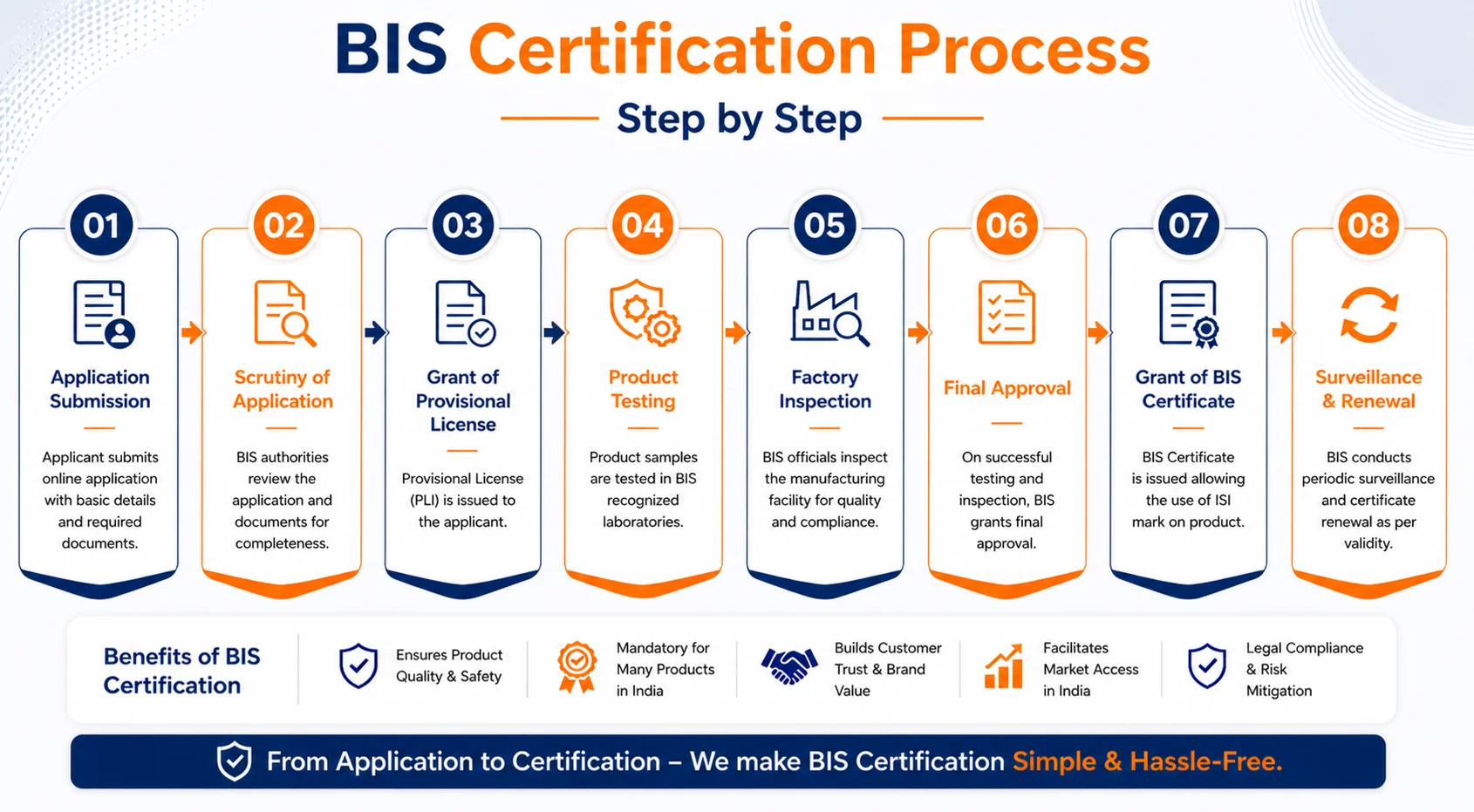
Identify the correct scheme
Test the product in a BIS-approved lab
Prepare all BIS Certification Documents
Submit the application
Factory inspection (if required)
Approval and issuance of BIS Certificate
For electronics, BIS Registration Online makes the process faster, but accuracy still matters.
You need to get your BIS certification documents right before applying.
Business registration proof
Product specifications
Test reports
Manufacturing details
Factory layout (for certain schemes)
Authorization letter (for importers)
Incomplete paperwork is one of the main reasons applications fail under BIS Certification Requirements
The BIS certification fees depend on your product and scheme.
|
Component |
New Application |
Renewal |
Inclusion |
|---|---|---|---|
|
Application Fees |
₹1,000 |
₹1,000 |
- |
|
Registration Fees |
₹2000 |
₹1000 |
- |
|
Processing Fees |
₹50000 |
₹25000 |
₹15000 |
|
Component |
Amount |
|---|---|
|
Application Fees |
₹1,000 |
|
License Fees |
₹1000 |
|
inspection Fees |
₹7000 |
The total BIS certificate cost in India increases if retesting or corrections are needed.
A BIS Certificate usually remains valid for 1–2 years.
Can be renewed
Requires ongoing compliance
If standards are not maintained your BIS License can be cancelled
A BIS certificate includes important details such as the name and address of the manufacturer, license number, product name, applicable Indian Standard (IS number), and the validity period of the certification. It also contains the official BIS logo or ISI mark for domestic and foreign manufacturers, a compulsory registration scheme, and is duly signed and authorized by BIS officials.
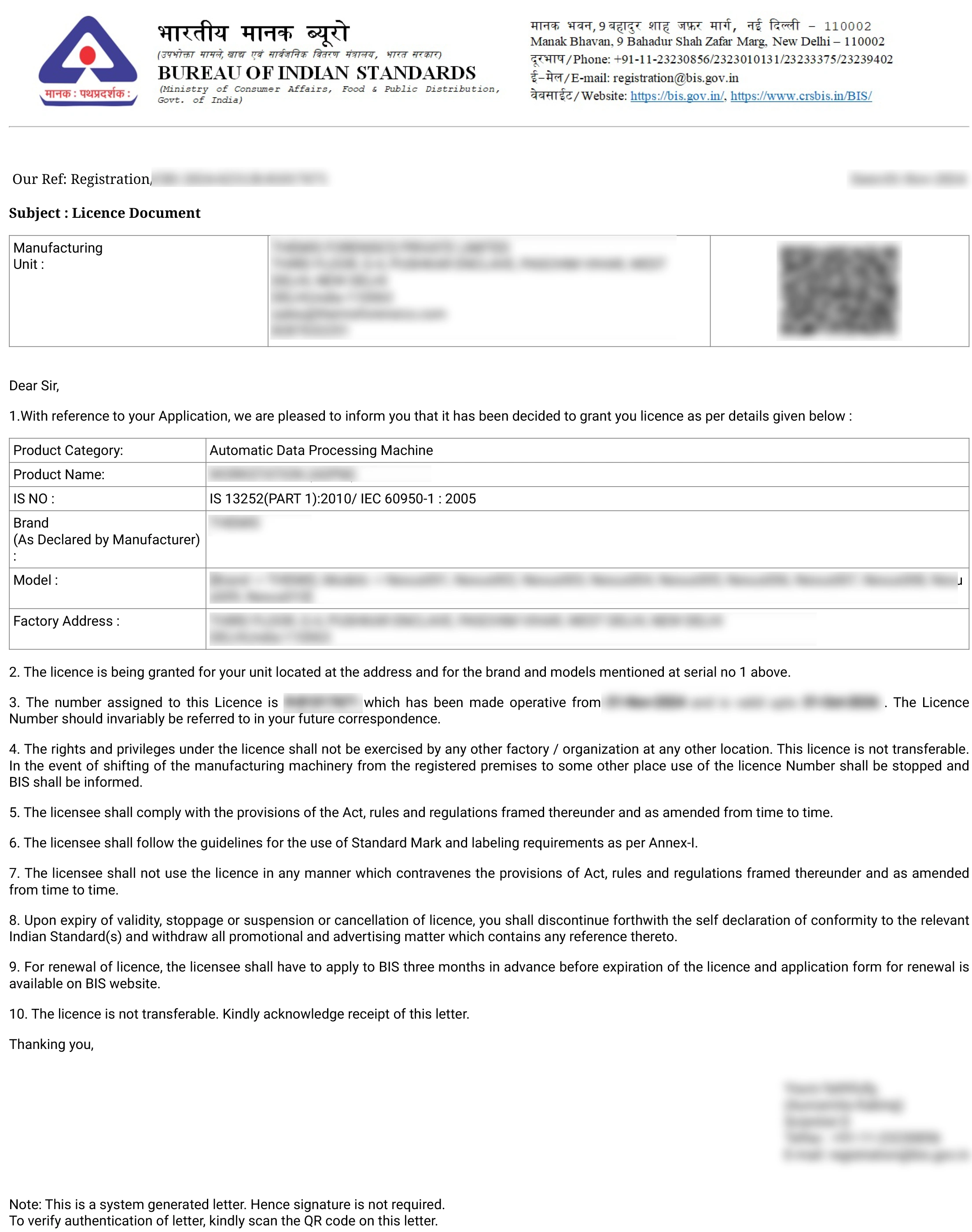
BIS Certification has many benefits for manufacturers, importers and consumers in India. This guarantees product reliability, safety and market credibility.
In India, BIS certification is mandatory for several product categories. It ensures that companies are following Indian rules and are allowed by law to sell their goods in the market without fines and limits.
The certification is a certification of products conforming to quality standards of Bureau of Indian Standards. Trust is built through consistent performance and compliance with approved specifications.
BIS certified products are subjected to strict tests to ensure that they are safe for use. This is especially true for electrical, electronic and industrial products where the safety risks are higher.
The acceptance of BIS-certified product is more in the Indian market. Retailers and distributors favor certified goods which broadens business reach and sales opportunities.
BIS certification enhances the goodwill of a company. It is indicative of the brand’s commitment to quality, safety and regulatory compliance, which is key to building customer trust over the long term.”
Certification reduces the risk of product rejection, legal issues or recalls. It lays a strong foundation for smooth business processes.
BIS-certified products have an upper hand over others. Certification can be a powerful selling point against non-certified competitors.
Ignoring BIS Certification in India requirements can lead to:
Financial penalties
Seizure of goods
Import restrictions
Legal action
Trying to bypass compliance usually costs more in the long run.
If you’re importing goods BIS Certification for Import is mandatory
Needed before customs clearance
Requires CRS or FMCS, depending on product
Must appoint an Authorized Indian Representative
Without it, your shipment can be stopped or rejected
If you’re serious about selling products in India, BIS certification in India is not something you delay. It’s part of building a compliant and stable business. Understanding the BIS certification process early helps you avoid repeated corrections, added costs, and delays. If you want to get your BIS certificate without going back and forth on errors, working with Agile Regulatory gives you a more structured path and faster execution.
Handling the BIS approval process without proper understanding often leads to delays. Agile Regulatory helps you:
☑️ Select the correct certification scheme
☑️ Choose correct applicable IS code
☑️ Prepare proper BIS certification documents.
☑️ Assist in establishing a manufacturing site
☑️ Assist in setting up laboratory equipment
☑️ Training of quality control charge
☑️ Handling inspection officers
☑️ Avoid rejection and rework
☑️ Apply for BIS Certification without unnecessary delays
Get Instant Solution By an Expert Advisor
(4.8)
Yes, BIS Certification is required for notified products before they can be sold or imported
It depends on the scheme. CRS can take a few weeks while ISI and FMCS may take longer due to inspections
BIS CRS Registration is a certification system for electronics based on lab testing and self-declaration
No. Selling without a BIS License can lead to penalties and product seizure
It is a mark issued under ISI Mark Certification showing that a product meets Indian standards
Yes BIS Certification for Import is required for regulated products
FMCS BIS Certification applies to foreign manufacturers exporting to India.
A BIS Certificate is typically valid for 1–2 years
The BIS Certification Fees vary based on product, testing and inspection
Manufacturers or authorized representatives can apply for BIS Certification
Proven 4-step Process: Consultation, Documentation, Submission, and Certification.


Startups to large enterprises, we deliver end-to-end solutions business compliance needs.
 One-Stop Compliance Solution:
From BIS, CDSCO, Drug License, EPR, BEE, WPC, LMPC, PSARA, Startup Compliance, Pollution Certificates, Factory License, Fire NOC, Export Licenses and more.
End-to-End Support:
We don’t just advise - we manage the complete process which includes a proper Consultation & Requirement Analysis, Complete Documentation & Application Filing, Face to Face Coordination with Department Authorities, Certification, Renewal & Post-approval Support.
Clear and set prices:
There are no extra fees or last-minute surprises, because our prices are straightforward, competitive, and set in stone.
Focus on the client:
Each client has a dedicated project manager who keeps them up to date and makes sure communication goes smoothly.
Support for Indian and Foreign Companies:
We offer customized compliance plans and authorized representative services to both Indian businesses that are growing in India and foreign manufacturers that want to enter the Indian market.
One-Stop Compliance Solution:
From BIS, CDSCO, Drug License, EPR, BEE, WPC, LMPC, PSARA, Startup Compliance, Pollution Certificates, Factory License, Fire NOC, Export Licenses and more.
End-to-End Support:
We don’t just advise - we manage the complete process which includes a proper Consultation & Requirement Analysis, Complete Documentation & Application Filing, Face to Face Coordination with Department Authorities, Certification, Renewal & Post-approval Support.
Clear and set prices:
There are no extra fees or last-minute surprises, because our prices are straightforward, competitive, and set in stone.
Focus on the client:
Each client has a dedicated project manager who keeps them up to date and makes sure communication goes smoothly.
Support for Indian and Foreign Companies:
We offer customized compliance plans and authorized representative services to both Indian businesses that are growing in India and foreign manufacturers that want to enter the Indian market.


What our customer says about us
Lavkush Sharma
KTPL Instruments
Agile Regulatory handled my BIS Certification registration smoothly. Their expert team ensured quick approvals, transparent pricing, and a completely stress-free compliance experience.

Nitin Mukesh
Justrack IOT
We are grateful to Agile Regulatory for their excellent support. Their team showed patience, expertise, and professionalism throughout, providing clear guidance and making the entire process smooth and hassle-free.
Pradeep Varma
Coaire Compressor
Being an excellent BIS Certification Consultant provider, they help customers with all requirements such as BIS Certification, CDSCO services, Agile Regulatory support, legal issues, and lab testing with quick results.

Bharat Bachwani
Easy Polymer
With the help of Agile Regulatory, we have made significant progress in our business. Their service is fast, genuine, and reliable. We look forward to continued success together in the future.
Atul Jain
Tarus International
Many thanks to Agile Regulatory for all the support, guidance, and expert advice. Their professional approach and consistent assistance have made a significant difference.

Paramjeet Singh
Anchor Weighing
Top-tier consulting! offered strategic solutions that revolutionized our approach. Their deep expertise and personalized guidance made a significant impact on our success. Highly recommend their services.

Anshul Rathi
AM Capacitor
Agile Regulatory exceeded expectations! Their tailored solutions, expertise, and proactive approach led to remarkable results. Highly recommend for businesses seeking impactful and strategic guidance.

Shekhar Maurya
Imaxx Pro Aquistic
Outstanding service! delivered targeted solutions with professionalism and expertise. Their insights elevated our business strategies, resulting in noticeable growth. Highly recommended for exceptional consultation.

