

Get Instant Solution By an Expert Advisor
(4.8)
India’s print media ecosystem is not just large it’s layered, fragmented and deeply regulated. There are thousands of publications operating across multiple languages, regions and audience segments. So if you’re planning to launch a newspaper, magazine, or even a small periodic publication you don’t get to just design, print, and circulate it. There’s a mandatory entry point and that is RNI Registration in India





150+
Expert Advisors

200+
Compliance Services

10000 +
Projects Completed for Our Respected Clients.

15 +
Years Experienced Advisors in Indian Compliance.

98.9%
Project Delivery Ratio for Our Valuable Clients.

99.9%
Satisfied Customers All Over India.


This registration is handled by the Registrar of Newspapers for India, which now functions under the name Press Registrar General of India. It comes under the Ministry of Information and Broadcasting. The rule is simple and non-negotiable: if your publication is being printed and distributed whether people pay for it or not it must be registered before it goes out to the public
A lot of first-time publishers underestimate this step or treat it like a formality they can deal with later. That assumption is wrong. Publishing without registration doesn’t just put you in a grey area it puts you in direct violation of the law, and the consequences show up fast:
You cannot legally circulate your publication
Your title has no ownership protection, meaning someone else can legally use it
You won’t qualify for government advertisements through DAVP
Postal concessions from India Post won’t apply
Printing vendors or distributors may refuse to work with you due to compliance risks
Agile Regulatory is a service provider that handles this entire process end-to-end starting from checking whether your title is available to securing the final registration certificate while managing documentation, coordination, and follow-ups across each stage.
At its core, RNI Registration is the legal clearance required to publish a print periodical in India. Once approved, your publication is assigned a unique registration number by the authority, which effectively becomes its official identity.
This process is governed by the Press and Registration of Books Act 1867. Despite how old that law is it still applies today without exceptions. It doesn’t matter whether your publication is small or large, printed in English or a regional language, released daily or once a year the requirement remains the same.
The regulatory body maintains a centralised database of all registered publications. This allows the government to track active publications, verify ownership and ensure that the information being published is tied to accountable entities
Once registration is granted, your publication is issued a unique number. This number is often linked with ISSN standards and must appear in every issue you print. It’s not optional it’s a legal requirement, and it’s what distinguishes a registered publication from an unregistered one.
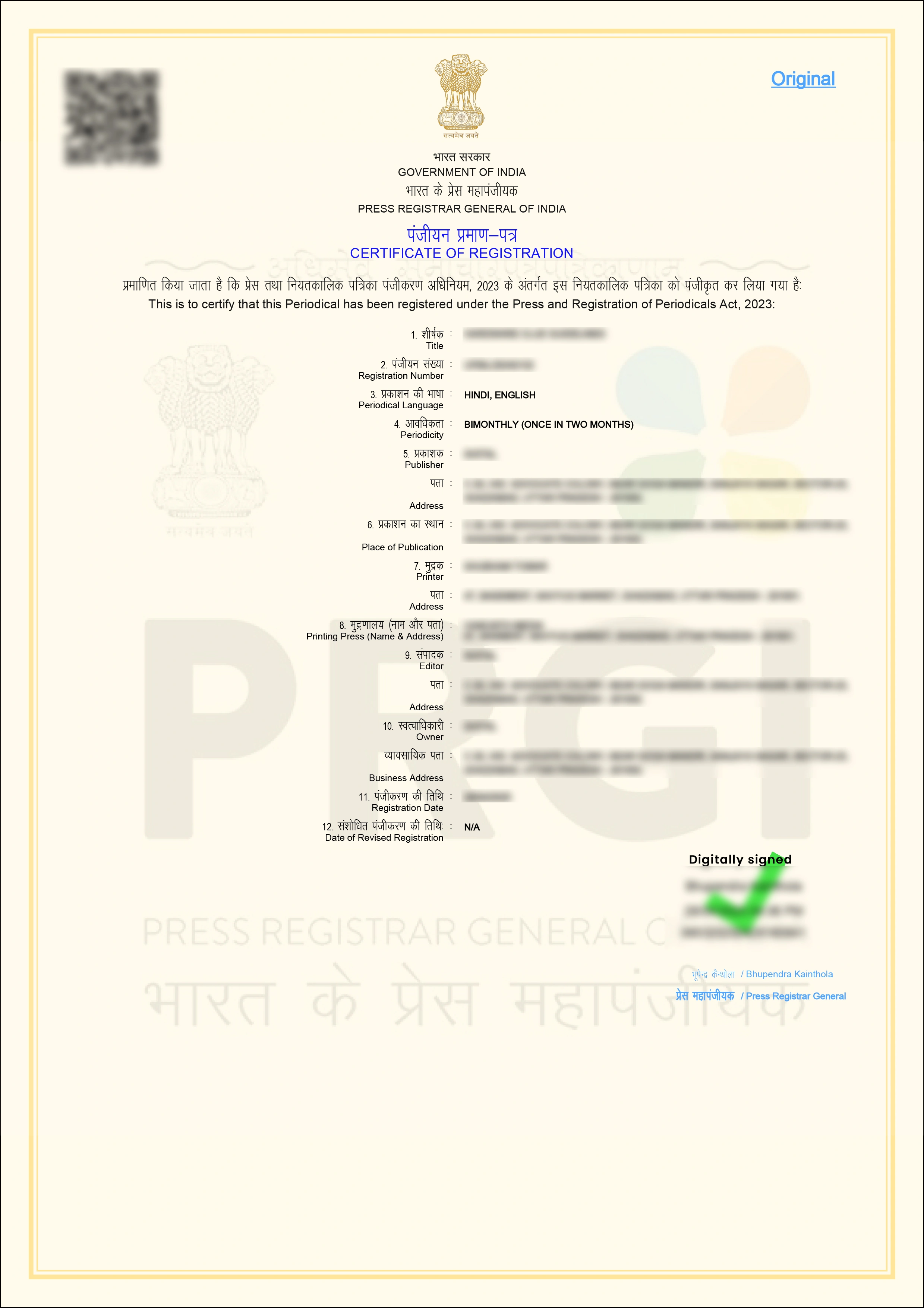
This is where people try to look for loopholes but there really aren’t any. If you are printing and distributing something periodically you fall under this requirement
Here’s how it typically breaks down:
|
Type of Publication |
Examples |
|
Daily Newspapers |
City papers, regional dailies, national editions |
|
Weekly / Fortnightly |
News summaries, local bulletins |
|
Monthly Magazines |
Industry publications, lifestyle content, niche topics |
|
Quarterly / Annual |
Academic journals, institutional reports |
|
Free Distribution |
Newsletters, promotional prints, community updates |
Your legal structure doesn’t matter. You could be an individual journalist, a registered company, a trust, an NGO, or a full-scale media house. If you’re producing printed content on a recurring basis, registration is mandatory.
Even if your main presence is digital but you also produce a printed edition, that printed version must go through this process.

To apply for RNI and obtain registration for a periodical in India under the new PRGI system, you must satisfy certain basic, clear criteria.:
The publisher must be either an Indian citizen or a legal entity like a company, firm, or trust that is incorporated and registered in India under the existing laws. Foreign entities can only bring out a facsimile edition of a foreign periodical with prior approval from the Central Government.
The individual owner and publisher must be of legal age and sound mind. The Act specifically prohibits any person who has been convicted by any court for an offense involving a terrorist act, unlawful activity, or an offense against the security of the State from bringing out a periodical. This rule is very strict.
Any foreign newspaper corporation or entity wishing to publish their newspaper in India must acquire RNI registration before the commencement of business.
The process is structured and sequential. You can’t skip steps and you can’t rearrange them
Everything starts with the title. Before you invest time or money into your publication you need to check whether your chosen name is available
You apply through the official portal and submit details such as:
Proposed title
Language
Frequency (daily, weekly, monthly, etc.)
Place of publication
Content category
If the title is not already registered or too similar to an existing one you receive a Title Verification Letter. This document is your entry ticket to the next stage. It comes with a validity period so delays here can force you to restart the process
Once the title is cleared the publisher must file a formal declaration before the District Magistrate (or Additional District Magistrate) in the area where the publication will be printed
This declaration includes:
Approved title
Language and frequency
Publisher’s details
Printer’s details and press information
Place of publication
This step requires physical presence. There’s no online workaround for it. The declaration must be signed, verified and officially attested
After the declaration is approved, you are required to print the first issue of your publication.
This isn’t a sample or draft it has to look like a proper issue and must include:
Title
Publisher and printer names
Printing press address
Place of publication
Date of issue
This copy acts as proof that your publication is ready for circulation and forms part of your registration application.
At this stage, you compile everything and submit your application to the RNI office.
The submission includes:
Title verification letter
Attested declaration
First issue copies
Supporting documents
Fee payment proof
The authority reviews your application, checks for consistency, and may ask for clarifications if anything doesn’t match their records.
If everything is in order, your publication is officially registered.
You receive a certificate along with a unique registration number. From this point onward, every issue you print must carry that number.
This is where most delays happen. Not because the requirements are unclear, but because people submit incomplete or inconsistent paperwork.
The standard list includes:
Filled application form (Form I)
Title verification letter
Attested declaration from DM/ADM
Copies of the first issue
Printer agreement
Publisher affidavit
No foreign tie-up affidavit
Address proof of publication office
Identity documents (Aadhaar, PAN, etc.)
Fee payment receipt
Some documents need to be notarized. The declaration must be original, and properly attested photocopies won’t work at that stage.
The cost structure is straightforward, but people often misunderstand where the actual expense lies.
|
Fee Component |
Approximate Cost |
|
Government Fee |
₹1,000 |
|
Consultancy Fee |
Variable |
The government fee itself is minimal. The bulk of the cost usually comes from handling documentation, coordination and ensuring that the process doesn’t get delayed or rejected
There’s no fixed timeline, but a realistic estimate looks like this:
|
Stage |
Time Required |
|
Title Verification |
2–4 weeks |
|
Declaration Filing |
1–2 weeks |
|
First Issue Printing |
1–2 weeks |
|
Application Review |
4–8 weeks |
|
Certificate Issuance |
1–2 weeks |
Total duration: roughly 2 to 4 months.
Most delays are self-inflicted missing documents incorrect details or slow follow-ups.
Rejections usually come down to avoidable errors:
Title already exists or is too similar
Mismatch between declaration and application details
First issue missing mandatory information
Affidavits not notarised properly
Printer details incorrect or not verifiable
Declaration filed in the wrong jurisdiction
None of these are complex issues. They just require attention to detail.
Registration isn’t just about staying compliant. It directly affects how your publication operates.
Once registered, your publication name is protected across India within its language category.
Without registration, government advertising is off the table completely.
Postal concessions can significantly reduce operational expenses.
In case of disputes, your registration acts as documented proof of ownership.
Advertisers prefer working with registered publications it’s seen as a basic legitimacy check.
Journalists can apply for official press credentials only if the publication is registered.
The process itself isn’t technically difficult. What makes it frustrating is the number of moving parts different authorities, strict documentation, and zero tolerance for inconsistencies.
Agile Regulatory handles:
Title search and verification
Document preparation and review
Coordination with the District Magistrate
First issue compliance checks
Application submission and tracking
Continuous follow-up until approval
Their involvement reduces the chances of errors that typically cause delays or rejections
Get Instant Solution By an Expert Advisor
(4.8)
Yes. Every print publication must be registered under the law.
No. Only a single issue can be printed for application purposes.
Around 2–4 months depending on how efficiently the process is handled.
Same authority. Only the name has changed.
It confirms your chosen title is available and allows you to proceed.
Yes, but only through formal approval.
No. Only print publications are covered.
It’s your publication’s legal identifier and must appear in every issue.
A formal agreement and valid registration details.
Yes, but with stricter regulations and additional approvals.
The Registrar of Newspapers for India administers newspaper registration across the Indian region.
According to the updated RNI Title Registration Guidelines, effective from January 1/ 2021, owners/publishers must register their title within 1 year from the date of title verification.
Applying for RNI registration is straightforward. Simply visit [www.rni.nic.in], where you can submit your application by uploading the required documents, including personal details, PAN, TAN, and affidavits.
Proven 4-step Process: Consultation, Documentation, Submission, and Certification.


Startups to large enterprises, we deliver end-to-end solutions business compliance needs.
 One-Stop Compliance Solution:
From BIS, CDSCO, Drug License, EPR, BEE, WPC, LMPC, PSARA, Startup Compliance, Pollution Certificates, Factory License, Fire NOC, Export Licenses and more.
End-to-End Support:
We don’t just advise - we manage the complete process which includes a proper Consultation & Requirement Analysis, Complete Documentation & Application Filing, Face to Face Coordination with Department Authorities, Certification, Renewal & Post-approval Support.
Clear and set prices:
There are no extra fees or last-minute surprises, because our prices are straightforward, competitive, and set in stone.
Focus on the client:
Each client has a dedicated project manager who keeps them up to date and makes sure communication goes smoothly.
Support for Indian and Foreign Companies:
We offer customized compliance plans and authorized representative services to both Indian businesses that are growing in India and foreign manufacturers that want to enter the Indian market.
One-Stop Compliance Solution:
From BIS, CDSCO, Drug License, EPR, BEE, WPC, LMPC, PSARA, Startup Compliance, Pollution Certificates, Factory License, Fire NOC, Export Licenses and more.
End-to-End Support:
We don’t just advise - we manage the complete process which includes a proper Consultation & Requirement Analysis, Complete Documentation & Application Filing, Face to Face Coordination with Department Authorities, Certification, Renewal & Post-approval Support.
Clear and set prices:
There are no extra fees or last-minute surprises, because our prices are straightforward, competitive, and set in stone.
Focus on the client:
Each client has a dedicated project manager who keeps them up to date and makes sure communication goes smoothly.
Support for Indian and Foreign Companies:
We offer customized compliance plans and authorized representative services to both Indian businesses that are growing in India and foreign manufacturers that want to enter the Indian market.


What our customer says about us

Lavkush Sharma
KTPL Instruments
Fantastic support from the team. Their expertise transformed our approach, driving remarkable outcomes. A must-have partner for businesses seeking effective consulting solutions. Highly recommended.

Nitin Mukesh
Justrack IOT
Agile Regualtory delivers exceptional solutions. Their insightful guidance streamlined our processes and boosted profitability. Highly recommended for businesses seeking expert consulting services to thrive.

Pradeep Varma
Coaire Compressor
Impressed by Agile Regulatory's expertise. Their strategic insights and practical solutions have elevated our business operations. A reliable partner for effective consulting services. Highly recommended for growth-focused businesses.

Bharat Bachwani
Easy Polymer
Extraordinary consulting services. Their insightful solutions and dedicated team reshaped our business, driving remarkable improvements. Highly recommend it for transformative results.

Atul Jain
Tarus International
Incredible experience with Agile Regulatory. Their innovative strategies and expert advice revitalized our business model, resulting in impressive growth. Highly recommend their exceptional consulting services.

Paramjeet Singh
Anchor Weighing
Top-tier consulting! offered strategic solutions that revolutionized our approach. Their deep expertise and personalized guidance made a significant impact on our success. Highly recommend their services.

Anshul Rathi
AM Capacitor
Agile Regulatory exceeded expectations! Their tailored solutions, expertise, and proactive approach led to remarkable results. Highly recommend for businesses seeking impactful and strategic guidance.

Shekhar Maurya
Imaxx Pro Aquistic
Outstanding service! delivered targeted solutions with professionalism and expertise. Their insights elevated our business strategies, resulting in noticeable growth. Highly recommended for exceptional consultation.

